Century Egg (Pi Dan): How to Buy, Cook and Eat
Reviewed 31 October 2026 by the China Food Way editorial team
I bought my first century egg from a market in Manchester’s Chinatown, took it home, cracked it open over the sink, and immediately understood why the woman at the stall had wrapped it in two layers of paper. The smell was sharp enough to feel: ammonia, wet ash, something between a cleaned oven and a chemistry lesson. The white inside had turned into translucent amber jelly and the yolk had gone the colour of wet slate. I stood there holding a perfectly ordinary duck egg that had become something else entirely, and I had no idea what to do next.
What I did next was eat it, plainly, with a spoon, standing over the sink. It was strange and good. Years later, having cooked these eggs in everything from congee to cold tofu salads, I can tell you the smell is the least interesting thing about them — and that the difference between a good one and a bad one is almost entirely down to how it was cured.
How long does it actually take to make a century egg?
Weeks, not years — the name is folklore and the folklore is wrong. Duck eggs, occasionally chicken, are packed in a paste of clay, wood ash, salt, water and quicklime, sometimes with tea leaves or rice husks, and left to cure for anything from two weeks to a couple of months. The quicklime is the active agent: it pushes the egg’s pH to somewhere between 9 and 12, and at that alkalinity the white’s proteins denature into a firm, jelly-like gel rather than a solid white, while the yolk concentrates and darkens into the green-grey pine-flower pattern that gives the egg its other name, sōnghuā dàn (松花蛋). The high pH is also what keeps pathogens from growing, so the process is a controlled cure rather than rot.
Not a Hundred Years Old
The name is folklore, and the folklore is wrong: nothing here is a century old. A century egg takes weeks. Duck eggs — occasionally chicken — are packed in a paste of clay, wood ash, salt, water and quicklime, sometimes with tea leaves or rice husks in the mix, and left to cure for anything from two weeks to a couple of months. The quicklime is the active agent: it pushes the egg’s pH to somewhere between 9 and 12, and at that alkalinity the proteins in the white denature into a firm, jelly-like gel rather than a solid white. The yolk concentrates and turns dark green-grey, streaked with the pattern that gives the egg its other common Chinese name, 松花蛋 (sōnghuā dàn, “pine-flower egg”). As Wikipedia’s entry on the century egg explains, the transformation is a controlled alkaline cure, closer to a chemical reaction than to rotting — the high pH is precisely what keeps pathogens from growing.
One story traces the discovery to Ming-dynasty Hunan, where duck eggs were said to have been left behind in a pool of slaked lime and found weeks later transformed. Whether or not that happened, the egg that reached the mainstream was a rural trick for preserving eggs without a cold chain, and it stuck.
The ammonia smell is a side effect of the same chemistry: the alkaline cure breaks proteins down into simpler compounds, some of them volatile. A faint smell is normal and cooks in China rinse the egg and get on with it. A strong, eye-watering smell means the cure went too far or the egg is old, and that egg will taste harsh.
What should I look for when buying century eggs?
Look for weight and an intact coat. A good century egg feels heavy for its size, the clay-and-ash coating is unbroken, and there is no wet, dark patch suggesting a crack underneath — rinse the coating off under cold water before you judge the shell, and do not be alarmed by dark specks on it, which are just the ash doing its job. The interior tells you the rest: a translucent, tea-coloured white that holds together like firm jelly, and a yolk with visible pine-flower rings and sometimes a creamy centre. If the white is uniformly opaque and chalky, or the yolk is dry and powdery all the way through, the egg was cured too long or stored too dry. Buy from a shop with a quick turnover and take the eggs nearest the cold cabinet, which are usually the freshest batch.
How to Buy a Good One

In a Chinese market you will find century eggs in three states, and each has its use:
| Sold as | Smell | Keeps for | Best for |
|---|---|---|---|
| Coated in clay and ash (fresh-cured) | Faint, earthy | Months in a cool cupboard | Eating plain, congee, anything you control |
| Vacuum-packed, peeled | Noticeable | Months unopened, days once opened | Convenience, packed lunches |
| Loose peeled eggs in tubs, in brine | Strongest | Days in the fridge | Congee shops, restaurants |
Whichever form you buy, the checks are the same. The egg should feel heavy for its size, the coating should be unbroken, and there should be no wet, dark patch suggesting a crack. Rinse off the clay under cold water before cutting — the coating is packaging, not food — and do not be alarmed by the dark specks on the shell; that is the ash doing its job.
The interior should tell you everything. A good century egg has a translucent, tea-coloured white that holds together like firm jelly, and a yolk with visible pine-flower rings, sometimes with a creamy centre. If the white is uniformly opaque and chalky, or the yolk is dry and powdery all the way through, the egg was cured too long or stored too dry. Buy from a shop with a quick turnover: the eggs sitting nearest the cold cabinet are usually the freshest batch.
Cutting It Without Losing Your Temper
Century egg sticks to a knife the way nothing else does, and there are three honest solutions. Wipe the blade with a little oil between cuts; use unflavoured dental floss, pulled under the egg, which is what my mother-in-law does and it works beautifully; or simply push down gently with the flat of a spoon and accept ragged edges, which matter less than people think once the egg is dressed.
Cut into wedges for a cold plate, into cubes for congee, into slices for a salad. The white is firm enough to hold a shape and soft enough to bruise, so a sharp, light touch beats a sawing motion.
The Dish That Made It Famous
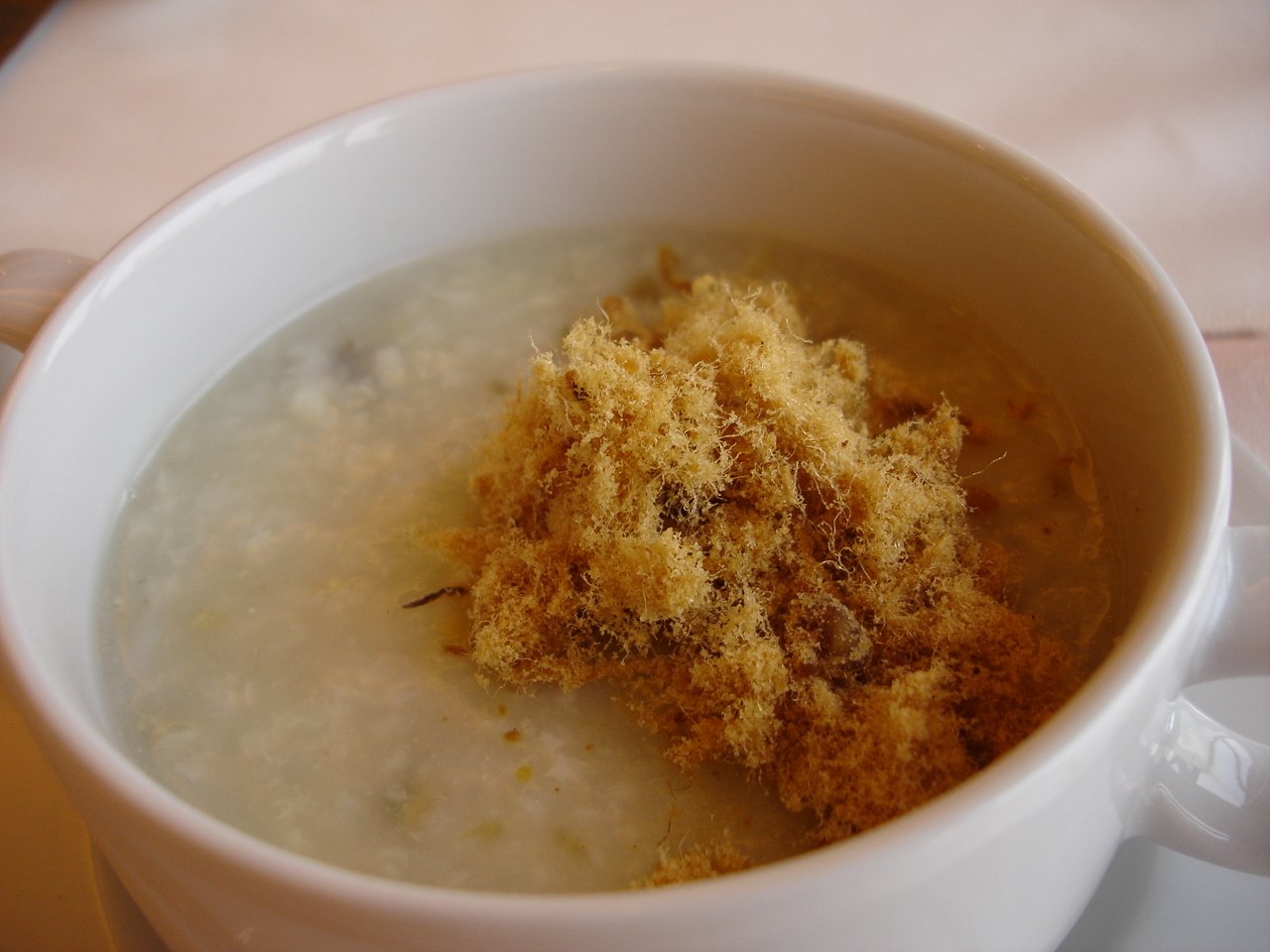
Congee is where most people meet this egg properly: a slow-cooked rice porridge, silky and bland, into which cubes of century egg go for the last stretch of cooking so they keep their shape and lend the rice a savoury, faintly alkaline depth. The dish belongs to Cantonese cooking, where congee shops have served it for breakfast and at midnight for generations, and it is the most persuasive argument for the egg’s charm — the congee is comfort, the egg is the conversation.
The rice question matters more than the egg question, as it does in any congee: Chinese rice types behave differently, and a short- or medium-grain rice with enough starch breaks down to the right silkiness over ninety minutes. My century egg and pork congee method uses a ratio of one part rice to ten parts water, a knob of ginger, and the egg added twenty minutes before the end — late enough that the white stays identifiable.
What’s the easiest cold century egg dish besides congee?
The five-minute cold one: pí dàn dòu fu (皮蛋豆腐). Cube silken tofu onto a plate, cube the egg over the top, and dress with light soy sauce, Chinkiang vinegar, toasted sesame oil and a little chopped spring onion — and use light soy rather than dark, because the point is to season the tofu without colouring it. The egg’s funk against the cool, neutral tofu is the whole appeal, which is why it is the dish I make for someone who claims to hate century eggs. The egg behaves best cold or barely warm: it appears with pickled ginger on old tea-house plates, or goes into a quick soup at the very end, off the heat. What it does not enjoy is long cooking — the white toughens, the ammonia returns, and the delicacy you bought disappears.
Beyond Congee
The other national century egg dish is a cold one, and it takes five minutes: silken tofu, cubed, on a plate, with cubed century egg over the top and a dressing of light soy sauce, Chinkiang vinegar, toasted sesame oil and a little chopped spring onion. This is 皮蛋豆腐 (pí dàn dòu fu), the dish that appears at summer tables from Guangzhou to Chengdu, and it is a job for light soy sauce rather than dark — the point is to season the tofu without colouring it. The egg’s funk against the cool, neutral tofu is the whole appeal, and it is the dish I make when I want someone who claims to hate century eggs to change their mind.
Beyond those two, the egg behaves best cold or barely warm. It appears in cold plates with pickled ginger — a pairing from the old tea-house tradition, where the sharp ginger cuts the egg’s richness. It can go into a quick soup at the very end, off the heat. What it does not enjoy is long cooking: the white toughens, the ammonia returns, and the delicacy you bought disappears.
How the egg sits on a table says something about Chinese food culture more broadly — small cold dishes shared at the centre, eaten slowly, alongside rice, rather than plated individually. A plate of pidan with ginger and a bottle of beer is a summer evening, not an appetiser in the Western sense.
Can I substitute something else for century egg in a recipe?
Honestly, no — there is no real substitute for a century egg. The nearest relative in the preserved-egg family is the salted duck egg (xián dàn, 咸蛋), which is saline rather than alkaline and will give congee salt and a rich, oily yolk, but it brings no jelly and none of the pine-flower flavour, so it changes the dish. For the cold tofu plate the egg can simply be omitted; the dressing still makes a decent salad, it just stops being the dish it was. On storage, unopened vacuum packs sit in the cupboard for months, but once opened they go in the fridge and should be eaten within a few days, and any cut leftover wants a lid. A century egg and salted duck egg pairing is the classic comparison.
Storage and Substitutions
Unopened vacuum packs live in the cupboard for months; once opened, the fridge, and eat within a few days. Coated eggs keep longest — a month or two in a cool, dark place — but once you rinse one, it is committed, so rinse only what you will use. Leftover cut egg should be covered and refrigerated; it will not spoil quickly, but it will dry and its smell will take over the fridge, so give it a lid.
If a recipe calls for century egg and you have none, be honest about the substitute: there isn’t one. Salted duck egg (咸蛋) is the nearest relative in the preserved-egg family — saline rather than alkaline — and it will give congee salt and a rich, oily yolk, but no jelly and no pine-flower flavour. For the cold tofu dish, the egg can be omitted and the dressing will still be a decent salad; it just stops being the dish it was.
Frequently Asked Questions
Is century egg actually safe to eat, or is it rotten?
It is safe, and it is not rotten. The alkaline cure raises the pH far beyond the range where food-poisoning bacteria thrive; the egg is preserved, not spoiled. What you are eating is a chemically transformed egg.
Why does it smell of ammonia?
The same alkalinity that sets the white into jelly also breaks proteins into volatile compounds. A faint smell is normal; a strong one suggests over-curing or age. Rinsing the peeled egg under cold water takes most of the edge off.
The yolk has a green-grey ring. Is that bad?
No. It is iron sulphide, formed when sulphur and iron react under alkaline conditions — the same chemistry that greens the rim of an over-boiled egg, just deliberate here.
Can I eat it straight from the shell?
Yes, once the coating is rinsed off. It needs no cooking, which was the entire point of the method for peasants with no fridge.
Why does my century egg stick to the knife?
The white is gelatinous. Oil the blade, or use unflavoured dental floss to slice, or cut with a warm, wet knife and accept imperfect edges.
What is the difference between 皮蛋 and 松花蛋?
Same egg, two names. 皮蛋 (pí dàn, “leather egg”) refers to the texture of the cured white; 松花蛋 (sōnghuā dàn, “pine-flower egg”) refers to the pattern in the yolk. Regional shops lean one way or the other.
The Egg Worth Getting Past
The reputation precedes it, and the reputation is mostly the smell — thirty seconds of ammonia that tells you almost nothing about the twenty minutes of eating that follow. Buy one coated egg from a busy shop, rinse it, cut it over cold tofu with soy and vinegar, and the joke writes itself: the most intimidating ingredient in the Chinese market turns out to be the easiest one to use.