The Honest Forbidden City Guide – What’s Worth It and What Isn’t
Last updated 31 October 2026 · checked by the China Food Way editorial team
The Forbidden City has 9,999 rooms. It took fourteen years and roughly a million workers to build. It covered the lives of twenty-four emperors. And on the day I first went, about 80,000 other people had, more or less, the same idea. The numbers don’t prepare you. What they should tell you is that this is not a quick stop: it’s 720,000 square metres of courtyards, halls, and walls, and most visitors see perhaps five per cent of it before their feet give out. The trick is not to see all of it. The trick is to see the right part of it.
As the Wikipedia entry on the Forbidden City points out, the site is the largest preserved wooden palace complex on earth, which is exactly why it swallows a day if you let it. I’ve now been three times, and the version below is the one I’d hand a friend.
Booking ahead: the one thing that saves the trip
The single rule that catches people out is this: you buy tickets online, in advance, against your passport number, and you enter through one gate only. The palace is closed on Mondays all year, and it caps daily entries, so on a spring or autumn weekend it can sell out days ahead. At the time I’m writing, the standard ticket is RMB 60 in peak season, from April to October, and RMB 40 in the off-season, with the Treasure Gallery and Clock Gallery each adding around RMB 10 if you want them. Those figures move, so confirm on the official site before you go, and book the moment your dates are fixed.
You enter at the Meridian Gate, the south face, and you exit at the Gate of Divine Prowess in the north. There is no walking back through; the route is one way, which is why the plan below matters. Bring the passport you booked with, because they check it, and arrive with a charged phone, because the audio guide and the map both live on it. Opening hours run 8:30 to 17:00 in the warmer months and close half an hour earlier in winter, with last entry roughly an hour before closing, so a morning start is not optional if you want to see it properly.
Which buildings should I prioritise inside the Forbidden City?
Prioritise three things and let the rest blur. The Hall of Supreme Harmony is the headline — the giant throne hall on the central axis where you grasp the scale of the place — so see it first, before the courtyard crowds thicken. Then walk through to the Palace of Heavenly Purity, the emperor’s living quarters, which feels human after the ceremonial front. Finish in the Imperial Garden at the rear, the one spot with trees and a place to sit. The endless side palaces repeat the same furniture and fade into one another after the third; see two and move on. The point is not to collect halls but to feel the axis and the scale. Spend your energy on the centre line and the garden, and you leave satisfied rather than exhausted.
What’s actually worth your time
Walk in through the Meridian Gate and keep going north along the central axis. The Hall of Supreme Harmony is the headline, the biggest throne hall, and it does deliver. Past it, the Hall of Central Harmony and the Hall of Preserving Harmony are quicker, and then the living quarters begin: the Palace of Heavenly Purity, the Hall of Union, and the Palace of Earthly Tranquillity. By the time you reach the Imperial Garden at the north end, you’ve done the spine of the place, and that alone is a full, satisfying morning.

The eastern and western “Six Palaces” branch off the sides and are quieter, with fewer tour groups and more small exhibits. If your legs hold up, these are where the Forbidden City feels like a place rather than a postcard. The Treasure Gallery in the northeast corner is worth the extra ticket if you like jade and gold; the Clock Gallery is for horology fans and skippable for everyone else.
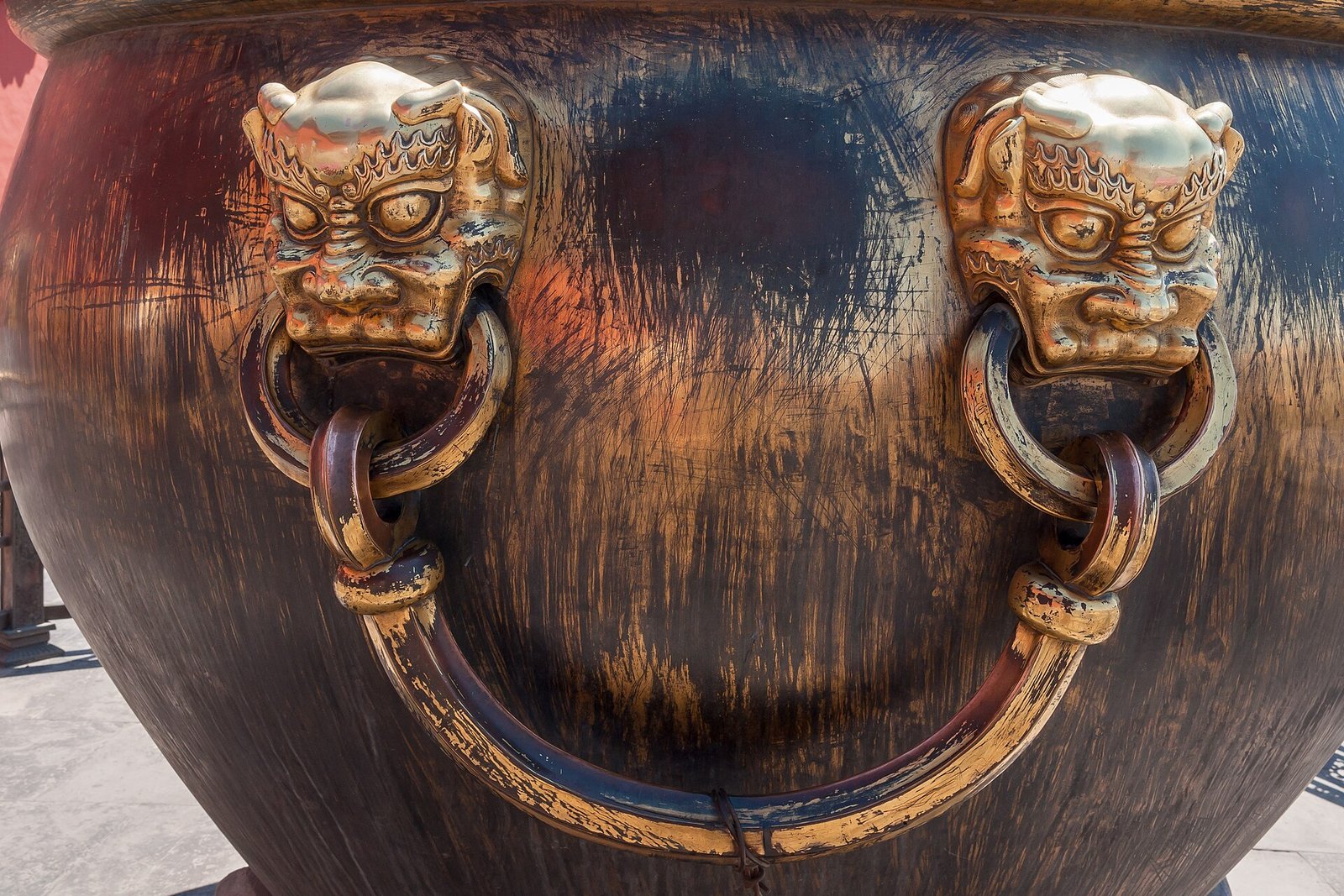
Look up as you walk. The roofs are topped with ranks of mythical beast figures, the number of which signalled a building’s importance, and the yellow glaze was reserved for the imperial family alone. The bronze turtles and cranes in the main courtyards were not decoration but symbols of longevity and stability, and the giant sundial and grain measure outside the Hall of Supreme Harmony were props of legitimacy as much as instruments. Noticing these small things is what turns a march between rooms into a story.
Is the Treasure Gallery worth the extra ticket?
Only if you care about the objects. The Treasure Gallery and the Clock Gallery each add around 10 yuan and hold genuinely fine jade, gold and imperial trinkets, but they are separate buildings off the main axis and easy to miss if your feet are already done. Skip them without regret if you are short on time or energy — the core route through the central halls stands on its own. Keep them if you enjoy craft objects or are photographing details, since the light inside is calmer than the open courtyards. The mistake is treating them as mandatory; they are a bonus, not the visit. I have done the palace twice without them and once with, and neither version felt incomplete.
What you can skip
Be honest about your stamina. The two side galleries and the long rear courtyards are rewarding only if you’re a repeat visitor or a specialist. On a first trip, I’d drop the outer western wings entirely and save them for next time. The “enhanced experience” add-ons sold near the entrance, the costume photos and the rickshaw touts outside the north gate, are tourist machinery; the real sight is free once you’re inside the walls.
The inner court’s smaller residential rooms are atmospheric but repetitive if you’re tired, and the museum shops inside the complex sell the same tins of tea and fridge magnets you’ll find cheaper outside. Save your money and your energy for the open courtyards, which are the point.
What time should I arrive to avoid the worst of the crowds?
Arrive at the opening bell, 8:30, and walk in with the first wave rather than mid-morning, when tour buses unload. The gate queues are shortest then and the central courtyards are still photogenic before the human carpet forms. Once inside, turn right and work anticlockwise — most groups drift left and clog the eastern palaces first, so the western side stays calmer for an hour. The rear gardens and side lanes are always quieter than the central axis at any time. If you cannot make the opening, late afternoon is the next best window, as coach parties thin before closing. The crowd is unavoidable at peak season, but an early start trades a little sleep for a wholly different visit.
Beating the crowds
Timing is everything. Arrive at the Meridian Gate at opening, currently 8:30, and walk the central axis against the flow; most group tours start from the south and drift north, so going early and moving steadily keeps you ahead of them. Avoid weekends and any date near a national holiday. The light is best in the first two hours anyway, and the long shadows on the red walls are the picture you came for.
If you can’t come midweek, the next best trick is to spend the first hour on the central axis and then peel off into the side palaces while the tour groups pile into the Treasure Gallery. By late morning the coaches have unloaded, and the eastern palaces go almost empty. I once had a whole courtyard to myself at noon in October, which is the closest the Forbidden City gets to peaceful.
Two minutes’ walk north, Beihai Park is the calmer follow-up most people miss. It’s a former imperial garden wrapped around a white dagoba on an island, and after the press of the palace it feels like exhaling. Climb Jingshan, the hill directly behind the north gate, for the one photograph everyone takes, the sea of golden roofs laid out below you, and do it late in the day when the tour buses have gone.
If you only have half a day and the palace feels like too much, the table below shows how the nearby options compare for a shorter visit.
| Sight | Time needed | Rough cost | Best for |
|---|---|---|---|
| Forbidden City | Half to full day | RMB 40–60 | History, scale, architecture |
| Beihai Park | 1–2 hours | RMB 10–20 | A calm lakeside walk next door |
| Jingshan Park | 30–45 minutes | RMB 2 | The classic overhead photo of the roofscape |
Pair it with the Great Wall
The Forbidden City sits at the heart of a walkable cluster, but the scale that beats it is out at the Wall. The Badaling Great Wall covers the easiest-reach section if you want monumental defences without a long drive, and it pairs naturally with a Beijing stay even though it deserves its own day.
Is the Forbidden City a better visit than the Summer Palace?
They are different experiences, not rivals. The Forbidden City is a formal palace — vast courtyards, throne halls, the weight of imperial ceremony — best appreciated as architecture and history, and tiring on the legs. The Summer Palace is a garden retreat: a lake, bridges, covered walkways, somewhere to stroll rather than march. Pick the Forbidden City if you want the iconic imperial set-piece and can handle a half-day on foot; pick the Summer Palace if you want a gentler, prettier afternoon. First-time visitors short on days should do the Forbidden City for the must-see factor and save the Summer Palace for a return. Both reward a weekday over a weekend more than they reward each other.
How it compares with other imperial sights
If your trip ranges wider, the comparisons get interesting. Down in Xi’an, all about big wild goose pagoda describes a Tang-dynasty tower that, like the Forbidden City, was built to impress and still does, though on a completely different scale. For a vertical, modern answer to imperial Beijing, the Canton Tower Guide walks through Guangzhou’s skyline, which is worth seeing precisely because it is the opposite of a closed palace.
If you’re headed west, Chengdu Panda Base explained tells you how to meet the animals without the queues that plague the capital’s indoor sights, and it makes a gentle contrast to the formal courtyards here. Over in Chongqing, everything you need to know about ciqikou covers the old riverside town that survived the bombing and the rebuilding, a humbler sort of heritage than the emperors enjoyed.
And if you want the most dramatic pairing of all, how crescent lake dunhuang is really done explains the desert oasis that makes the Forbidden City’s enclosed splendour look like the opposite end of China’s geography.
Mistakes I made and saw
The first time, I went on a Monday. The gates were shut, and I spent the day on the outside wall instead. The second time, I booked late and paid a premium through a reseller who simply held a standard ticket. The third time, I arrived at opening with my passport and a plan, and it was a different place. Other common errors: assuming the north gate is an entrance (it’s an exit only), wearing unsuitable shoes for kilometres of uneven courtyard stone, and forgetting water on a summer day when the open squares bake.
Frequently Asked Questions
Can I buy a ticket at the gate? Almost never. Tickets are sold online against your passport, with a daily cap, and the gate has no general walk-up sales. Book ahead on the official platform.
Why is it closed on Mondays? Routine maintenance and crowd recovery. It’s a fixed closure, not a seasonal one, so plan your week around it.
How long does a visit take? A focused visit is three to four hours; a thorough one is a full day. Most first-timers are done by early afternoon if they follow the central axis.
Is the audio guide worth it? Yes, if you want the stories behind the halls. It’s cheap, and it turns a walk past empty rooms into something you remember.
What’s the best exit strategy? Walk out the north gate, then straight up Jingshan for the view, or west into Beihai Park. Don’t try to double back south; the route is one way.
Should I combine it with the Great Wall in one day? No. Both deserve their own day. Cramming them together means you rush the palace and tire out before the Wall, which is the worse of both.