Types of Tofu: Silken, Firm, Fried and Dried
Last reviewed 31 October 2026 · China Food Way editorial team
Tofu is the most unfairly ignored ingredient in the average British supermarket. We buy a block, we fry it until the outside is a golden armour and the inside is a warm, spongy nothing, and we conclude that it is a boring thing to put in stir-fries. Done properly it is one of the most useful ingredients in the whole Chinese pantry, and the single biggest difference between a home stir-fry that tastes like a restaurant and one that does not is usually the tofu.
The complication is that tofu comes in at least five distinct forms, sold in the same refrigerated aisle and behaving in completely different ways. A recipe that specifies a particular texture is telling you which of these five to buy, and using the wrong one is why so many people conclude they dislike tofu.

What are the five main forms of tofu?
Silken, soft, firm, dried and fried — with tofu skin as a sixth, separate thing. Silken is set with nigari and barely pressed, about eighty to ninety per cent water, and behaves like a set custard for cold dishes and steamed custards. Soft sits in the middle and holds shape in soup. Firm, around seventy per cent water, fries, grills and braises without falling apart. Dried tofu — doufu gan (豆腐干) — is pressed hard, then often soy-cured, and keeps for months as a chewy, meaty bite. Fried tofu comes as small golden pillows, spongy or dense. Tofu skin is the dried layer that forms on simmering soy milk, a different ingredient entirely, and is extraordinary in a stir-fry once reconstituted.
The Five Forms
All Chinese tofu begins as doufu (豆腐), which is soy milk set with a coagulant. What changes between the forms is the coagulant, the pressure applied afterwards, and how much water is left in the block. That last variable is the whole story: the more water, the more delicate the tofu, and the less work it can take before it falls apart.
Silken tofu is the youngest and softest. It is set with nigari, a purified magnesium chloride derived from seawater, and it has around eighty or ninety per cent water. The result is closer to a set custard than a cheese: it pours, it wobbles, and it breaks into pieces if you stir it hard. It is the correct choice for cold dishes and for the steamed savoury custards. Soft tofu, the standard type sold in Chinese supermarkets for hotpot, sits in the middle: it holds its shape in soup, has a slightly chalky bite, and takes on flavour quickly. Most home stir-fries should use this one.
Medium and firm tofu have been pressed, which squeezes out water and raises the protein and calcium content. Firm tofu is around seventy per cent water and can be fried, grilled or braised without falling apart. It is what you want for mapo tofu, for twice-cooked pork, and for anything going into a stir-fry where you need the pieces to survive being tossed.
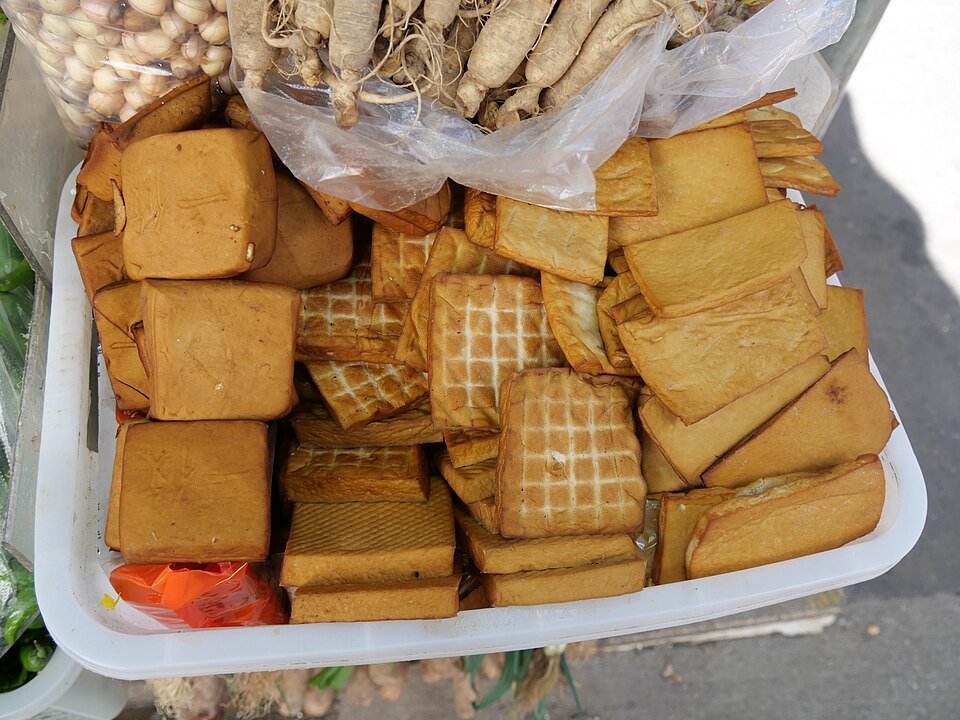
Dried tofu is doufu gan (豆腐干), and it is a different ingredient entirely rather than a wetter or drier block. It is pressed harder, then soaked, pressed again and dried, sometimes with soy and spices added during the process. The result is firm, chewy and faintly leathery, and it keeps for months in a sealed jar. It is what gives a vegetarian dish its bite.
Then there are the two fried forms. Fried tofu is zha doufu (炸豆腐), sold in Chinese supermarkets as small golden pillows, and it is either soft and spongy inside or dense and meaty depending on the region. Tofu skin is fu zhu (腐竹), which is not tofu at all but the skin that forms on top of simmering soy milk, dried into brittle sheets. Reconstituted, it becomes sheets with a wrinkled texture that is extraordinary in a stir-fry, and it is what makes the vegetarian version of a Sichuan dish satisfying rather than merely meat-free.
How long should I press tofu before frying it?
Thirty minutes with a modest weight is enough for most frying, and an hour with something heavier gets you stir-fry-ready. The technique is plain: block on a plate, second plate on top, something heavy on that, and wait. Water content is everything — the more you press out, the better it browns, the more seasoning it holds, and the less it collapses in the wok. Two hours starts pushing toward the texture of shop-bought firm tofu, and you can speed it with a tea towel and a pan of hot water on top. Pressing in the fridge slows things and keeps the flavour clean. Skip it and you get the sad, watery block that put so many people off tofu in the first place.
Pressing Time and What It Does
Pressing is the variable that separates home tofu from shop tofu, and the reason so many home cooks end up with a sad, watery block. If you press your own tofu, you control the water content, and the water content controls everything else: how it holds seasoning, whether it browns, whether it holds together in a wok.
The technique is simple. Put the block on a plate, put a second plate on top, put something heavy on top of that, and leave it. Thirty minutes gives you a firmer, better-frying tofu, an hour with a heavier weight gives you something that will hold a stir-fry, and two hours starts pushing toward the texture of shop-bought firm tofu. You can also press it in the fridge, which slows things down and gives a cleaner flavour because the tofu stays cold.
There is a shortcut that works surprisingly well: put the block between two sheets of kitchen paper, or on a tea towel, and put a heavy pan of hot water on top. The paper wicks moisture out of the surface, the weight does the rest, and you get a noticeably drier surface in about twenty minutes. This is the version I use when I want to fry tofu. For soft and silken tofu, never press. For firm, press for at least thirty minutes. If you want the outside to crisp and the inside to stay soft, dust the pressed surface with a little cornflour before frying, which gives a barrier that stops the oil soaking all the way through.
| Form | Water content | Behaviour in the pan | Best for |
|---|---|---|---|
| Silken | Around 90% | Wobbles, breaks if stirred | Cold dishes, steamed custards, soup |
| Soft | Around 85% | Holds shape, soaks up broth | Soup, braising, gentle stir-fries |
| Medium | Around 80% | Firm enough to stir-fry | General use, mapo tofu |
| Firm | Around 70% | Holds shape under high heat | Frying, grilling, hot pot |
| Dried | Very low | Chewy, resists liquid | Stir-fries, braises, keeps for months |
| Tofu skin | Rehydrated after drying | Wrinkled, catches sauce | Vegetarian Sichuan dishes |
Why does plain tofu taste of so little?
Because blandness is the design, not a defect. Tofu is soy milk set and pressed, with almost no flavour of its own, which is exactly why it works in Chinese cooking: it is a blank, savoury sponge that takes on whatever it sits in. That is why the same ingredient carries a chilli-oil dressing cold, a black-bean braise hot, and a sweet-sour glaze without complaint. The catch is that it only absorbs what you give it time and seasoning to take — a quick toss in a weak sauce leaves it tasting of nothing, while a braise or a marinade lets it drink the flavour deep. Treat it as a delivery system for sauce rather than a source of taste, and the ‘boring tofu’ problem disappears.
How Tofu Takes Flavour
Tofu is porous in a way that makes it a flavour sponge rather than a flavour delivery system. It does not hold a sauce on its surface the way a slice of meat does; it drinks it in. This is why a plain block of firm tofu tossed in soy sauce and vinegar comes out blandly salty, and why the same tofu marinated for half an hour before cooking comes out deeply savoury.
The second technique is salting, which sounds odd but is the most useful thing you can learn about cooking tofu. Salt it, wait, and the tofu does two things. It firms up as the salt draws out water and the tofu protein tightens, which means it holds its shape better. And it creates a subtle base layer of seasoning right through the block rather than only on the surface. My method is to cube the tofu, salt it lightly, leave it in a colander for fifteen or twenty minutes, then pat it dry before it goes into the pan.
Third, and this is the one home cooks miss: tofu needs fat to carry flavour. Soya sauce, vinegar and aromatics alone will taste thin, because the soy and vinegar are water-soluble and there is nothing fat-soluble to hold them together. A spoonful of sesame oil, a drizzle of chilli oil, or the rendered fat from a piece of pork belly changes the dish completely. The toasted sesame oil guide covers the aromatic version of this in detail.
Which tofu should I use for mapo tofu?
Firm, at around seventy per cent water, which is the form that survives the tossing and the chilli-oil braise without breaking into mush. Soft silken tofu would dissolve in the sauce, and the supermarket rubber block stays in lumps but misses the tender bite the dish wants. Cube the firm block, let it poach in the ma la liquid rather than stir it hard, and it stays in pieces while soaking up the heat. My vegetarian mapo tofu uses the same firm block and shows the texture to aim for. For cold dressed tofu or steamed custards, switch down to silken; for a chewy, meat-free bite in a stir-fry, reach for dried tofu instead.
Choosing for the Dish
Mapo tofu is the dish people know tofu from, and the form matters. I use medium or firm tofu, cubed and fried briefly before going into the sauce, because the sauce is thick and the stirring is vigorous. My authentic mapo tofu recipe goes through the reasoning step by step. Soft tofu would break into porridge in the time it takes the sauce to thicken.
For hot and sour soup, the answer is different: soft or silken, added at the very end, so that you get distinct soft cubes in a thickened broth. My hot and sour soup recipe uses napa cabbage as the main vegetable and tofu as the soft counterweight, and the two together are the reason the dish works. The egg drop soup recipe shows the same principle in a simpler form.
For a stir-fry with a strong sauce, fried tofu is the move. Deep-fry the pillows or blocks until the outside is crisp, then add them to the sauce at the end so they soak without going soft. Twice-cooked pork uses a version of this logic, and so does a home hot pot, where fried tofu and dried tofu are the two things to have on the table. For a braise, dried tofu or firm tofu; dried tofu gives you a chew that plain tofu never has.
For dumplings, tofu is a filling rather than a main ingredient, and it goes in as firm tofu that has been pressed and crumbled so the moisture does not leak into the wrapper. The guide to making Chinese dumplings at home covers how to drain it properly. And for a plain cold dish, silken tofu with soy, vinegar, chilli oil and spring onion is one of the best things you can make in ten minutes.

Buying and Storing
Chinese supermarkets in Britain stock all of it, and the prices are low. A block of firm tofu is usually around ninety pence to a pound and twenty, silken tofu rather more, dried and fried tofu a couple of pounds for a bag that lasts weeks.
Buy tofu with your nose. It should smell faintly of soy and nothing more; a sour or ammoniacal smell means it has been left too warm. If the block is sitting in a puddle, it has been sitting. Tofu keeps three or four days in the fridge, and you should change the packing water daily.
For longer storage, freeze it. Firm and medium tofu freeze well, and the texture after thawing is slightly spongier, which helps in a braise and hurts in a salad. Silken tofu does not freeze at all; the structure collapses. Dried tofu and tofu skin keep for months in a sealed jar away from light.
Frequently Asked Questions
Which tofu should I buy if I can only get one?Medium or firm. It is the most versatile, it holds together, it fries, it braises and it works in soup. Buy soft or silken only if you are specifically making a cold dish or a steamed custard.
Do I need to press tofu bought from a shop? Not strictly, but it improves things noticeably. Thirty minutes under a weight dries the surface, which means it browns rather than steams and holds a sauce better.
Why does my tofu fall apart in the pan? It is too soft, too wet, or you are stirring too hard. Press it, use a firmer variety for stir-fries, and push rather than stir, turning the pieces individually with a spatula.
Can I use tofu instead of meat in a stir-fry? Yes, but you need to build the flavour differently. Firm or fried tofu, more fat in the pan, more mushroom or fermented bean paste for umami, and no expectation that it will taste identical. The best meat-free versions use tofu skin for texture.
What is the difference between tofu and bean curd? They are the same thing. Bean curd is simply the older English term, still common on packaging and in older recipes, and it refers to tofu rather than to a different product.
Is tofu healthy? It is a complete protein, low in fat, and a good source of calcium when made with calcium sulphate, which is what most Chinese tofu uses. The sodium content depends on how much salt has been added, which varies enormously between shop-bought blocks and salted dried tofu.
The Short Version
Tofu comes in five forms and they are not interchangeable. Silken is set with nigari and about ninety per cent water, so it is for cold dishes and custards. Soft holds its shape in broth, while medium and firm are pressed and are what you want for mapo tofu, for frying and for general stir-fries. Dried tofu is pressed, soaked and dried, and keeps for months. Press shop-bought firm tofu for half an hour before frying, salt it for fifteen minutes before braising, and always cook it with some fat, because tofu drinks sauces rather than wearing them.