How to Visit Mount Fanjing Without the Crowds
At ten past six on a Tuesday in May, the east gate car park at Jiangkou had the atmosphere of a sold-out football final. A man in a fluorescent vest was directing queues that did not yet exist, two families were discussing whether the cable car started at seven or half past, and a vendor was doing a brisk trade in thermoses of hot water. The mountain itself was invisible behind a low ceiling of cloud. These are the first five minutes of most visits to Mount Fanjing, and they are worth remembering, because the next four hours are unlike almost anything else in Guizhou — once you get past the administration.
So, is it worth it?
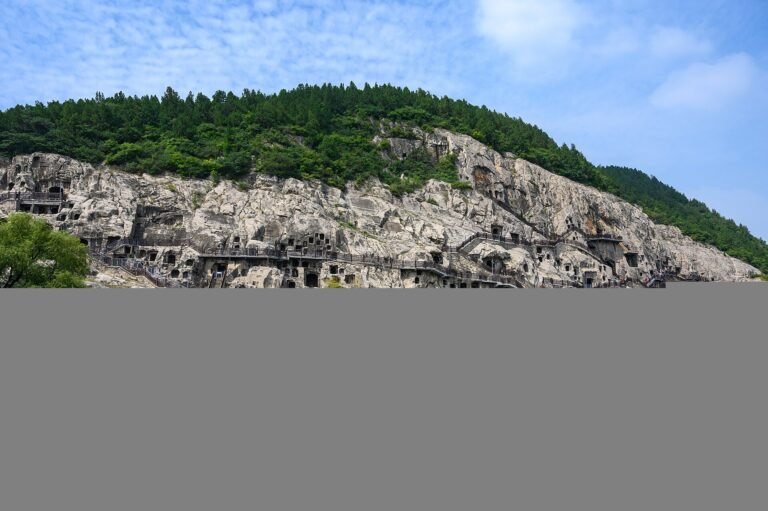
The short answer is yes, with conditions. Fanjingshan, as the Chinese name is often rendered, is a granite massif in the Wuling Mountains of northeastern Guizhou, and its highest points carry a Buddhist temple in a position that looks structurally ill-advised until you stand beneath it. Wikipedia’s entry on Mount Fanjing records that the site was inscribed on the UNESCO World Heritage List in 2018, which is the moment the international queue began forming. The view from the top is genuinely strange: two summits joined by a narrow bridge, shrines squeezed onto rock, cloud moving through the gaps below. Whether that pays for a day of tickets, shuttle buses and queuing is the argument below.
The case against: quotas, concrete and queuing to queue
Let us be fair to the sceptics, because they have material. Fanjing is managed more tightly than any mountain I have visited in China. Entry is timed, daily numbers are capped, and you move through a sequence of ticket hall, shuttle bus, cable car station and stairway that feels designed by someone who has never met a tourist with a short attention span. On my first visit I queued to collect a ticket, queued for a bus, queued for the cable car and then, for variety, queued at the top of the steps for the narrow bridge to the smaller summit. I have seen gentler conversations at passport control.
There is more concrete than you expect. Much of the upper route is paved and railings appear at every convenient point, which is excellent if you dislike drops and slightly disappointing if you came hoping for a wild granite scramble. The cost mounts too: entry, the compulsory shuttle and a return cable ride together come to a figure that buys a decent room in Guiyang, and the small add-ons are where the day quietly gets expensive. Prices and the booking rules change, so check the official site before you go and reserve in advance rather than turning up hopeful. Then there is the weather: the summit sits above 2,000 metres and cloud can swallow the entire view for hours. I watched a family arrive, wait forty minutes, see nothing and leave. If this sounds familiar, everything you need to know about badaling great wall covers another famous climb where the management is the story as much as the scenery.
The case for: the view from the Golden Summit
Now the other side. The New Golden Summit, around 2,336 metres, is a blade of rock with a temple on it and a footbridge crossing to a second, smaller peak that holds another shrine. The bridge is narrow enough to make a sensible person pause, and the drop on either side is real. I am not usually thrilled by engineered viewpoints, but the position is extraordinary — the rock falls away almost vertically, and on a clear morning you can watch cloud pour over the ridge like water over a weir. The older Golden Summit is higher but quieter, and the walk between the two is the best half-hour on the mountain. The temples are Buddhist and associated with Maitreya, and the smaller shrines have been rebuilt more than once after fire and weather; the present buildings are tidy rather than ancient, which surprised me until I remembered how little survives at 2,300 metres. What the place lacks in antiquities it makes up for in position. A monk I passed sweeping the steps said the view was clearest before the morning thermals built, which matched what I had read and, for once, what actually happened. Mount Hua has a more notorious plank walk, but Fanjing’s setting feels stranger because the building is so small against the rock.
Go early. I reached the bridge at seven on my second visit and had it almost to myself for twenty minutes; by eight the same spot required careful elbow work. That single hour is the difference between a great trip and a grumble.
The mushroom rock and the reasons to look down
The landmark everyone photographs is a stone balanced on a narrower stone, known as the mushroom rock, which has survived longer than most of the buildings around it. It is about a twenty-minute walk from the upper cable station, and it is usually surrounded by people taking the same photograph. The better reason to linger here is what lies below: the mountain is a forest refuge of unusual biological value, with a humid, layered vegetation that changes quickly with height. The golden snub-nosed monkey lives in these forests, though seeing one requires luck and patience rather than a ticket — a fact the signboards mention with far more enthusiasm than the monkeys themselves show. The forest also holds a large number of plant species found nowhere else, which is the quieter reason UNESCO took an interest. I found the vegetation more absorbing than the rock after the first hour: the change in leaf size and moisture over a few hundred metres of steps is obvious once you stop looking at your feet. I spent an hour scanning a ridge and was rewarded with a distant shape that may well have been a monkey; my companion, who had better eyes, said it was a branch. Check the official site before you go for current trail access, because paths around the sensitive areas do change.
Fanjing against the other sacred mountains
| Mountain | The draw | The catch | Best for |
|---|---|---|---|
| Mount Fanjing | Sheer summit shrines, UNESCO forest | Timed entry, tight crowds | A strange, memorable day |
| Mount Tai | Imperial history, sunrise tradition | Heavy foot traffic | History first |
| Mount Hua | Plank walk, steep granite | Exposure, demanding climb | Thrill seekers |
| Mount Wuyi | River scenery, tea hills | Lower, less dramatic | A slower pace |
Comparisons are useful only up to a point. Mount Tai Guide deals with a peak whose weight is historical, layered over centuries of emperors and pilgrims; Fanjing has none of that baggage and feels younger, stranger and considerably more vertical. Mount Wuyi explained describes a gentler Fujian landscape where the river and the tea terraces matter as much as the heights, which makes it a good follow-up rather than a rival. Mount Lu, over in Jiangxi, offers mist and villas instead of a temple on a knife-edge. And if what you actually want is a long, old pilgrimage route rather than a managed summit, all about mount song is the more traditional choice — fewer rules, more steps.
How to dodge the worst of the crowds
This is the practical part, and it determines whether the verdict above holds. Come on a weekday outside the school holidays and avoid the first week of October entirely; the difference in waiting time is not marginal, it is the whole trip. Choose the eastern approach at Jiangkou if you want the cable car and the classic route, or the western approach at Yinjiang if you prefer a longer walk and a thinner crowd. Book the earliest cable slot the system offers, carry your own water and food, and do not plan a tight connection afterwards — a wind hold on the upper cable car is common enough that I now leave a free afternoon. The steps between the cable station and the summit are steep but short, roughly 800 of them, so save something for the descent.
If all that organisation sounds exhausting, there are gentler days to be had elsewhere: my notes on big wild goose pagoda cover a flat, shaded site in Xi’an, and how beihai park is really done describes a Beijing garden where the steepest thing is the price of a boat. Fanjing asks more of you, but it gives back a view neither of them can match.
Frequently Asked Questions
How long does a visit take? Allow a full day. The cable car and shuttle transfers eat into the morning, and the summit circuit with the two Golden Summits takes three to four hours once you are up there.
Do I have to use the cable car? No, but the walk from the base is long and the final rise is steep. Most visitors use the cable car and then walk the upper steps, which is the sensible compromise.
What is the best time of day? The first cable of the morning. The summit is clearest early, and the bridge to the smaller peak is far easier to cross before the tour groups arrive.
Can I see the golden snub-nosed monkeys? Possibly, but never count on it. They live in the surrounding forest rather than on the summit path, and a sighting is a matter of luck.
Is the summit bridge safe? It is railed and closely managed, with staff controlling the flow. It is narrow and exposed, so anyone who dislikes heights should stop at the temple and skip the crossing.