Changsha Food Guide: The City That Never Sleeps
Last updated 31 October 2026 · checked by the China Food Way editorial team
A City That Does Not Believe in Bedtime
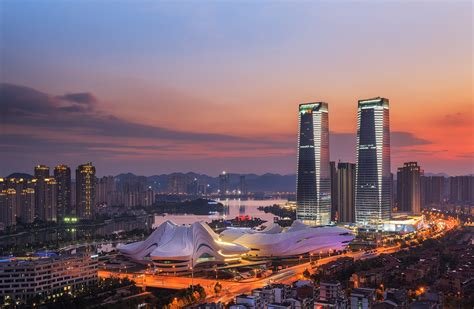
The first thing you notice about Changsha is the smell. It hits you at the taxi rank outside the station, a warm, fermenting, faintly alarming funk that turns out to be stinky tofu (臭豆腐) frying four stalls deep along the approach road. The second thing you notice is that it is half past midnight and the queue for that tofu is longer than the one you joined for dinner. Changsha is the provincial capital of Hunan, but nobody who has spent a night here calls it that. They call it the city that forgot to close.
I arrived expecting a stopover between Zhangjiajie and the Yangtze and left three days later with a stomach I was actively negotiating with. This is a place where the most famous restaurant brand in town is built entirely around the memory of street food, where a milk-tea chain has devotees who queue an hour for a cup, and where the local definition of a good evening starts at ten and ends when the last crayfish shell is cracked. If you are building a China food trip and skipping Changsha, you are skipping the country’s most purely hedonistic eating city.
This guide is the one I wish I had: what to eat, where the performances end and the real food begins, how to order without melting, and why the city’s whole identity now revolves around the plate.
How is Hunan heat different from Sichuan’s mala?
Hunan builds its heat on chillies, not on Sichuan peppercorn. The Sichuan signature is mala — the numbing tingle of huajiao married to chilli — whereas Hunan’s xiang la (香辣) is pure, dry, aromatic heat with almost no numbing at all, built from fresh chillies, fermented chilli pastes and smoked chillies rather than the tingly prickly ash. Once you can taste that Hunan leans on fragrance and straight heat while Sichuan leans on numbness and depth, a Changsha menu stops being a wall of red and starts being a set of choices. The two provinces get lumped together by anyone who has never stood in both with chopsticks in hand, but the difference matters the moment you sit down to order — order for brightness and burn, not for tingle.
Why Hunan Food Is Its Own Thing
Hunan cooking — xiang cai — gets lumped with Sichuan by everyone who has never stood in both provinces with chopsticks in hand. They are not the same, and the difference matters the moment you sit down to eat in Changsha. Sichuan’s signature is mala, the numbing-tingle of Sichuan peppercorn married to chilli. Hunan’s signature is xiang la — pure, dry, aromatic heat with almost no numbing, built on fresh chillies, fermented chilli pastes and smoked chillies rather than the tingly prickly ash.
If you want the fuller regional picture, my piece comparing Hunan and Sichuan cooking lays out the pantry and the logic, because once you can taste that Hunan leans on fragrance and straight heat while Sichuan leans on numbness and depth, Changsha’s menu stops being a wall of red and starts being a set of choices. The city is also the natural counterpoint to its neighbour — if you are doing a spicy-capitals route, pairing Chengdu and Changsha in one trip is the fastest education in Chinese regional heat you can get.
What’s the signature late-night dish in Changsha?
Spicy crayfish — xiao long xia, the local kǒu wèi xiā (口味虾). In summer the city eats them the way the north eats dumplings at New Year: in mountainous quantities, with bare hands, washed down with cheap beer and louder conversation. The standard version is stir-fried with a mountain of chillies, garlic, ginger and cumin until the shells are lacquered and the meat pulls free in one clean tug. You order by the jin, a half-kilo, wear the plastic bib they hand you, and do not attempt to look dignified — then mop the broth at the bottom of the plate with noodles once the shells are gone. The kitchens that serve it open around five and keep going until the crowd thins, which rarely happens before midnight, and that is why Changsha nights run so late.
The Night Economy, Decoded
Changsha’s reputation as an “entertainment capital” is not marketing. The city government literally brands it that way, and the proof is on the street after dark: riverfront light shows, karaoke towers, and a constellation of night markets that do their real business between nine and two. But the engine of all of it is food, and the dish that drives the engine is xiao long xia — spicy crayfish (口味虾).
In summer the city eats crayfish the way the north eats dumplings at New Year: in mountainous quantities, with bare hands, washed down with cheap beer and louder conversation. The standard version is stir-fried with a mountain of chillies, garlic, ginger and cumin until the shells are lacquered and the meat pulls free in one clean tug. You order by the jin (half-kilo), you wear the plastic bib they give you, and you do not attempt to look dignified. The broth at the bottom of the plate, once the crayfish are gone, is the point — locals mop it up with noodles.
The crayfish boom is also why Changsha nights run so late. The kitchens that serve it open around five and keep going until the crowd thins, and the crowd rarely thins before midnight. If you want to understand the city, skip the scheduled attractions on night one and just find a crayfish street, sit, and watch who is eating: entire families, office groups still in work clothes, teenagers on scooters, old men who have clearly done this every Tuesday for a decade.

The Wenheyou Phenomenon
You cannot write about Changsha food now without the elephant in the room: 文和友 (Wenheyou). It began as a single stinky-tofu shop and became a multi-storey, meticulously staged recreation of a 1980s Changsha street, complete with fake rain, a preserved old neighbourhood facade, and dozens of small vendors selling the snacks the city grew up on. The original branch by the river regularly queues longer than any museum in town.
Is it a theme park? Partly. Is the food good? Some of it, yes — the stinky tofu and the crayfish are competent, and the point is the density of regional snacks under one roof. But the more interesting question is why it works. Wenheyou sells the feeling of having eaten Changsha food in a city that no longer quite exists, and for a visitor that is genuinely useful: in an hour you can sample a dozen Hunan street foods you would otherwise hunt across a dozen back alleys for. Treat it as a greatest-hits compilation, not the source record, and you will enjoy it.
The danger is that you mistake the staging for the city. The real Changsha is two streets over, in the unrenovated noodle shops and the late bakeries, where nobody is performing nostalgia because they are too busy actually cooking. Go to Wenheyou once for the range; spend your second night where the locals are not being photographed.
Stinky Tofu, Defended
Changsha stinky tofu is fermented in a brine of winter melon, vegetables and tea, then deep-fried until the outside is blistered and the inside stays creamy, and finished with chilli oil, garlic water and a spoon of pickled vegetables. The smell is the barrier; the taste is the reward, and the gap between them is the entire joke the city is in on. A good cube is crisp, savoury, faintly funky and nothing like the odour promises.
The version to avoid is the one sitting under a heat lamp at a tourist stall since lunch. Stinky tofu is a fresh-fry food — you want the batch that hit the oil as you arrived. The tell is the queue and the sound: a proper stall is popping and flipping constantly, and the person running it is slightly annoyed at how busy they are. That annoyance is your quality signal.
Steamed Fish Head With Chopped Chilli
If crayfish is the night dish, duo jiao yu tou (剁椒鱼头) is the table-centrepiece. A whole head of freshwater fish is steamed under a cap of chopped red and green chillies, fermented broad beans and garlic, then finished with a pour of hot oil at the table that wakes the aromatics. The meat around the cheek and collar is the prize, and the sauce underneath — chilli, steam, fish essence — is what you spoon over plain rice until the bowl is clean.
It is the dish that best explains Hunan to a newcomer: not the brute force people fear, but a careful balance where the chilli is fresh and bright rather than merely hot, and where the fish is allowed to taste like fish. Order it at a proper Hunan restaurant rather than a snack stall; it needs a kitchen that respects the steam timing. For the regional pantry behind dishes like this, my Sichuan cuisine guide covers the fermented-bean family that Hunan shares and adapts, and the same ingredients show up here with a sharper, drier hand.
What are Changsha rice noodles like and when should I eat them?
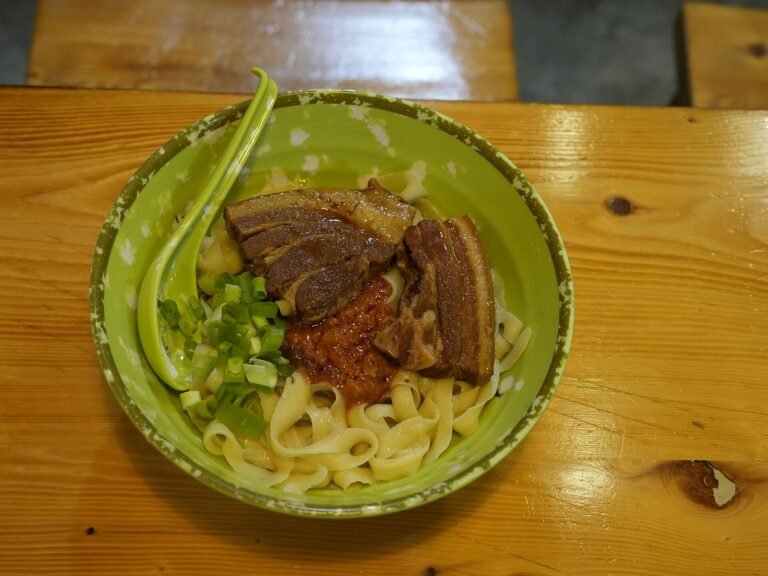
Local mi fen, and the Changsha style is often served dry-tossed — gan pao — dressed in a dark, savoury sauce of chilli oil, soy, pickles and a little broth, then topped with a fried egg or braised pork and stirred into a glossy tangle before the noodles cool. Breakfast is the main event: by nine the good shops have sold their first few hundred bowls and the latecomer gets what is left. The ritual is fast and unsentimental — order at the counter, a bowl within ninety seconds, eaten standing or on a stool because seating was never the point. The timing lesson for a visitor is strict: noodles before nine, everything else after six, and almost nothing worth eating between two and five. Compare the habit with the Xi’an noodle city for contrast.
The Rice-Noodle Habit
Changsha runs on mi fen — rice noodles — and the local style is distinct from the soupy bowls of neighbouring provinces. The Changsha version is often served “dry-tossed” (gan pao), the noodles dressed in a dark, savoury sauce of chilli oil, soy, pickles and a little broth, then topped with a fried egg or braised pork, and you stir it into a glossy tangle before the noodles cool. Breakfast is the main event: by nine the good shops have sold their first few hundred bowls and the latecomer gets what is left.
The ritual is fast and unsentimental. You order at the counter, you are handed a bowl within ninety seconds, and you eat standing or on a stool because seating was never the point. The regulars do not look up from their phones. The lesson for a visitor is timing: noodles before nine, everything else after six, and nothing much worth eating between two and five in the afternoon, when the city briefly admits it is human.
What sweet snacks should I try in Changsha?
Two things. The first is tang you ba ba (糖油粑粑) — small glutinous rice cakes fried in malt sugar until they gleam and turn chewy, sweet in the way only a fried starch can be, sold from carts that appear at dusk. The second is the milk tea, because Chayan Yuese was born here: drinks built around tea and rice, with queues that wrap around blocks and a brand loyalty bordering on civic identity. Notice what the sweets tell you about the savoury food — where other regions reach for vinegar to cut fat, Changsha reaches for sugar to cut heat, and that sweet-sour note sits behind several of its ‘spicy’ dishes. Whether you join the tea queue is your call, but the line is part of the experience the locals happily defend.
Sweets, and the Milk-Tea Empire
Two things close the Changsha day. The first is tang you ba ba (糖油粑粑) — small glutinous rice cakes fried in malt sugar until gleaming and chewy, sweet in the way only a fried starch can be, sold from carts that appear at dusk. The second is Chinese black vinegar territory in reverse: where other regions use vinegar to cut fat, Changsha uses sugar to cut heat, and the combination shows up in dressings, glazes and the sweet-sour notes behind several “spicy” dishes.
The milk tea is its own phenomenon. 茶颜悦色 (Chayan Yuese), born in Changsha, builds drinks around tea and rice, queues that wrap around blocks, and a brand loyalty that borders on civic identity. Whether or not you queue is your call, but notice what it tells you: in this city even the beverage is treated as a serious food decision, and the line is part of the experience the locals are happy to defend.
| Dish | What it is | Best time | Where to start |
|---|---|---|---|
| Spicy crayfish (口味虾) | Stir-fried freshwater crayfish, chilli-garlic-cumin | Summer nights, after 9pm | Crayfish streets near the river; order by the jin |
| Stinky tofu (臭豆腐) | Fermented, fried, dressed in chilli and pickles | Evenings, fresh-fried only | Busy standing stall with a constant queue |
| Steamed fish head (剁椒鱼头) | Fish head under chopped chilli, finished with hot oil | Dinner, at a proper restaurant | Established Hunan restaurants, not snack stalls |
| Dry-tossed rice noodles (米粉) | Rice noodles in savoury chilli-soy dressing | Breakfast, before 9am | Neighbourhood noodle shops, eaten standing |
| Glutinous rice cakes (糖油粑粑) | Fried malt-sugar rice cakes, chewy | Dusk, from carts | Night-market and street carts |
Practical Notes Before You Go
Three things will make the trip better. First, learn the word wei la (微辣, “slightly spicy”). Hunan cooks are generous with heat by default, and asking for the mild version is not weakness — it is how you keep your palate alive for day two. Second, the city pairs naturally with its neighbours: if you are already in Wuhan for the breakfasts or heading to the mountains, Changsha slots in as the late-night counterweight. Third, pace the heat. A day of nothing but the reddest dishes is a day you stop tasting; alternate a fiery meal with a plain-noodle breakfast and let the city’s range do the work.
And do not over-plan the food. The best bite I had was a six-yuan bowl of dry-tossed noodles at a counter where the cook had clearly been doing one thing for twenty years, and the regularity of the habit was the only seasoning that mattered. Changsha rewards the person who walks until something smells good and sits down.
Frequently Asked Questions
Is Changsha food unbearably spicy for a foreign visitor? Not if you ask for 微辣. Many signature items — stinky tofu, the fish head, the noodles — are flavour-first and heat-second, and the mild request is honoured without side-eye.
Is Wenheyou worth the queue? Once, as a greatest-hits sampler of Hunan street food under one roof. For the real city, eat where the locals are not being photographed.
What should I eat first if I only have one night? Spicy crayfish with a group, followed by fresh-fried stinky tofu from a busy stall. That pairing is the city in two bites.
When are the best restaurants open? Noodles before 9am; crayfish and hot dishes from around 5pm until late. The dead zone is roughly 2–5pm, when most good shops close.
How does Changsha compare to Chengdu for spice? Chengdu numbs; Changsha burns bright and clean. My Hunan-versus-Sichuan comparison explains the difference in pantry terms if you want to plan a two-city route.
Getting There and Eating On
Changsha sits on the high-speed line between the Yangtze cities and the western mountains, which makes it an easy anchor for a central-China food loop. Spend a day on the riverfront and the old streets, eat crayfish until you surrender, and let the late-night energy be the itinerary. If you want help building a route that strings Changsha together with the surrounding provinces and their signature tables, get in touch and I will sketch one around your dates and your heat tolerance.