Coriander in Chinese Cooking: The Herb Half the World Cannot Eat
Fact-checked and reviewed 31 October 2026 · China Food Way editorial team
On a night-market bench in Xi’an, a friend pushed a plate of cumin lamb skewers at me and told me to pile on the fresh coriander. I did, happily. He took one bite of his own, went pale, and pushed the plate away — not because the lamb was off, but because the herb I found delicious tasted to him of soap. That was the night I learned that coriander, known as 香菜 (xiāng cài, “fragrant vegetable”) in Mandarin, is the most divisive leaf in Chinese cooking, and that the divide between us was written into our genes rather than our palates.
It is also, despite the argument it starts, the default herb of the Chinese table. It sits on the hot-pot dipping bar in a wet heap. It is thrown over nearly every noodle and soup in the north. And in the streets it is treated less as a garnish than as a vegetable in its own right.
The soap thing is real, and it is genetic
Why do northern dishes use so much more coriander than southern ones?
Northern Chinese cooking leans far harder on coriander than the south because the herb thrives in the cooler, drier climate up there and became a cheap, everyday vegetable rather than a garnish. In Beijing and Shanxi you will find it heaped into noodles, stuffed into flatbreads and sold by the bunch at morning markets, whereas Cantonese kitchens treat it as a finishing sprinkle. The divide tracks geography more than taste: where the plant grows easily, it gets used generously. One honest caveat for the cook at home is that supermarket coriander loses its punch within two days, so the northern habit only works with genuinely fresh bunches. If you want that layered, herb-forward flavour, buy loose stems with the roots on and use them the same day rather than reaching for the pre-cut plastic packs.
Chinese coriander leaves in
Chinese coriander leaves in deserves a closer look. On a night-market bench in Xi’an, a friend pushed a plate of cumin lamb skewers at me and told me to pile on the fresh coriander. I did, happily. He took In the sections below we cover what travelers and home cooks actually need to know.
About one in seven people carries a variant of the OR6A2 olfactory receptor gene that makes coriander taste of crushed soap or old bugs. I am not one of them; my Xi’an friend is. This matters in a Chinese kitchen because coriander is everywhere, and you cannot simply assume a guest will enjoy it. The polite move, learned the hard way, is to serve it on the side rather than stirred through — which, conveniently, is also how a lot of Chinese cooking presents it.
In the different styles of Chinese hot pot, for instance, the dipping sauce is built by each person at the table: sesame paste, fermented tofu, chilli oil, and then as much or as little coriander as you can bear. Nobody is forced. That communal, build-your-own approach is exactly why coriander thrives in Chinese food — it is offered, not imposed.
Can you eat the roots, or just the leaves and stems?
The roots are not only edible, they are the most flavoured part of the plant, so don’t throw them away. Thai and southern Chinese cooking pounds washed coriander roots with garlic and pepper into a paste that seasons soups and marinades, carrying a deeper, less soapy taste than the leaves. Scrub them clean of soil, trim the very tip, and you have a free seasoning that most Western cooks bin. The stems come second, tough but aromatic, best in long-simmered stocks where leaves would dissolve. The honest limit: roots need a good wash and a hard chop or a mortar, because they are woody raw. Use the leaves last and raw, and you have stretched one £1 bunch through three different jobs instead of sprinkling it once.
The northern habit: coriander as a vegetable
Spend time in northern China and you stop seeing coriander as a sprinkle. At a lamb skewer stall the herb is washed, left whole, and handed over in a generous handful; you wrap it around the meat or lay it across the top. The same goes for 凉菜 (liáng cài, cold dressed dishes), where a plate of smashed cucumber or anise-fennel bark is buried under a tangle of leaves.
This is the part that surprises Western cooks, who treat coriander as a finishing touch measured in pinches. In the north it is closer to lettuce — a fresh, slightly citrusy bulk that balances the richness of grilled and braised meat. When I make cumin lamb at home now, I buy two bunches: one to cook lightly, one to pile on raw at the table.
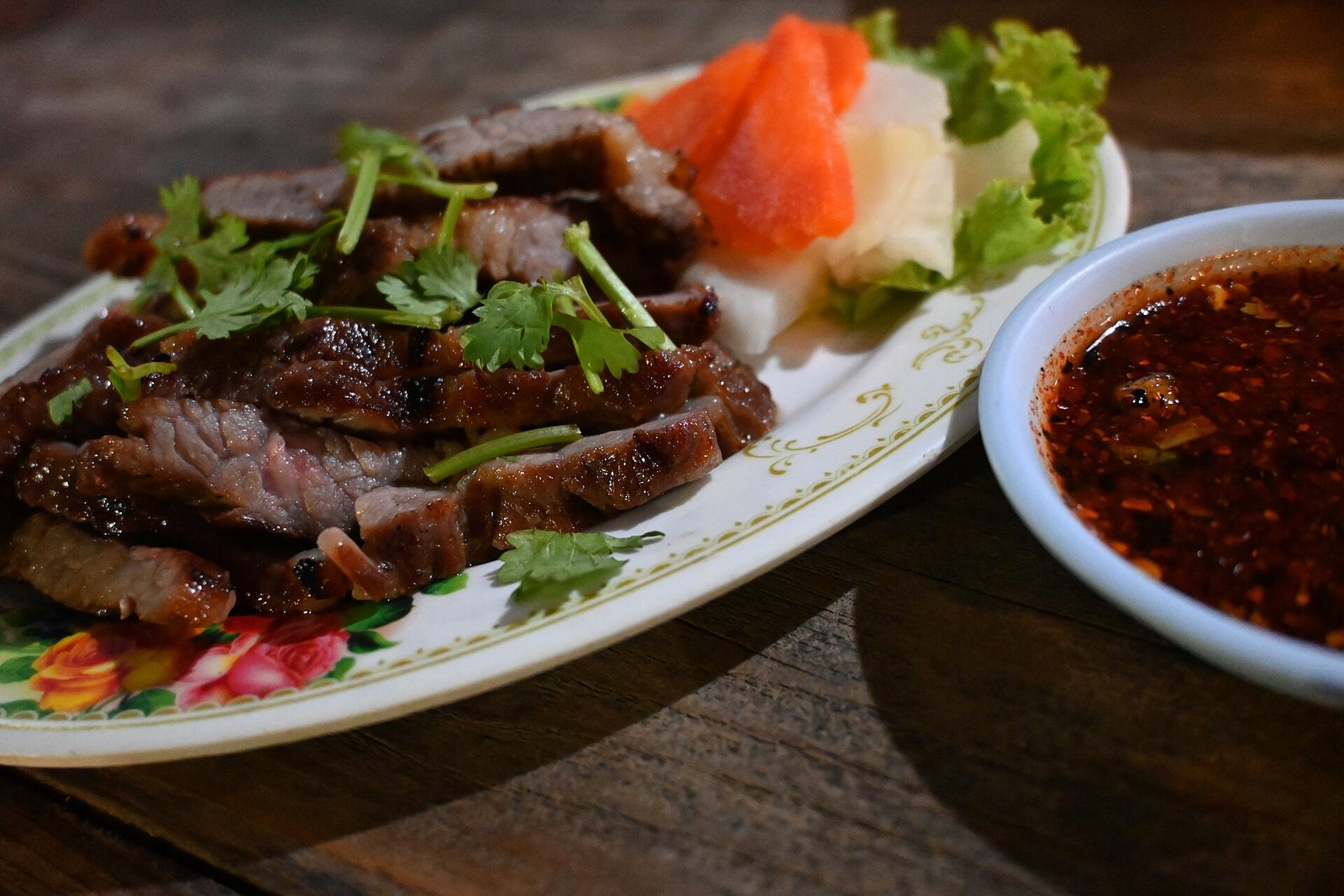
In cities like Lanzhou and Xi’an you will find 香菜牛肉 (xiāng cài niú ròu), paper-thin slices of poached beef buried under a snow of raw coriander and a slick of chilli oil, where the herb is not decoration but fully half the dish. The same instinct shows up in hand-pulled noodle shops, where a bowl of 凉皮 (liáng pí, cold wheat noodles) arrives under a tangle of coriander that you are expected to eat, not pick off. I used to push it to the side until a cook in Gansu told me, plainly, that I was leaving half the flavour on the plate.
Why does coriander wilt to nothing in a hot soup?
Coriander collapses in hot liquid because its volatile oils, the source of both its perfume and the soapy note some people hate, evaporate almost the instant they meet boiling stock. Drop leaves into a simmering bowl and within thirty seconds they turn black, slimy and flavourless, which is why the rule is to add them off the heat or at the table. Stems survive longer thanks to their firmer fibre, so they go in earlier if a recipe asks for them. The practical move is to keep a small pile of roughly torn leaves beside the pot and scatter them as each bowl is served, exactly as a hot-pot diner builds their own sauce. The caveat: pre-chopped coriander sweats and browns in its own bag, so tear it fresh for the best result.
Leaf versus stem: the soup rule
Here is the practical bit that took me too long to learn. The delicate, fragrant part of coriander is the leaf, and it dies in heat — add it at the very end or raw. The stem, thin and slightly fibrous, is where the real flavour lives in a long-cooked dish, and it can take twenty minutes of simmering without turning to mush.
In a northern chicken or beef soup, the cook rarely drops in leaves. Instead, a small handful of stems goes in during the last ten minutes, and the leaves are scattered at the table as everyone serves themselves. The clear Chinese soups I grew to love all follow this logic: stem for depth, leaf for freshness, never the two confused.
A Chinese omelette is the quickest way to taste the difference at home. Beat two eggs, fold in a small pile of chopped leaves and a few minced stems, and fry hot and fast. The leaf stays bright; the stem gives the egg a savoury, almost herbal backbone that plain chives do not.
How to choose coriander
At the market I buy it as a living plant whenever I can — roots still attached, soil around them — because cut bunches wilt within a day. Look for leaves that are a deep, even green without yellow or black edges, and stems that snap rather than bend limply. The roots, if present, should be pale and firm, not brown and slimy.
Avoid any bunch where the lower leaves are already turning black at the base; that rot travels upward fast and you will lose half the purchase before you get it home. Smaller, younger plants are more fragrant than the tall, flowering ones, which have turned bitter and woody. If you only have the supermarket option, pick the freshest-looking bag and use it the same day.

How to store coriander
The single best method I know is to treat it like a bouquet. Trim the ends, stand the bunch in a glass of water, and put a loose plastic bag over the top, secured with a rubber band at the rim. On the windowsill or in the fridge door, it stays perky for the better part of two weeks. Change the water every three days and pinch off any yellowing leaves before they spoil the rest.
The “wrap it in damp paper towel in a bag” trick works too, but I find it lasts roughly half as long and the leaves go limp faster. Whatever you do, do not wash it and then leave it wet in a sealed tub — that is the fastest route to black sludge. Wash just before use, not before storage.
When you’re out: substitutes
Coriander has a flavour — citrusy, sharp, faintly metallic to some — that nothing replicates exactly. But depending on the job, you have options.
| If coriander is meant to be… | Best substitute | Notes |
|---|---|---|
| A raw finishing herb | Flat-leaf parsley, roughly chopped | Lacks the citrus note but gives fresh bulk |
| A cooked stem in soup | A few thin slices of celery leaf | Use sparingly; more bitter |
| A dip ingredient (hot pot) | Finely sliced spring onion green | Different but acceptable; add a squeeze of lime |
| A cold-dish toss | Thai basil (holy basil if you can) | More aniseed; use less |
| The citrus lift | A little lemon zest + parsley | Mimics the brightness, not the herb |
None of these is a true match, and I would not pretend otherwise. The honest advice is to keep a plant on the go so you rarely run out — but if a guest is among the one-in-seven who taste soap, these swaps turn a liability into a workable dish. For cooked applications where coriander is one_note among many, a spoon of oyster sauce and a scatter of spring onion will carry the savoury weight without anyone missing the leaf.
Wikipedia’s overview of coriander traces its use back thousands of years across China and Southeast Asia, which is why it shows up everywhere from Chinese street food stalls to banquet cold plates — the herb is simply part of the furniture of the table.
What dish makes coriander the main event rather than a garnish?
The clearest centrepiece is coriander-stuffed flatbread or the northern ‘coriander with boiled peanuts’ cold plate, where the herb is piled on by the handful rather than dotted on top. In Yunnan and Guizhou, whole leaves wrap grilled meat at the table so each bite carries as much herb as filling, and that ratio is the point: the leaf is treated as a salad green, not decoration. A home version is quick — blanch the leaves for five seconds, dress with light soy, a drop of vinegar and chilli oil, and you have a side that eats like a vegetable. The honest caveat is that this only works with very fresh coriander; limp supermarket bunches taste of nothing and the dish falls flat, so buy roots-on and use within a day.
When coriander is the centrepiece
Most of the time coriander plays a supporting role, but a handful of dishes put it centre stage. The cold beef salad above is one; another is the coriander-heavy dipping sauce for 涮羊肉 (shuàn yáng ròu, mutton hot pot), where a bowl of coriander, fermented tofu and chilli oil is the point of the meat rather than an afterthought. In the south, whole sprigs — stem and leaf together — go into clear braises of fish or duck, where the stem softens and the leaf is lifted out before serving, leaving its perfume behind without a mouthful of green.
The roots, incidentally, are the most concentrated part of the plant, and while they are prized in neighbouring Thai cooking, Chinese home cooks more often just keep the lower stem rather than discarding it. If you buy coriander with the roots on, trim them, wash off the soil, and use the bottom inch of stem in a long-simmered broth — that is where the deepest flavour sits, and it is the part most recipes quietly assume you will not throw away.
Frequently Asked Questions
Why does coriander taste of soap to some people? It is largely genetic — a variant in the OR6A2 gene makes the aldehydes in coriander register as soapy. It is not a failing of taste or cooking; roughly one in seven people have it.
Should I use the stems or just the leaves? Both, for different jobs. Leaves for raw finishing and quick-cooked dishes; stems for soups and braises where they hold flavour and texture through long simmering.
How do I stop coriander going black in the fridge? Stand it in a glass of water with a loose plastic bag over the top, or wrap it only just before use. Never store it wet in a sealed container.
Can I grow it on a windowsill? Easily. Buy it as a rooted plant and cut leaves as needed, or sow seeds in a pot; it bolts (flowers) quickly in heat, so keep it cool and cut often.
Is coriander the same as Chinese parsley? Yes — “Chinese parsley” is just another name for the same plant, used when a recipe wants to avoid the word coriander entirely.
What do I do if a guest hates it? Serve it on the side. Chinese hot-pot and many northern dishes already do this by design, so the herb never has to be stirred through the whole dish.
Frequently Asked Questions
What is Chinese coriander leaves in?
Our guide to Coriander in Chinese Cooking: The Herb Half the World Cannot Eat covers this directly: On a night-market bench in Xi’an, a friend pushed a plate of cumin lamb skewers at me and told me to pile on the fresh coriander. The sections above walk through the practical details.
Related reading
Beggar’s Chicken (Jiao Hua Ji): Clay and Leaves