

The Chinese Omelette: Three Ways, from Plain to Oyster
Last updated 31 October 2026 · checked by the China Food Way editorial team
Most people in the West know the Chinese omelette only as the pale, gravy-drowned egg foo young from a takeaway, which is a shame, because the family of egg dishes in Chinese cooking is wider and better than that. I used to think the takeaway version was the whole story, until a breakfast in Guangzhou showed me a folded omelette with the edges still lacy and brown, and a year later a night market in Tainan handed me an oyster omelette that was half custard, half crunch. They share a name in English and almost nothing else.
Eggs are cheap and fast, so Chinese home cooks treat them as both a fallback and a craft. The everyday logic of Cantonese cuisine, where steamed and lightly cooked dishes rule, puts eggs in constant rotation.
A word on egg foo young, because it is the version most Western readers actually know, and it has done the family a disservice. The takeaway egg foo young is a flattened egg pancake drowned in a starch-thickened gravy, usually with a pile of bean sprouts and a few prawns lost inside. It is fine as takeaway goes, but it is about as representative of the Chinese home omelette as a burger is of French cuisine. The versions below are what people actually eat at home and at breakfast, and none of them need a gravy boat. (For a soupy egg, egg drop soup is the third pillar of a Chinese egg education.)
How many eggs should I use for one Chinese omelette?
Three or four eggs per omelette, beaten with a pinch of salt and a teaspoon of water or stock — no more. Beyond four eggs the layer is too thick to set before the bottom overbrowns, and you end up with a rubbery slab rather than a soft fold. The spoonful of water turns to steam and lifts the curd; milk is not traditional here and leaves a flat, dairy taste. Beat only until the yolks and whites are combined, not frothy, and season the filling separately before it goes into the egg. Cook in two tablespoons of hot oil, and fold after ten seconds.
Method One: The Cantonese Home-Style Omelette
This is the one to learn first. Beat three or four eggs with a pinch of salt and, if you like, a teaspoon of water or stock for lightness. The filling goes in the egg, not beside it: a handful of bean sprouts, a few prawns, chopped scallion, or leftover barbecue pork, all seasoned separately. Heat a wok or a small frying pan until it smokes a little, add two tablespoons of oil, pour in the egg, and let it sit for ten seconds to set the base. Then fold it over itself with a spatula and cook another twenty seconds. The result should have brown, lacy edges and a centre that is just set, not rubbery.
The error I made for a long time was cooking it like a Western omelette — low heat, slow, pale. The Chinese version wants aggression. A spoon of oyster sauce stirred into the egg before cooking gives it a savoury depth that needs no other seasoning at the table.
The filling is where you make it yours. Beyond sprouts and prawns, I like a little diced char siu for sweetness, or a handful of tomato for acid, or shredded bitter melon if I am feeling virtuous. The rule is to cook the filling separately first — a quick toss in the wok until just done — because raw prawn or damp sprout releases water into the egg and you lose the set. Season the filling on its own, lightly, since the egg and the table sauce will do the rest.

What gives the oyster omelette its chewy layer?
A slurry of sweet potato starch and water, not the egg — about two tablespoons of starch to four of water for one omelette, poured around the oysters once the egg has set at the edges. It sets into the translucent, slightly bouncy layer that makes the dish, and cornflour in its place turns chalky and dull. Stir the slurry again immediately before pouring, because the starch sinks within a minute and you will tip in mostly water. Rice flour is too soft to give that chew. The whole point is contrast: crisp lacy egg, chewy starch, and oysters that are only just warmed through.
Method Two: The Taiwanese Oyster Omelette
This one is its own beast, and as the Wikipedia article on the dish explains, it is a street-food staple across Taiwan and Fujian rather than a home recipe. You do not just beat eggs. You make a slurry of sweet potato starch and water, loosen it with a little egg, and cook it with a handful of fresh oysters until it sets into something between a pancake and a custard. Then you slide it onto a plate and spoon over a sweet-savoury sauce made from more sweet potato starch, chilli, and sometimes crushed peanuts.
The texture is the point: slippery, slightly chewy, with bursts of briny oyster. It is nothing like the folded omelette above, and trying to make it with flour will give you a soggy disc. Sweet potato starch is not optional; it is the ingredient that creates the signature bounce. I wrecked two attempts before I bought the right starch, and the difference was not subtle.
| Style | Binder | Fillings | Texture | Cook time |
|---|---|---|---|---|
| Cantonese | Egg only | Sprouts, prawn, pork | Lacy, soft centre | ~30 sec |
| Taiwanese oyster | Egg + sweet potato starch | Fresh oysters | Slippery, chewy | ~2 min |
| Steamed custard | Egg + stock | None, or shrimp | Silky, just set | ~10 min |
What is the right egg-to-water ratio for steamed egg custard?
One part beaten egg to about 1.5 parts liquid by volume — three eggs to roughly 180 ml of warm stock or water is a reliable starting point. Too little liquid gives a firm, rubbery custard; too much will never set. Strain the mixture through a fine sieve and skim the foam, then cover the bowl tightly with foil or a plate so condensation cannot drip back and pit the surface. Steam over low heat, about 80–85°C, for fifteen to eighteen minutes; a hard boil is what blows holes through it. Test with a gentle shake: the centre should wobble as one piece.
Method Three: The Steamed Egg Custard
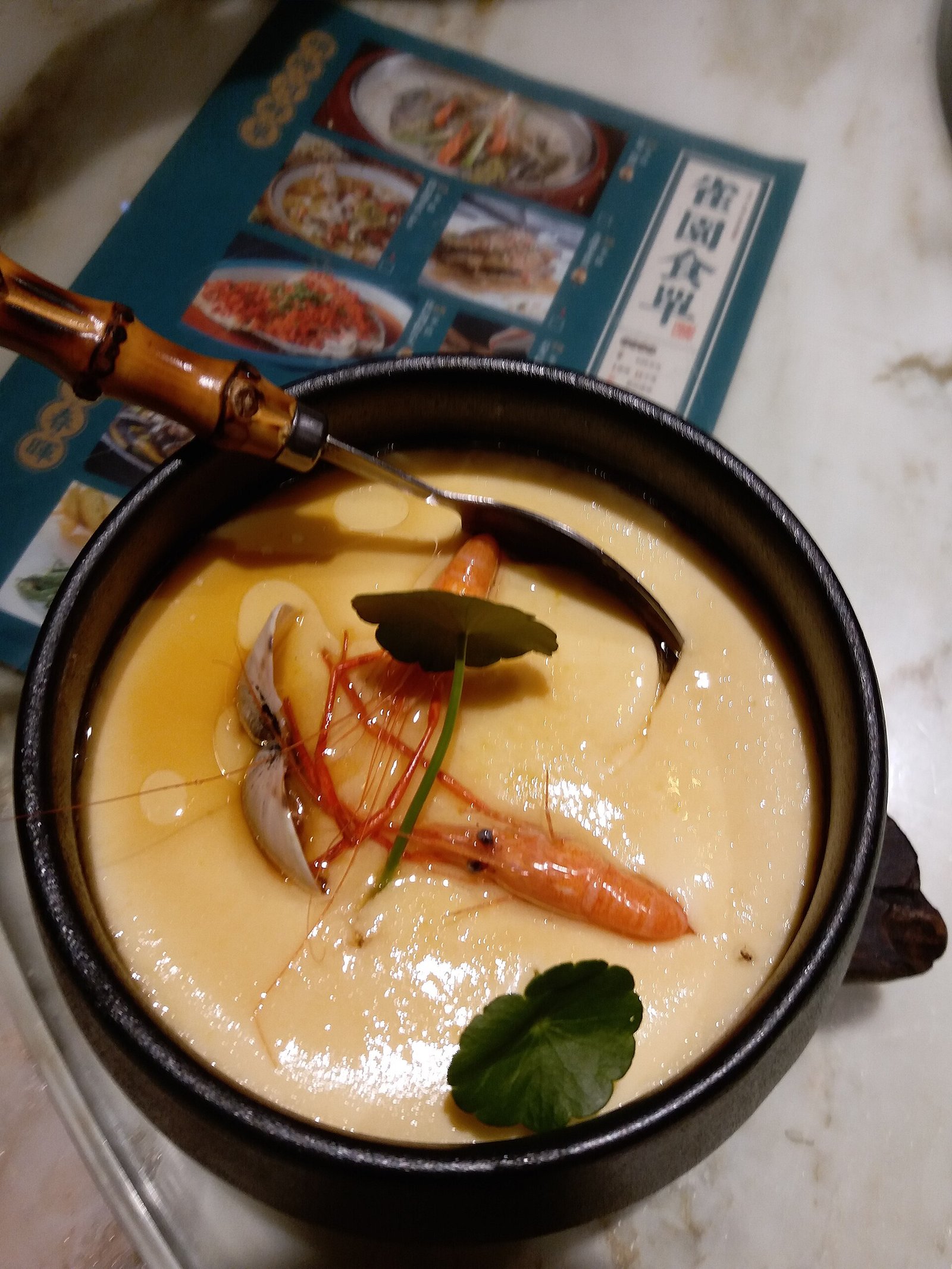
The quiet member of the family, and the one I make most when I want comfort without effort. Beat two eggs with an equal volume of warm stock (chicken or a light vegetarian stock), strain out the foam, and steam over a low simmer, covered, for about ten minutes, until the surface is just set and a chopstick comes out clean. The ratio is the whole game: equal parts egg and liquid, never more egg than liquid, or you get a rubbery puck. A few drops of sesame oil and light soy on top, and sometimes a prawn or two sunk into the custard before steaming, turn it into a proper side.
The custard is also the most forgiving canvas for extras. A few shreds of ginger steamed in the warm stock add warmth, a teaspoon of finely chopped scallion stirred in just before cooking adds freshness, and a quarter of a century egg chopped through turns it into a breakfast with real character. The only thing to avoid is overloading the ratio — more than a tablespoon of solid additions per two eggs and the custard loses its silky set, so treat additions as seasoning, not filling.
What links all three is the discipline of heat. The Cantonese omelette wants it high and fast; the custard wants it low and patient; the oyster omelette wants it moderate and confident. But in every case, the moment you overcook eggs they toughen, so the cook who watches the pan beats the cook who follows the clock.
What should I serve alongside a Chinese omelette?
Plain steamed rice and a light bowl of soup, with soy sauce at the table rather than poured over the top. These are home dishes, not sauced mains, and a heavy gravy buries the brown, lacy edges you worked for. For breakfast, congee is the usual partner; for supper, a plate of blanched greens with a spoon of oyster sauce alongside. The steamed custard wants nothing more than rice, a few drops of soy and maybe a scattering of scallion. The oyster omelette is the exception — a sweet-chilli dipping sauce belongs with that one, and with that one only.
Serving and Pairing
A folded omelette is a main over a bowl of Chinese rice, or one of several small dishes on a table. The oyster omelette is street food, eaten standing up with a fork. The custard is a side, best next to something with a bit of bite. All three pair well with a simple greens dish, and none of them needs a sauce except the oyster version, which arrives with its own.
If eggs are your starting point, tomato scrambled eggs is the other dish I would learn in the same week — it uses the same high-heat instinct and the same light hand with seasoning, and together the two cover most of what a Chinese egg repertoire needs.
If you are cooking for more than two, the folded omelette scales badly — it really wants a wok to itself, one at a time. The custard, by contrast, scales beautifully: a bigger bowl, the same ratio, a few more minutes of steam. I often make a double batch of custard for a table of four and let the omelette be the one showy hot dish. At the table, a small dish of light soy cut with a few drops of chilli oil is all any of these need; the eggs are the star, and a heavy sauce only proves you did not trust them.
On equipment, the wok is traditional but a small non-stick or well-seasoned carbon-steel frying pan is honestly easier for the folded omelette, because the egg releases without a fight and you are not fighting a curved surface with a flat spatula. The custard wants a shallow heatproof bowl that fits your steamer, and a plate to cover it so condensation does not pit the top. Use a neutral oil for the cook and reserve sesame oil for finishing — a few drops across a hot omelette is the difference between tasted and perfumed.
Frequently Asked Questions
Why are the edges of a good Chinese omelette brown and lacy? Because the pan was hot enough to fry, not just to set. That browning is flavour. A pale omelette was cooked too gently and tastes of little.
Can I make oyster omelette without oysters? You can make a sweet potato starch omelette without them, but then it is not the dish. Some stalls offer a prawn version; the starch batter is the real constant.
Why did my steamed custard come out full of holes and rubbery? Too much egg for the stock, or too fierce a steam. Use equal volumes and keep the water at a bare simmer, with the lid on to stop drips.
What oil should I use? Neutral, for the cook; a few drops of sesame oil for finishing. The omelette should taste of egg and filling, not of the oil.
Is egg foo young the same as the Cantonese omelette? Loosely. Egg foo young is the overseas, gravy-heavy descendant of the home-style omelette, usually with more filling and a thick sauce. The home version is lighter and drier.
How do I stop the oyster omelette sticking? A well-oiled pan and a flexible spatula. The starch batter sets quickly and releases once it has coloured; try to move it too early and it tears.


