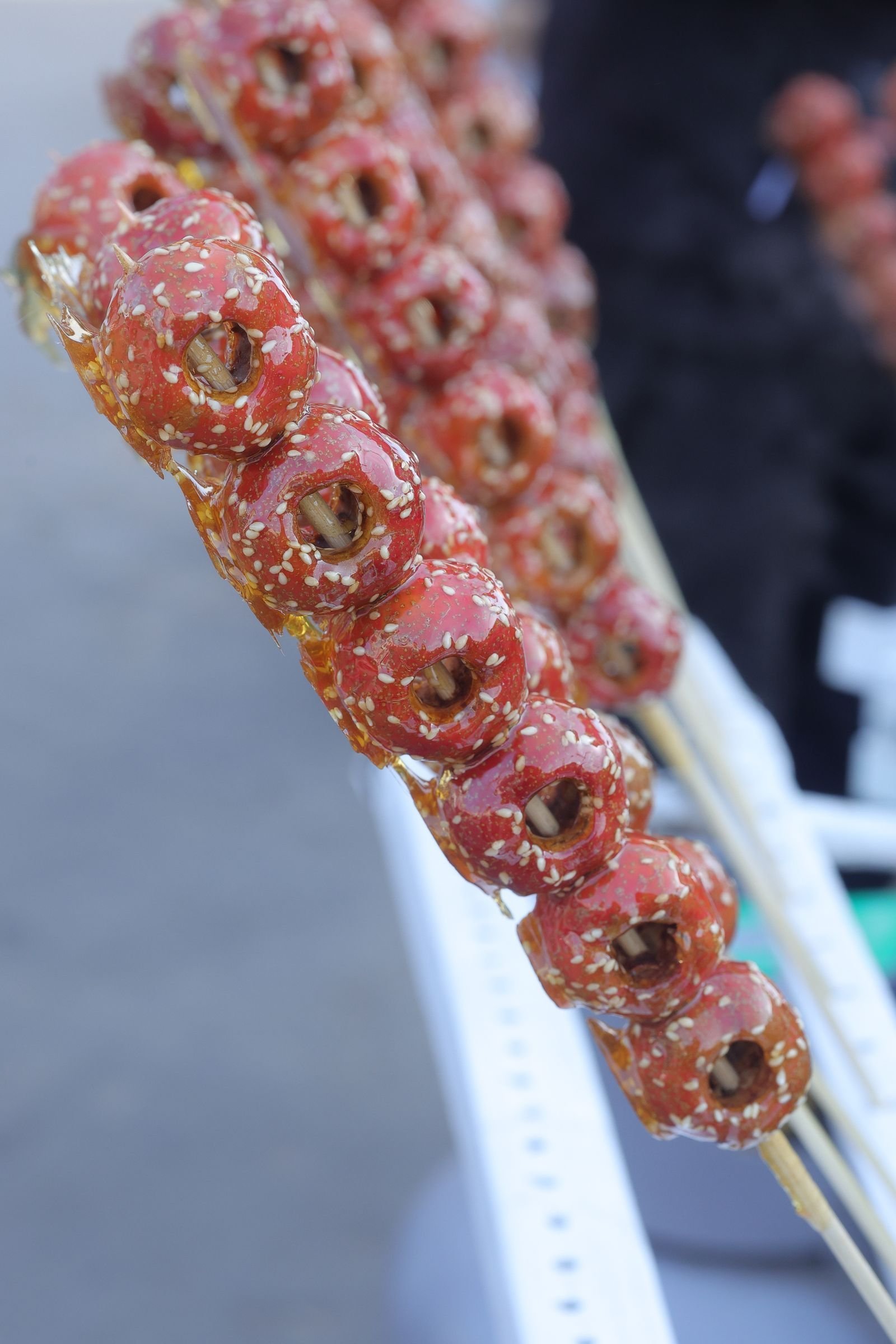
Tanghulu: The Candied Hawthorn Skewer That Snacks Like Glass
The first proper tanghulu I ever ate was from a cart outside a bookshop near Wangfujing, in January, at roughly minus eight. The vendor pulled a skewer from his rack, tapped it once against the edge of the tin with a fingernail, and handed it over. I bit down expecting something like a boiled sweet. What I got was a shell so thin and so crisp that it shattered audibly — a proper crack, not a crunch — and then gave way to a cold, sharp, faintly sour hawthorn underneath. I finished the whole skewer standing in the street and immediately wanted to know why my own attempts at home had produced something closer to toffee glue.
That gap between street version and kitchen version is the whole story of this recipe. Tanghulu is genuinely simple — fruit, sugar, water, a skewer — but the sugar is doing something precise and does not forgive hesitation. Below is everything I’ve worked out over about a dozen batches, including the three that went in the bin.
What tanghulu actually is
Tanghulu (糖葫芦, sometimes written bingtanghulu, “rock sugar gourd”) is a northern Chinese street snack: skewered fruit dipped in hot sugar syrup that sets into a hard, glassy shell. As Wikipedia’s entry on tanghulu records, it goes back at least to the Song dynasty, and the traditional fruit is the hawthorn berry — small, russet, and sharply tart, which is exactly why it works. The sugar shell is not there to make the fruit sweeter for sweetness’ sake; it is there to contrast with the acid underneath.
That sour base is the detail most Western copycat recipes miss. In Beijing the classic skewer is hawthorn, sometimes with a slit filled with red bean paste or sesame. The recent global trend — strawberries, grapes, even pineapple — is pretty but much sweeter, because the sugar shell has nothing to push against. My advice: if you can get hawthorn berries or unsweetened cranberries, use them. If not, strawberries with a squeeze of lemon juice do a decent impression.
A quick word about chasing snacks around China
Part of the reason I got obsessed with this skewer is that it belongs to a culture of street-side eating where the snack is made in front of you and eaten within minutes. I’ve spent days doing exactly this in different cities — the Nanjing Food scene taught me about duck dishes eaten standing up, and the tanghulu carts of Tianjin taught me the sound of correct candy. You calibrate by ear: a skewer tapped against the tin should ring, not thud. A thud means the shell absorbed moisture hours ago.
That habit of judging by texture before taste took me a while to bring back to my own kitchen — and if you’re curious about the steamed side of that street vocabulary, I’ve written Baozi explained elsewhere on the site. The point is: the snack’s maker has made thousands; you, at home, are making batch four. Weigh your sugar accordingly.
The sugar: hard-crack or nothing
Here is the single fact that fixed my tanghulu forever: the syrup must reach the hard-crack stage, around 150°C (300°F), and it must stay there while you dip. Below that temperature you get a sticky, chewy coat — pleasant, but not tanghulu. Above about 160°C the sugar tips into caramel and then into burnt within a minute, and the smell will follow you around the kitchen for two days. The window between perfect and ruined is genuinely narrow, which is why a thermometer is not optional kit here.
The science is straightforward. You are boiling off nearly all the water so that what remains is essentially melted sugar, which cools into a brittle amorphous glass. Any residual water — or any water absorbed later from the air or the fruit — softens that glass back towards syrup. This is why tanghulu is a winter snack in Beijing: dry, cold air keeps the shell crisp for hours. In a humid British kitchen, eat them within the hour.
A few hard rules I’ve learned the hard way:
- Use a heavy, wide pan. Sugar climbs the sides and crystallises; width slows that down.
- Do not stir once it boils. Stirring drags sugar crystals back into the syrup and seeds crystallisation. Swirl the pan instead.
- Brush the pan sides with a wet pastry brush for the first few minutes of boiling.
- Add a teaspoon of glucose syrup or a pinch of cream of tartar. Both interfere with crystallisation. I use glucose; it behaves more predictably.
- Work fast. Once at temperature, the syrup keeps thickening on the heat, and every second of delay changes the coat.
The heat discipline here is the same one that governs the savoury side of Chinese cooking — the lesson behind a proper Authentic Mapo Tofu Recipe: control the flame, not the clock. Get the heat right and the recipe almost runs itself; get it wrong and no amount of careful chopping saves you.
Choosing your fruit: what behaves and what sulks
Fruit choice is where home batches live or die, and it comes down to one variable: surface moisture. The shell adheres by flash-drying a microscopically thin layer against the fruit; wet fruit steams that layer loose and you get weeping, sliding, or a shell that cracks off whole at the first bite.
| Fruit | Surface moisture | Skin | How it behaves on a skewer |
|---|---|---|---|
| Hawthorn berries | Low | Firm, waxy | The classic; tart shell-fruit contrast is unbeatable |
| Strawberries | High | Soft, bruise-prone | Must be bone-dry and chilled; eat fast |
| Green or red grapes | Medium | Taut, glossy | Very reliable; the modern bestseller |
| Cherry tomatoes | Medium-high | Thin | Workable but leaky; the shell can split |
| Mandarin segments | High | None | Greedy choice; peels itself off the stick |
Whatever you use: wash it well ahead, dry thoroughly, and let it come to fridge temperature. Cold fruit sets the shell faster and buys you seconds. Trim strawberries but keep their crowns on for something to grip, and pat every piece dry right before dipping. I once skipped this with damp grapes and watched three coats slide off into the syrup in a row.
My exact quantities and method
For about eight skewers (a sensible household batch — tanghulu does not keep, so make only what will be eaten):
- 300 g granulated sugar
- 150 ml water
- 1 teaspoon glucose syrup (or a pinch of cream of tartar)
- 600–700 g prepared fruit, cold and dry
- 8–10 bamboo skewers, 20 cm or so, soaked and fully dried
Line a baking tray with greaseproof paper or a silicone mat. Push the skewers through the fruit, leaving a 10 cm handle. Set the tray near the hob — dip and lay down in one motion, not a walk across the kitchen with a dripping 150°C skewer.
Combine sugar, water and glucose in the pan and bring to the boil over medium heat without stirring. Wash down the sides with a wet brush. Clip on the thermometer and let it run to 150°C, then pull the pan off the heat. Tilt the pan to pool the syrup at one side, dip a skewer at a shallow angle, rotate it through the syrup in about two seconds, lift, let it stop dripping, and lay it on the mat. The shell sets in under a minute at room temperature; in a cold kitchen, seconds.
If the syrup darkens towards caramel before you finish dipping, work two shorter syrup batches rather than rescuing one. I now do two 150 g batches instead of one 300 g, and my last coat is as good as my first.
Three batches I ruined, and what each one taught me
Batch one never left the syrup stage: I pulled the pan at 115°C, panicked, and produced eight skewers of amber toffee bonded permanently to the paper. Trust the thermometer, not your nerve.
Batch two crystallised into a grainy sand because I stirred it, out of pure habit, while it boiled. Stirring is a wok reflex — the high-heat tossing behind everything you need to know about beef chow fun demands constant motion — but sugar work inverts the rule: stillness is correct, motion is sabotage.
Batch three was my overconfidence batch: fruit that hadn’t dried properly, syrup at 148°C because I got impatient, and a kitchen already steaming from a pot of something else on the back burner. The shells went cloudy and tacky within twenty minutes. Humidity is the silent killer — Beijing stalls dip in the open cold, and I now boil the kettle for tea after the dipping is done.
There’s a broader point in those failures: nearly every Chinese street food has one non-negotiable step that looks optional and isn’t. Think of how beggars chicken is really done: hours of low heat and a sealed clay armour, none of it skippable. Tanghulu’s non-negotiable is the 150°C hard-crack. Miss it by ten degrees and you’ve made a different snack.
And if “sugar shell over something sharp” still sounds odd, consider that Chinese cooking loves the contrast everywhere — in Kung Pao Chicken, the glossy sweet-and-sour glaze only works because the dried chillies and Sichuan pepper underneath are biting back. Tanghulu is the same principle with the savoury part removed and the sugar promoted to structural material.
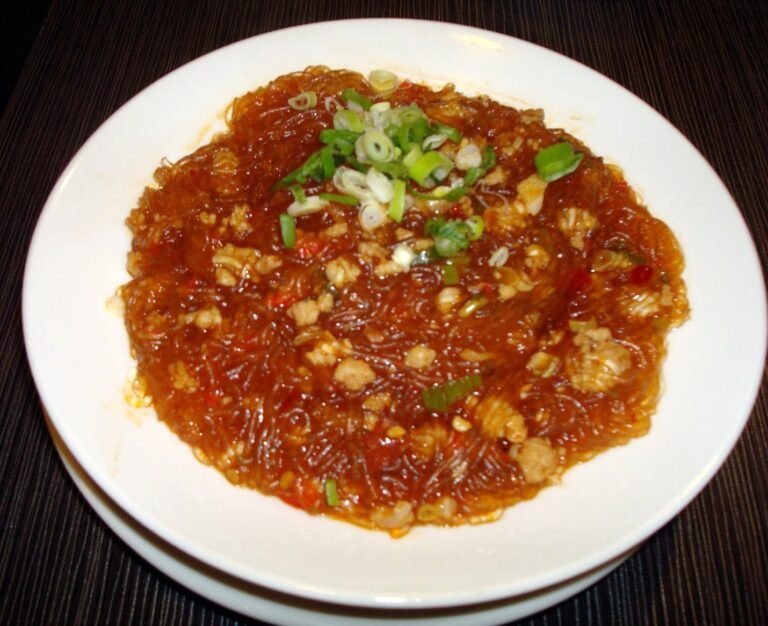
Even the names in this canon are enjoyably literal — a candied skewer is called “sugar gourd” because the hawthorn berries strung on a stick resemble a small gourd, and elsewhere on the site I’ve covered all about ants climbing a tree, a dish named for mince climbing cellophane noodles. Chinese food names describe what you see, and I find that refreshing.
Serving, storing and eating them properly
Eat tanghulu the way Beijing does: standing up, within the hour, directly off the stick. If you must hold them, keep them uncovered and cool — a fridge is humid, and a wrapped tanghulu is a sad, sweating tanghulu within thirty minutes. Loose berries on a tray in a cold, dry room will stay crisp for two or three hours in winter conditions; on a July afternoon, budget for minutes.
Pairing-wise, tanghulu after a rich, savoury meal is the classic order — the acid and the crack reset the palate. Unsweetened tea is right; milk is wrong. I have tested this.
Frequently Asked Questions
Can I make tanghulu without a sugar thermometer? You can, but it’s the one piece of kit I won’t cut. The iced-water brittle test works, but you’re making that judgement every thirty seconds while also dipping. Practise it first with a sacrificial syrup batch.
Why is my tanghulu sticky instead of crisp? Either the syrup didn’t reach hard-crack (most likely), or moisture got in — wet fruit, steam, or humid air. Fix the temperature first, then the drying.
Which sugar is best? Plain granulated white sugar is what the street stalls use and what I use. Caster works too. Avoid anything with anti-caking additives; brown sugar brings moisture and never fully sets.
Can I use honey or maple syrup? Not for a proper tanghulu shell. Fructose-rich syrups stay soft or weep at room temperature. You’ll get a glaze, not glass.
How do I clean the pan afterwards? Fill it with water, bring it back to a simmer, and the hardened sugar dissolves in minutes. Never chip at it dry — that’s how I bent a spatula.