Huangshan Food Guide: Stinky Fish and Hairy Tofu
Fact-checked and reviewed 31 October 2026 · China Food Way editorial team
Huangshan has one of the great price gradients in Chinese tourism. A bottle of water that costs two yuan at the foot of the mountain costs fifteen at the summit, and the gap is not greed so much as physics: every apple, every cabbage and every crate of beer up there arrived on the back of a porter walking a stone staircase. Once you understand that, the mountain stops feeling like a rip-off and starts feeling like a logistics problem you can plan around — and the food at the bottom, which is where you should be eating anyway, turns out to be some of the most unusual cooking in eastern China.

Yellow Mountain sits in southern Anhui, historically Huizhou, and Huizhou cooking is one of the genuine oddities of Chinese regional food. It is a merchant cuisine from a mountainous, land-poor region whose sons left to become bankers and salt traders across the Yangtze delta, and it developed two characteristics that define it: heavy salting to keep food edible on long journeys, and a tolerance for strong fermented flavours that surprises visitors expecting gentle eastern Chinese cooking.
Can you actually eat chouguiyu if you hate strong smells?
Yes, provided you let the kitchen cook it through rather than sniffing the raw plate. Chouguiyu’s smell is strongest before the braise, when the fermenting fish is still cool and uncooked; once it hits the wok with pork, bamboo and chilli, much of that odour cooks off and what remains is savoury rather than offensive. The texture is the part that wins over doubters — the flesh sets into firm, separable flakes instead of collapsing like fresh steamed fish. If you are genuinely smell-averse, order it at a busy restaurant where it is fried hot, not at a cold buffet. One honest caveat: the aroma never fully disappears, and a table of four will notice it. Ask for a smaller portion to share before committing to a whole fish.
The Two Dishes That Define Huizhou
Chouguiyu, literally “stinky mandarin fish,” is the dish that Huizhou is known for and the one that most reliably divides a table. A whole mandarin fish is salted and left to ferment for several days in a controlled way — not rotting, but deliberately matured — then fried and braised with pork, bamboo, chilli and garlic. The finished dish has a firm, almost meaty texture and a smell that is unmistakable before the plate reaches the table.
The comparison that helps is cheese. Nobody describes a ripe époisses as spoiled, and nobody would eat it fresh. Chouguiyu operates on the same principle: controlled fermentation developing savoury depth that the fresh fish does not have. The texture is the thing converts people — the flesh separates into large firm flakes rather than falling apart, and the flavour is deeply savoury rather than fishy.
Maodoufu, “hairy tofu,” is the second and stranger one. Cubes of tofu are left to ferment until they grow a fine white mould — the “hair” — then pan-fried until the mould forms a crust and served with chilli and soy. Eaten hot, it is creamy inside, savoury and faintly funky. It is not commercially produced in most of China, and outside Anhui it is essentially unavailable, which alone makes it worth ordering while you are here.
Both dishes depend on fermentation as a preservation strategy from a pre-refrigeration era, and both are best understood through the wider framework of Anhui cooking, where salt, smoke and controlled decay do the work that freshness does elsewhere.
How much should I budget for food on the summit?
Budget roughly 60 to 100 yuan for a hot meal at the summit, against 15 to 30 yuan for the same dish at the base, and treat the difference as a porter’s wage rather than a rip-off. Everything above the treeline arrived on a person’s back up stone steps, so a bowl of noodles that costs 12 yuan in Tunxi can reach 45 yuan at Beihai Shelter. The maths is simple: carry your own lunch. A filled bao or two, a few mandarins and a litre of water weigh little and save you perhaps 80 yuan a head. Buy water at the foot — two yuan a bottle there, fifteen at the top — and refill at the stamped stations where the spring is safe to drink. Eat your proper meal in the villages below, where the cooking is better and a third of the price.
Eating on the Mountain
| Where | What is available | Relative cost | Advice |
|---|---|---|---|
| Summit hotels | Set meals, buffet, hotpot | Very high | Book half-board; à la carte is worse value |
| Mountain cafeterias on the trails | Instant noodles, buns, sausages, drinks | High | Snacks only |
| Tangkou village (base) | Full restaurants, Huizhou cooking | Mid | Eat here before and after |
| Hongcun / Xidi villages | Village cooking, home restaurants | Low to mid | Best food of the trip |
The summit restaurants are not bad for what they are; they are expensive because a porter carried your dinner up four thousand steps. The sensible approach is to carry your own food. A bag of bread, sausage, fruit, chocolate and two litres of water bought in Tangkou costs a fifth of the equivalent bought at the top and weighs less than you think. If you are staying overnight for the sunrise — which you should — book a half-board rate at the summit hotel rather than ordering à la carte, because the set meals are priced for people with no alternative and the à la carte menu is priced for people who did not read the set menu.
One genuine mountain pleasure: the hot tea sold at the trail cafeterias. It is expensive by the cup and completely worth it at six in the morning when the temperature on the summit is near freezing and the sunrise is ten minutes away.
Before and After: The Base Villages
Tangkou, at the foot of the mountain, is a purpose-built service town and its restaurants are competitive rather than captive — walk the length of the main street and compare before you sit down. The good ones have a cold case of raw ingredients you point at and a handwritten list of dishes, and they will steer you toward the fish and the tofu.
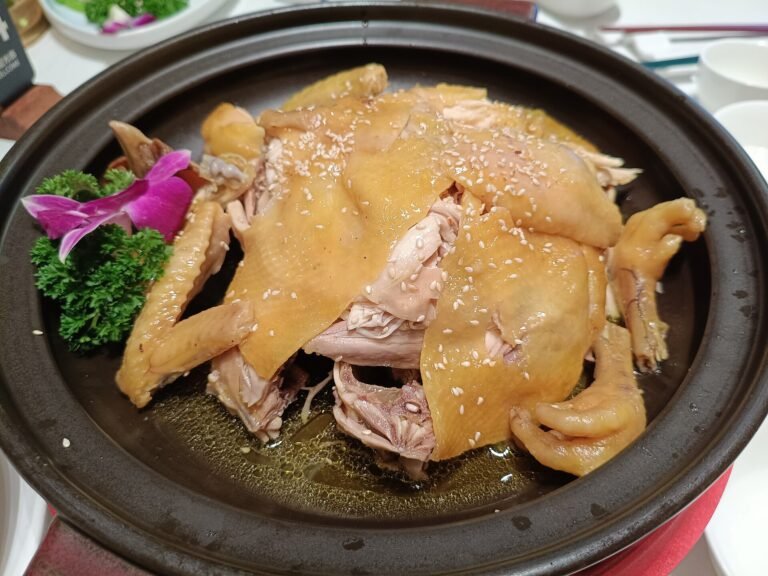
The real prize, though, is the ancient villages an hour away. Hongcun and Xidi are UNESCO-listed settlements of whitewashed Huizhou merchant houses with black tile roofs and reflecting ponds, and they are also places where families cook for guests in their own courtyards. The food is simpler than the restaurant versions and better: free-range chicken stewed with nothing but ginger and salt, river fish, a plate of cured pork with dried bamboo shoots, greens from the garden, and rice cooked in a wood-fired pot with a crust on the bottom.
The contrast with the polished, knife-work-driven cooking of the neighbouring Yangtze delta cities — the tradition described in the Huaiyang cooking guide — is stark: one cuisine was built by merchants showing off, the other by farmers surviving winter. Booking one of these meals is the single best food decision available on a Huangshan trip. Ask at your guesthouse the night before — they will usually arrange it with a family they know, at a fixed price per person, and you will eat food that no restaurant in Tangkou can reproduce.
Why does Huizhou cooking use so much cured and dried food?
Because Huizhou was a mountainous, land-poor region whose merchants travelled for months at a time, and salt-curing and air-drying were the only ways to keep food edible on the road. The classic pantry — cured pork, dried bamboo shoots, salted black beans, preserved vegetables — developed as portable rations, not as flavour experiments. In the dish larou (腊肉) the pork is wind-dried through the cold winter rather than smoked heavily, which gives a cleaner, less fatty cure than northern bacon. Dried bamboo, rehydrated and braised with that pork, is the provincial signature and turns up in nearly every feast meal. The honest trade-off is texture: dried bamboo is chewy and faintly sweet where fresh shoots are crisp, and it needs a long braise — at least forty minutes — to soften. Buy the pale, neatly sliced packs from a reputable shop rather than the dark, oily ones tourists are sold.
Cured Pork and Dried Bamboo
Huizhou cured pork is different from the smoked hams of the west in a specific way: it is salted and wind-dried rather than heavily smoked, so the fat goes translucent and sweet rather than smoky, and the meat stays a deep red rather than turning dark. Sliced thin and steamed with dried bamboo shoots, it is the region’s definitive home dish, and the pairing is not accidental — the dried bamboo soaks up the rendering fat and becomes the best thing on the plate.
Bamboo shoots are the other regional obsession, and they come in a confusing variety: winter shoots, spring shoots, dried, pickled, and the tiny tender tips that are genuinely a delicacy. A dish of cured pork with spring bamboo is the taste of Anhui in a way that no banquet dish manages, and if you see it on a menu in March or April you should order it immediately.
The Snack: Huangshan Shaobing
Sold from drum ovens on street corners and at every service stop, Huangshan shaobing is a small flat pastry stuffed with cured pork and preserved vegetable, slapped onto the inside wall of a clay oven to bake, and eaten hot. It is the correct hiking food — salty, portable, keeps for a day, costs almost nothing — and buying six of them in Tangkou before you start climbing is the smartest thing you can do with two minutes and a few yuan.
The filling is the same cured-pork-and-pickle combination that runs through the whole cuisine, which tells you something about how coherent Huizhou cooking is. This is not a region with dozens of unrelated dishes; it is a region with a few ingredients — salt pork, bamboo, tofu, river fish — worked through dozens of variations because there was never much else.
What local tea should I bring home from Huangshan?
Bring Huangshan maofeng, the loose green tea grown on the mountain’s cloudy lower slopes, which is the one souvenir worth the luggage weight. The best grades are picked before the Qingming festival in early April, when the buds are small and the cup is sweet rather than bitter; buy those from a proper tea house in Tunxi and expect to pay 200 to 600 yuan per 100 grams for a good lot. Avoid the vacuum-sealed tins at the summit shops, which are the same leaf repackaged at triple the price. A simpler, cheaper local drink is the chrysanthemum and wolfberry infusion sold at base villages, served warm and faintly floral. The honest caveat: maofeng loses its character after a year, so check the harvest date and store it in the fridge. Drink it with water at 80°C, never boiling, or the buds scorch.
What to Drink
Anhui is a tea province and Huangshan produces two of China’s most famous teas: Maofeng, a green tea with a soft chestnut sweetness, and Taiping Houkui, a green tea with absurdly long flat leaves and a faint orchid aroma. Both are grown on the slopes you are climbing, and buying them at a village rather than at an airport shop is the difference between paying for tea and paying for packaging.
For alcohol, the local preference is a rice wine rather than the sorghum spirit of the north — a divide that runs through almost everything about how the two halves of the country cook, as the north-south split in Chinese food explains — and it is mild and slightly sweet. Beer is universally available. The one thing to avoid is drinking heavily at altitude before an early start — the combination of thin air, cold and a 4 a.m. alarm has ruined more sunrises than cloud cover has.
Practical Notes
The standard itinerary is a dawn start from Tangkou, the cable car up, the West Sea Canyon loop, an overnight on the summit, sunrise at Bright Summit or Beginning-to-Believe Peak, and a walk or cable car down the next morning. That plan means two dinners and one breakfast at the bottom, one dinner and one breakfast on top. Front-load the eating: a proper dinner in Tangkou the night before, a big breakfast before the cable car, and a celebratory meal in a village on the way out.
Anhui is one of the eight canonical regional traditions, though it is the least known of them outside China; the overview in the eight great cuisines explains why a mountain merchant culture ended up with a seat at that table. Cash is useful in the villages; cards work in Tangkou and at the hotels. Water is the thing to over-buy — the mountain sells it at summit prices and the stair sections are harder work than the distance suggests. And if you are travelling with someone who will not countenance fermented fish, every restaurant has a plain fried rice and a stir-fried green vegetable, and the mountain has instant noodles.
Frequently Asked Questions
Is the food on the mountain worth the price? It is expensive for a real reason — everything is carried up by porters. Carry your own snacks, book half-board if you stay overnight, and eat properly at the bottom.
What is stinky mandarin fish, really? A whole fish fermented under salt for several days, then braised. The smell is strong and the texture is firm and flaky. Think cheese rather than spoilage.
Is hairy tofu safe to eat? Yes. The white mould is a controlled fermentation, similar in principle to a bloomy-rind cheese, and it is pan-fried before serving.
Where is the best food near Huangshan? The ancient villages — Hongcun and Xidi — where families cook for guests. Arrange it through your guesthouse the night before.
Should I buy tea here? Yes, from a village or a Tangkou shop rather than an airport. Huangshan Maofeng and Taiping Houkui are both grown locally.

The Short Version
Huangshan is a mountain where you carry your lunch and a region where you eat extraordinarily well the rest of the time. Buy shaobing in Tangkou, fill your water bottles at the bottom, eat chouguiyu and hairy tofu without flinching, and arrange a courtyard meal in one of the old villages. The granite peaks and the sea of cloud are what you photograph; the plate of cured pork with spring bamboo is what you will still be talking about in a year.