Meizhou Food Guide: The Hakka Heartland in Eastern Guangdong
Reviewed 31 October 2026 by the China Food Way editorial team
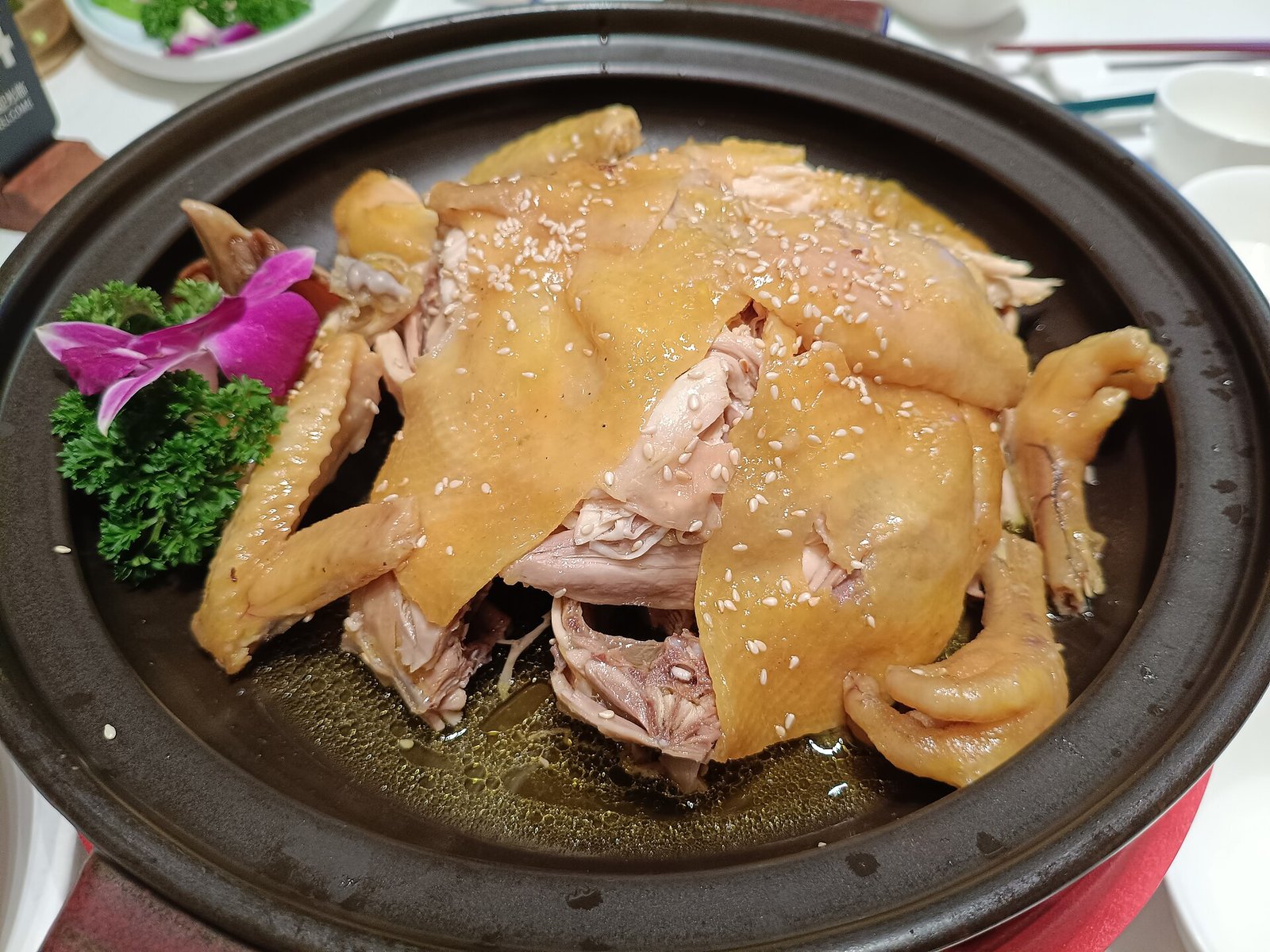
The waiter did not bring a plate. He brought what looked like a small grey brick, set it on the metal tray, and cracked it open with the back of a spoon; inside was a chicken, its skin pulled tight and pale gold, the whole thing smelling of salt and something faintly medicinal. It was a Sunday lunchtime in Meixian, the old county seat that is now a district of Meizhou, and the bird had cost ¥88. We ate it with our hands, because that is what everybody else in the room was doing, and I have been trying to reproduce that skin ever since without success.

Meizhou sits in the north-east corner of Guangdong, in hills that run up towards Fujian and Jiangxi, and it is the place that Chinese food writing calls the Hakka heartland. “Hakka” (客家, kejia, literally “guest families”) describes Han Chinese who moved south in successive waves from the Central Plains over roughly a thousand years and ended up on land other people already farmed — the poor hills, the marginal valleys, the places nobody wanted. The food follows from that: it is hill food, salt food, food built for carrying, and food that has changed less in three centuries than anything on the Guangzhou restaurant circuit.
Why are Hakka dishes built around preservation rather than freshness?
Hakka dishes lean on preservation because the migrants who created them farmed poor hill land and travelled, so food had to survive the journey and the lean months. Salt-baked chicken, stuffed tofu, pressed mustard greens, pounded tea and a portable grain each answer a constraint: meat spoils, so pack it in salt; there is no wheat, so stuff the local vegetable; there are no fresh greens, so salt and press them. The logic is practical, not decorative, and it shows in every plate on a Meizhou table. The honest point is that this was hill food for working people, not banquet cooking, which is why the seasoning is bold and the technique forgiving. A visitor expecting delicate Guangzhou flavours will read the salt as excess; it is really the whole design.
Five Dishes, Five Problems They Solved
What makes Meizhou worth the trip is that the signature dishes are not arbitrary. Each one is a solution to a constraint the migrants actually had, and read in that order the whole table starts to make sense.
| Problem | Solution | The dish |
|---|---|---|
| Meat spoils on a long walk | Pack it in salt, then cook it in salt | 盐焗鸡 (yánjú jī), salt-baked chicken |
| Wheat dumplings, but no wheat flour | Stuff the filling into what grows here | 酿豆腐 (niàng dòufu), stuffed tofu |
| No fresh greens for months | Salt and press them | 梅菜 (méi cài), preserved mustard greens |
| A meal has to be one pot | Pound everything together | 擂茶 (léi chá), pounded tea |
| Breakfast before hard labour | Cheap starch, strong flavour, fast | 腌面 (yān miàn), “marinated” noodles |
That is the whole Hakka logic in five rows, and you can eat your way through it in about thirty-six hours.
The Chicken, and the Story About It
The conventional explanation for salt-baked chicken goes like this: migrant families cooked chicken and packed it in salt to keep it edible on the road, and over generations the preserving technique turned into a cooking technique. It is plausible and hard to document, so treat it as a good story rather than a citation. What is certain is the method, and the method is unusual: the bird is rubbed inside and out with salt and a little spice, wrapped in oiled paper or cheesecloth, and buried in a wok or pan of hot coarse salt over dry heat for forty minutes or more with a lid on. There is no water, no steam, no browning. The salt is a seal and a heat reservoir rather than a seasoning, which is why the meat comes out seasoned and not remotely salty.
Two things matter if you are ordering it. Ask whether the bird is free-range (走地鸡), because a battery bird collapses into mush under dry heat; and eat it within ten minutes of it being cracked open, because the skin goes from taut to leathery fast. The same salt treatment is applied to prawns, quail eggs, pork belly and even whole fish, and every one of them is worth ordering if it is on the board.
How do you stuff tofu without it falling apart?
You stuff tofu by choosing a firm block, cutting it into squares, and scooping a small pocket from the top with a teaspoon before packing in the pork-and-fish paste. The trick is to remove just enough flesh to hold the filling without thinning the walls, then simmer or braise gently so the parcel keeps its shape. Hakka cooks hollow out aubergine and chilli the same way, which is why the dish reads as a dumpling with the wrapper replaced by the vegetable itself. The honest catch is the paste: too wet and it weeps out during cooking, too dry and it crumbles. A practical note — buy the coarse pork-and-fish mix from a market stall rather than a supermarket tube; the texture is the difference between a springy bite and a pasty one.
Stuffed Tofu: A Dumpling With the Wrapper Replaced
酿豆腐 is the dish I would argue over. A block of firm tofu is cut into cubes or triangles, a cavity is scooped out with a spoon, the cavity is dusted with starch, and it is packed with a paste of minced pork — often with a little fish or salted fish in it — then pan-fried flat-side down until the filling side is browned, and finally braised briefly in a light sauce.
The story attached to it is the one I find most convincing: these were northerners who knew how to make dumplings and arrived in a place with no wheat flour, so they kept the filling and substituted the wrapper. Tofu is the obvious candidate — tofu in Chinese cooking is the ingredient that takes on whatever shape the cook needs, and here it takes on the shape of a dumpling skin. Whether or not the story is true, the technique has a giveaway in it: dusting the cavity before filling. Skip that step, as I did twice in my own kitchen, and the plug of pork slides straight out in the pan. It is a two-second step that separates a plate of stuffed tofu from a plate of tofu with pork next to it.
In Meizhou the filling goes into more than tofu. Aubergine, bitter melon, chilli, mushroom caps and sheets of dried tofu skin all get the treatment, and the mixed plate is one of the best-value things on any menu in the city — usually under ¥40, and filling enough for two people with rice.
What are preserved mustard greens, and how are they cooked in Meizhou?
Preserved mustard greens, called mei cai, are the salted and pressed leaves of a mustard green that keep for months without a fridge — the Hakka answer to a winter with no fresh vegetables. In Meizhou they are most famous steamed long and slow beneath a slab of pork belly, the dish mei cai kou rou, where the greens draw off the fat and turn dark, sweet and intensely savoury. The long steam is not optional; a quick cook leaves them tough and salty rather than silky. The honest trade is time against tenderness: the pork needs the same hour the greens do. A practical note — rinse the preserved leaves once if they taste too sharp, but not twice, or you wash away the very flavour the dish was built around. Serve it with plain rice to balance the salt.
Preserved Mustard Greens and the Long Steam
梅菜 (méi cài) is mustard green that has been salted, wilted, pressed and dried until it is nearly black, with a smell somewhere between a brine jar and a compost heap before you cook it, and a deep sweet-savoury flavour after. The classic use is 梅菜扣肉: pork belly parboiled, pricked, fried or seared, sliced thick, laid skin-down in a bowl over a layer of chopped mei cai, and steamed for anything from ninety minutes to three hours, then inverted onto a plate so the fat has run down into the greens.
This is the anchor of the region’s preserved-food habit, and it is the same instinct you find in Chinese preserved foods far up the coast — salt, air and time doing work that refrigeration later took over. What is specific to Meizhou is how much of the greens get eaten relative to the pork. In a good version you finish the greens first.
What goes into lei cha, and is it a drink or a meal?
Lei cha is a meal, not a drink: a gritty, savoury gruel made by pounding roasted rice, peanuts, sesame, herbs and sometimes tea leaf in a mortar, then loosening the powder with hot water into a bowl you eat with a spoon. Alongside it come small plates of cooked vegetables, beans and puffed rice to stir in. The honest description is medicine-adjacent — it was a field food for labourers needing something warming and fortifying, and it still tastes restorative rather than refreshing. The catch for newcomers is texture: it is deliberately coarse, more like wet polenta than a broth. A practical tip — add the puffed rice last and eat at once, because it turns to paste if it sits. Order it where Hakka families gather, not at a generic tea house.
Lei Cha: A Tea You Eat With a Spoon
I had assumed 擂茶 was a drink. It is not, quite. Tea leaves, roasted peanuts, sesame, ginger, sometimes rice, and a handful of herbs or greens go into a large glazed ceramic bowl with a thick serrated wooden pestle, and someone grinds them against the ridges of the bowl for a quarter of an hour until it is a coarse green paste. Boiling water is poured on, and the result is poured over rice and eaten from a bowl, with the solids going down with it.
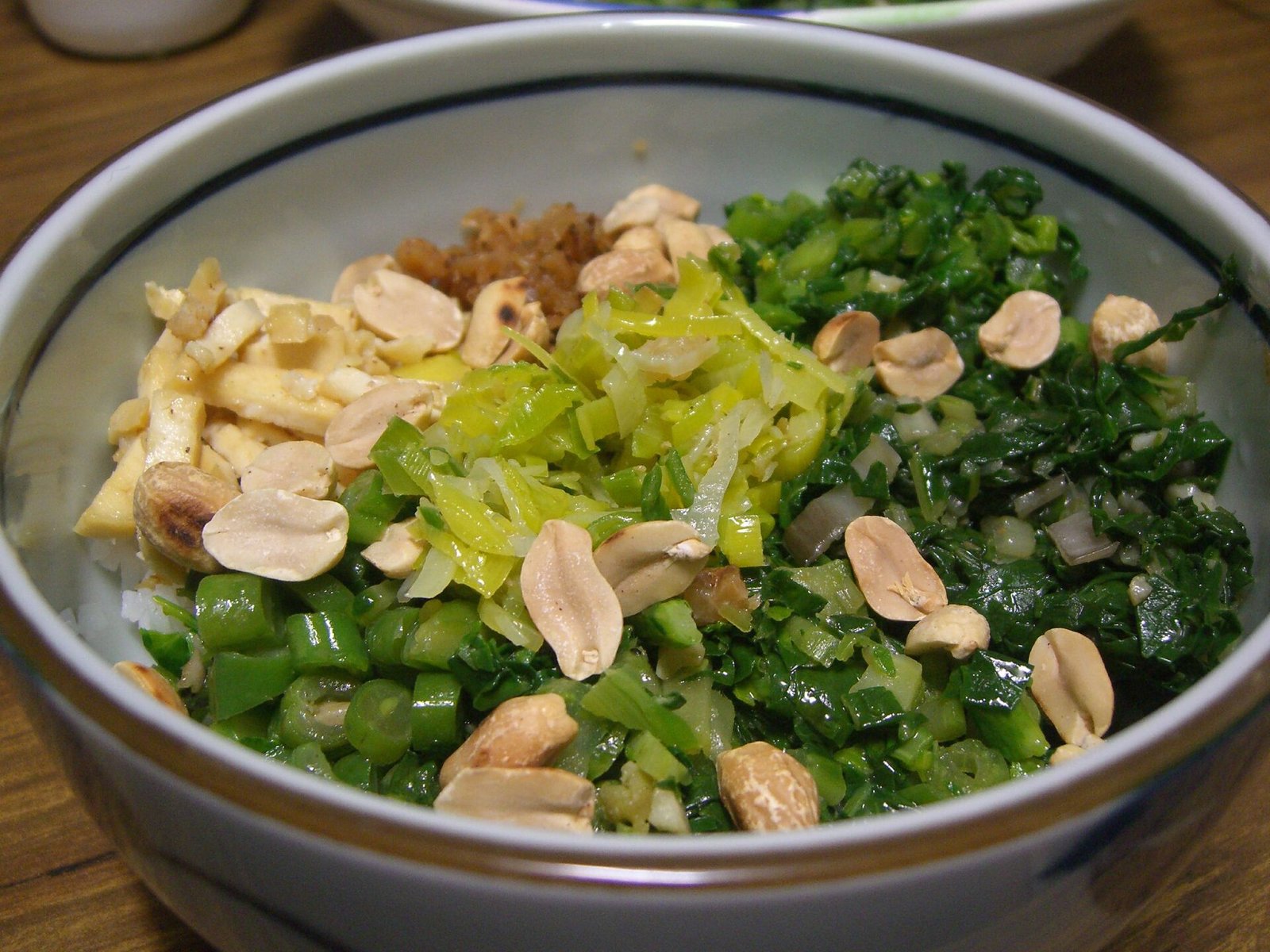
The bowl I was given came with puffed rice, chopped greens, peanuts and fried beans on the side to add yourself, and the woman who made it refused to let me help, which I now understand — the grinding is not a performance, it is the cooking, and hand it over too early and the paste stays gritty. In the hills around Meizhou some households make a version with thirty-odd ingredients, adjusted by season. It is filling, faintly bitter, and nothing at all like what a teahouse pours; the Chinese tea and food pairing habits most visitors arrive with have nothing to do with this.
Eating in Meizhou: Prices, Timing and the Rest of the Table
The Breakfast That Nobody Outside Guangdong Knows
If you only eat one Meizhou meal, make it the one locals eat. 腌面 — “marinated noodles” — is a bowl of thin wheat noodles tossed while hot with lard, minced garlic, soy and a little salt, thrown around in the bowl rather than plated, and eaten standing up at about seven in the morning for ¥8–12. Alongside it comes 三及第汤, a clear soup of lean pork, liver and intestine or chitterlings, seasoned with pepper and a handful of chopped coriander. It is a working breakfast: fast, salty, and finished in six minutes.
What Else Turns Up
The rest of the Meizhou table is worth a paragraph each. 娘酒 (niángjiǔ) is a dark, slightly sweet home-brewed rice wine, drunk warm and used in cooking — most notably in 黄酒鸡, chicken simmered in it and traditionally served to women recovering after childbirth. Glutinous rice cakes appear at every festival, some wrapped in bamboo leaves, some green with mugwort. The salted, dried, pressed habits of this kitchen sit at an angle to how north and south China differ: wheat memories carried into rice country, and a preference for salt that would startle a Guangzhou cook.
Meizhou is not on the high-speed line from Guangzhou in any convenient way; the sane route is the three-hour express coach or a flight into Meixian airport, and then a car. Two full days covers the city and one hill village; three if you want the tea-growing slopes above Fengshun.
| Dish | Best meal | What to pay |
|---|---|---|
| 腌面 + 三及第汤 | Breakfast, 6.30–8.30am | ¥10–15 |
| 盐焗鸡 | Lunch or dinner | ¥70–100 per bird |
| 酿豆腐 platter | Lunch | ¥30–45 |
| 梅菜扣肉 | Dinner with rice | ¥40–60 |
| 擂茶 | Late morning | ¥15–25 |
| 黄酒鸡 | Dinner, cold weather | ¥60–90 |
One useful piece of context: eastern Guangdong is not one kitchen. Ninety minutes east the language changes and so does the cooking — far lighter, broth-driven, seafood-forward, and described in Teochew cooking. The contrast is instructive. Hakka cuisine is the heavier, saltier, hill-country answer, and Meizhou is where it is least diluted.
Frequently Asked Questions
Is Meizhou worth the detour?
If you care about regional cooking, yes — a genuinely distinct kitchen, barely packaged for visitors. If you want nightlife and English menus, go to Guangzhou.
How salty is it, really?
Saltier than Cantonese food and much less sweet. The salt-baked chicken is the exception that surprises people: it is seasoned, not saline. Order one plain vegetable stir-fry per table to balance things.
What is 娘酒?
A dark, sweet-ish home-brewed rice wine, usually 12–20% and served warm, either in a bowl or cooked into chicken. It is not the same thing as commercially sold Shaoxing wine, which is clearer, saltier and made to a standard; niangjiu is brewed at home and tastes of it.
Can I eat here as a vegetarian?
With difficulty. Tofu and preserved greens are everywhere, but pork fat appears in rice cakes, greens and soups. Ask for 全素 (quán sù, “all-vegetarian”) and expect the kitchen to look uncertain.
Is the pounded tea caffeinated?
Yes — the leaf is ground and eaten rather than steeped and discarded, so it hits harder than tea. Do not order it after eight in the evening.
Where should I stay?
Meixian district, near the old streets, rather than the new town — the breakfast shops open around 6am within walking distance and that is where the day in Meizhou properly begins.
Why This Place Stays With Me
I have eaten versions of almost everything on this list in Guangzhou, Shenzhen and Hong Kong, and the versions here are plainer and better. Wikipedia’s overview of Hakka cooking gives the dish-by-dish inventory; what it cannot give you is the reason a bowl of noodles at seven in the morning tastes so resolved. That comes from three centuries of cooking for people who had to carry the food with them, and from a set of hills nobody else wanted to farm.