Lanzhou Beef Noodle Soup: The Real Recipe
Reviewed 31 October 2026 by the China Food Way editorial team
In a proper Lanzhou beef noodle shop, you do not study a menu. You stop at the window, and before you have paid anything, a voice asks the only question that matters: what width? 毛细, 二细, 韭叶, 大宽 — hair-thin, thick-thin, chive-leaf, extra-wide. The soup has already been decided for you; the only thing you get to choose is the shape of the noodles.
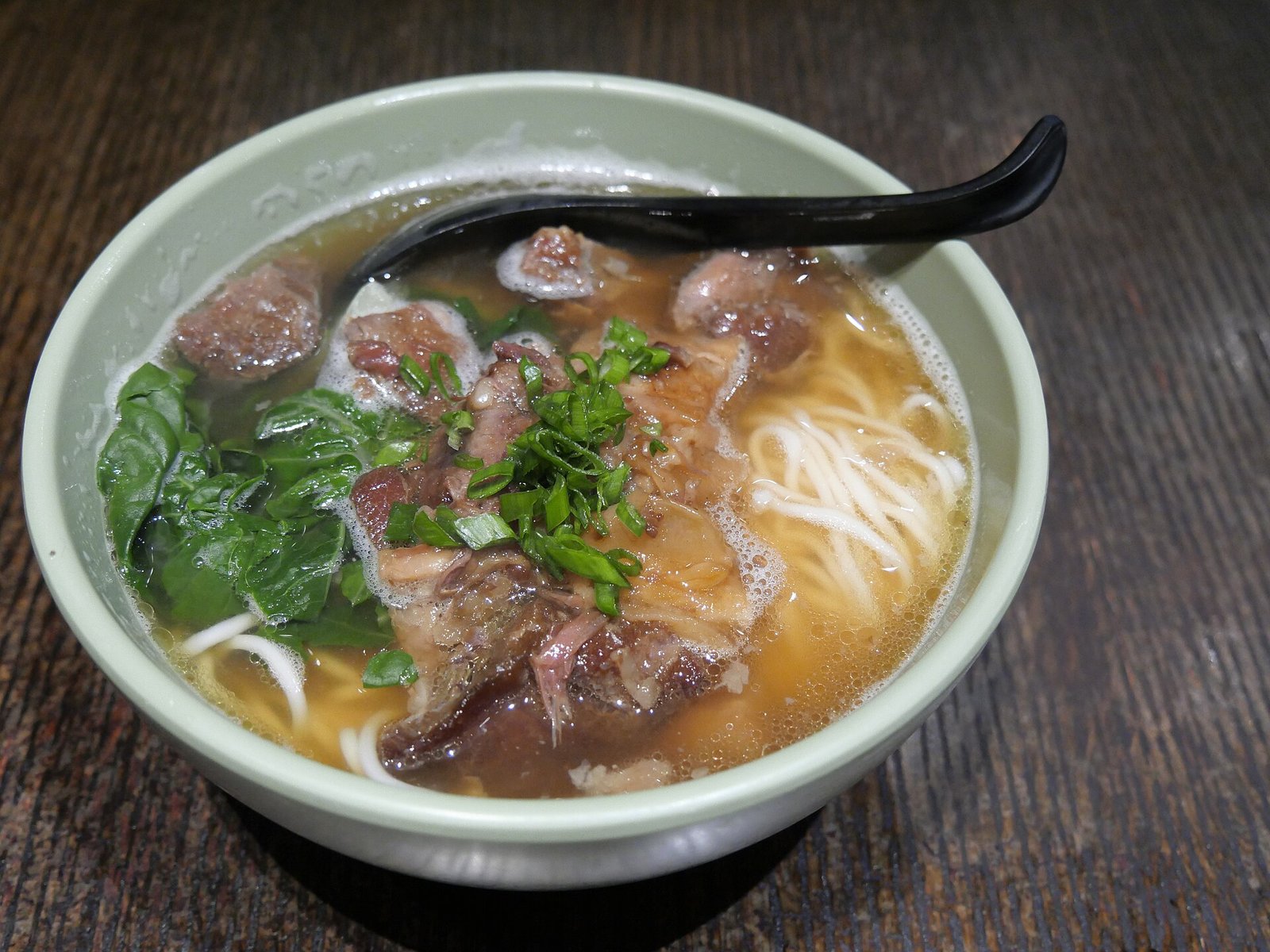
I learned this the slow way. My first bowl was ordered by pointing, which got me a bowl of 细面 that was fine, and a look from the queue behind me that was not. The second time, in a shop near the Yellow River where the noodle-puller worked behind a plate-glass window, I said 韭叶 and watched him stretch one dough log into a flat ribbon a metre long before my bowl hit the counter in under two minutes. That bowl — clear broth, translucent radish, a slick of red chilli oil — was a completely different dish from the one I had pointed at.
This guide takes the dish apart in the order a Lanzhou cook would: the five-character standard that judges the bowl, the soup that must never boil, and the noodle widths that most visitors order without understanding.
Is the five-character test an official grading system or a local saying?
It is a local judging convention, not an official grading system, though Lanzhou’s own food writers and a well-known encyclopaedia entry treat it as the standard. Read it as a checklist: one clear broth, two white radish, three red chilli oil, four green herbs, five yellow noodles, each a separate discipline. A bowl that fails any one of the five is, by that reckoning, not the real thing. Home cooks most often fail ‘four green’, throwing coriander and garlic sprouts in too early so they wilt and brown. My caveat: treat it as guidance rather than a pass mark, since every shop interprets the redness of the oil and the paleness of the radish a little differently.
The Five-Character Standard
The local judging system for this bowl is a five-word phrase: 一清、二白、三红、四绿、五黄 — one clear, two white, three red, four green, five yellow. Wikipedia’s overview of the dish records it as the standard the city’s own food writers use, and it is worth reading as a checklist rather than a slogan. Each character is a separate discipline, and a bowl that fails any one of them is not the real thing.
| Character | Means | The element | What goes wrong |
|---|---|---|---|
| 一清 (qīng) | One clear | The beef broth | Cloudy stock from a rolling boil; greasy film |
| 二白 (bái) | Two white | Radish slices | Undercooked radish stays opaque and hard |
| 三红 (sān hóng) | Three red | Chilli oil | Pale, dull oil — or so much it greys the soup |
| 四绿 (sì lǜ) | Four green | Garlic sprouts and coriander | Wilted, browned herbs thrown in too early |
| 五黄 (wǔ huáng) | Five yellow | The noodles | Overcooked, grey, slack noodles |
Read that table and the dish stops looking like a bowl of soup and starts looking like five separate problems that all arrive in the same bowl. The rest of this article is about solving them in order.
At what temperature should the broth sit if it must never boil?
Around 90 to 95 degrees Celsius, a bare shiver across the surface rather than a rolling boil. Holding the stock below boiling is what keeps it clear: a hard, turbulent boil emulsifies rendered fat and dissolved collagen into the liquid and turns it milky, the fault most home cooks hit. Keep the pot at a tremble, skim the grey foam in the first twenty minutes, and top up with boiling water from a kettle, never cold, which clouds the broth. Unlike the braised beef noodle soups found elsewhere, this one is never darkened with soy. The honest limitation is that a domestic hob struggles to hold that narrow band, so use a heat diffuser or the smallest ring.
The Soup: Clear, and Never Boiling
Everything starts with the broth, and the broth has one absolute rule: it must never reach a rolling boil. This is the detail home cooks get wrong, and I got it wrong myself the first time I tried to reconstruct the bowl in my own kitchen. I put the bones on high heat, walked away for twenty minutes, and came back to a pot that looked like a muddy river. It tasted fine. It was not the dish.
The physics is straightforward. Beef bones and connective tissue carry fat and dissolved proteins. Agitated at a full boil, the fat breaks into droplets that stay suspended instead of floating clear, and the proteins denature into a fine cloud that never settles. A simmer — 85 to 90 °C, a surface that barely shivers — lets the fat rise and be skimmed, and the stock clarifies itself. That is what 清 means: not “clear” as a flavour note, but clear as in you can see the bottom of the bowl.
A working home version:
- 1.5 kg beef bones (marrow and knuckle bones preferred), blanched in cold water for 5 minutes and rinsed
- 400 g beef shin or brisket, for the meat that goes on top
- 3 litres cold water
- 3 slices ginger, 1 scallion, 1 star anise, 2 bay leaves, a small piece of cinnamon bark, 4–5 slices of licorice root, and 1 teaspoon Sichuan peppercorn in a sachet
- Half a daikon radish, peeled and cut into 5 mm half-moon slices
Bring to a bare simmer — never a boil — and hold it there for 3 hours, skimming whenever fat collects. The whole spice list goes in for the last 45 minutes only; any longer and the spices talk over the beef. Add the radish in the final 30 minutes: it should come out translucent, still holding its shape, which is what 二白 is asking for. Salt at the end, and no soy sauce anywhere. The classic bowl seasons the soup with salt and spice alone, which is why it tastes lighter than most Western beef soups.
The Noodle Width Chart
Now the part you actually get to choose. A Lanzhou pull is one piece of dough, stretched and folded, stretched and folded — the number of folds decides the number of strands, and the final stretch decides the shape. The classic menu runs to eight or nine widths, and they are not interchangeable. Ordering the wrong one for your eating style is the most common visitor mistake.
| Width | Chinese | Shape | Best for |
|---|---|---|---|
| Hair-thin | 毛细 (máoxì) | Round, 1 mm | Thin soup lovers; soaks up broth fast |
| Thinner | 细面 (xìmiàn) | Round, 1.5 mm | First-timers; closest to spaghetti |
| Thin | 三细 (sānxì) | Round, 2 mm | The standard order; balanced chew |
| Thick-thin | 二细 (èrxì) | Round, 3 mm | Chewy eaters; my default |
| Thicker | 粗面 (cūmiàn) | Round, 4 mm | Very chewy; can feel doughy |
| Chive-leaf | 韭叶 (jiǔyè) | Flat, 1 cm wide | Holding chilli oil on the surface |
| Wide | 宽面 (kuānmiàn) | Flat, 2 cm wide | Slurping; soup pools in the ribbon |
| Extra-wide | 大宽 (dàkuān) | Flat, 3–4 cm | Belt noodles; the showiest pull |
| Buckwheat-prism | 荞麦棱 (qiáomàiléng) | Triangular | A novelty; angular, very chewy |
Two rules of thumb from eating my way through the list. First, round widths carry soup inside the noodle when you lift them, so they taste beefier; flat widths carry soup and chilli oil on the surface, so they taste brighter. Second, eat fast: 毛细 in a hot bowl has perhaps three minutes before it goes from slippery to sodden, while 大宽 survives a slower eater.
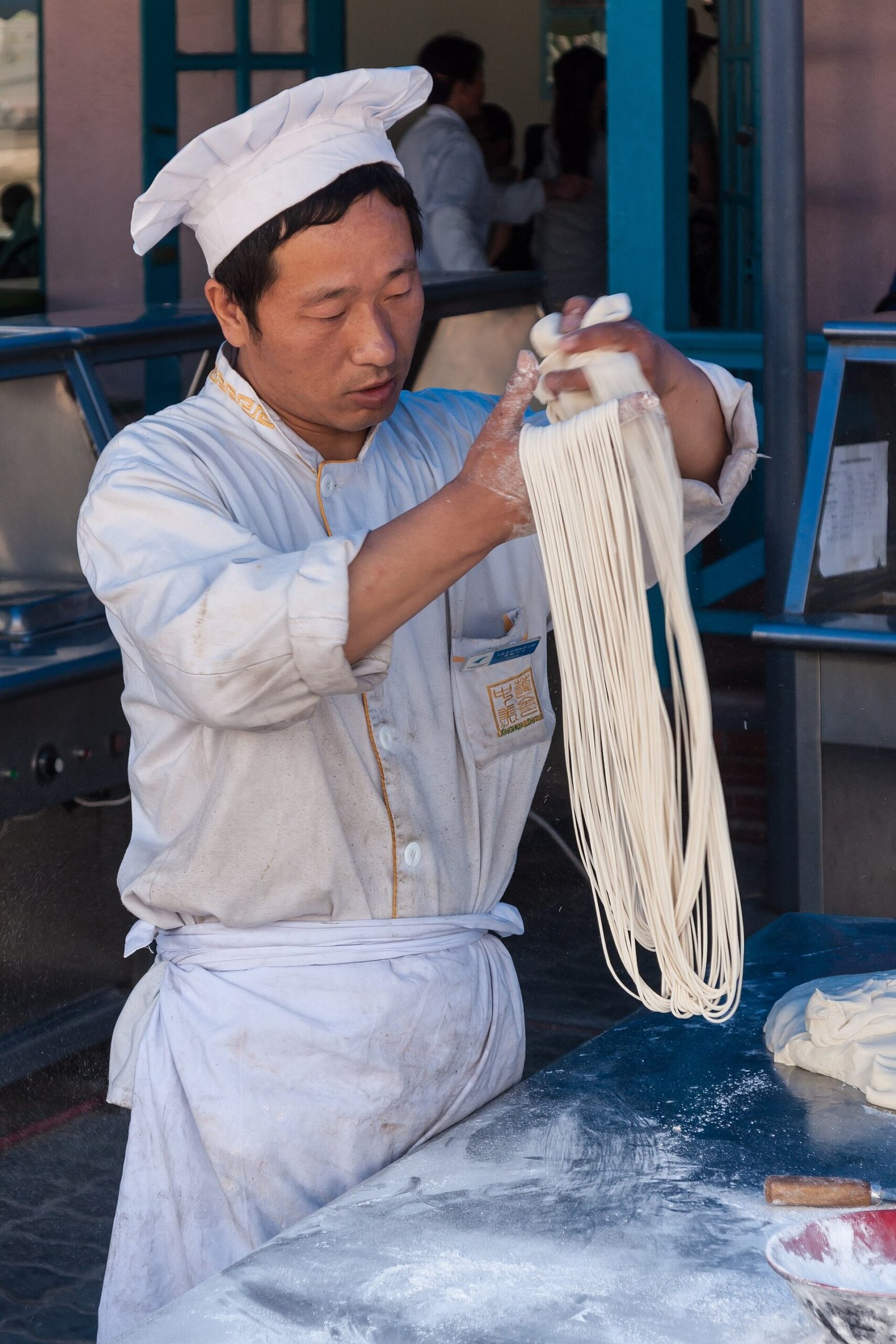
The dough behind all of these is flour, water, salt and — traditionally — a pinch of peng hui (蓬灰), an alkaline ash from the desert plant kang that gives the noodles their spring and slight yellow tint. At home, a quarter-teaspoon of baking soda per 500 g of flour does an honest job. Rest the dough, well oiled, for at least an hour; the pull is not strength so much as relaxation. If you have ever made scallion pancakes you already know the principle: a stiff, rested dough stretches where a fresh one snaps. The same family of hand-worked wheat dough runs right across the northwest — Shaanxi’s biang biang noodles are the belt-width cousin of 大宽, and the dough discipline is identical.
How much chilli oil should I add, and does the vinegar go in the bowl?
About a tablespoon of chilli oil, added at the table rather than cooked into the broth, and yes, a splash of vinegar goes in the bowl too. Use the clear red oil floating on top of the jar rather than the dense sediment at the bottom, which is gritty and turns the soup a muddy grey. The vinegar is there to cut the richness and sharpen the beef, so start with a teaspoon and adjust; too much flattens the broth. Add coriander and garlic sprouts last, off the heat, so they stay bright green. One caveat: a heavy hand with the oil is the fastest way to fail the ‘three red’ test, since it should stain the surface, not drown it.
Chilli Oil, Vinegar, and the Table
The red on top is not a chilli paste but an oil: coarsely ground Gansu chillies bloomed in hot rapeseed oil until the oil itself turns bright red. It is spooned on at the end, a tablespoon or two, and it should sit as a slick on the surface rather than being stirred into greyness.
Then the table, and this is where a bowl becomes yours. Every Lanzhou shop sets out three things: chilli oil, vinegar, and white pepper. The vinegar is usually a dark Shanxi-style black vinegar; a few dashes cut the beef fat the way black vinegar does in a northern kitchen. The white pepper is the local secret weapon — a small shake lifts the beef flavour without tasting of pepper. Go easy on both the first time; a good bowl is already seasoned.
How does a shop get a bowl out in under two minutes?
By splitting the work so nothing happens in sequence. The puller stretches a single pre-portioned dough log by hand and drops it straight into boiling water, where a thin width cooks in under a minute, while another hand ladles hot broth and lays radish, herbs and chilli oil into the bowl in parallel. You choose the width at the window before you pay, so there is no menu and no decision to slow the line. I once watched a cook turn one log into a metre-long flat ribbon and have the bowl on the counter inside two minutes. The caveat: that speed depends on a stockpot already at temperature, which a home kitchen can only mimic by preparing everything first.
The Counter Theatre, and the Hualong Question
Half the experience is watching the pull. The puller takes a rested, oiled dough log, slaps it flat, and works it into a loop that he folds and stretches repeatedly — each fold doubles the strands — before a final stretch that sends the noodles into the pot in one motion. From ticket to bowl is about ninety seconds, and in a good shop the window between kitchen and customer is deliberately open. The performance is part of the seasoning.
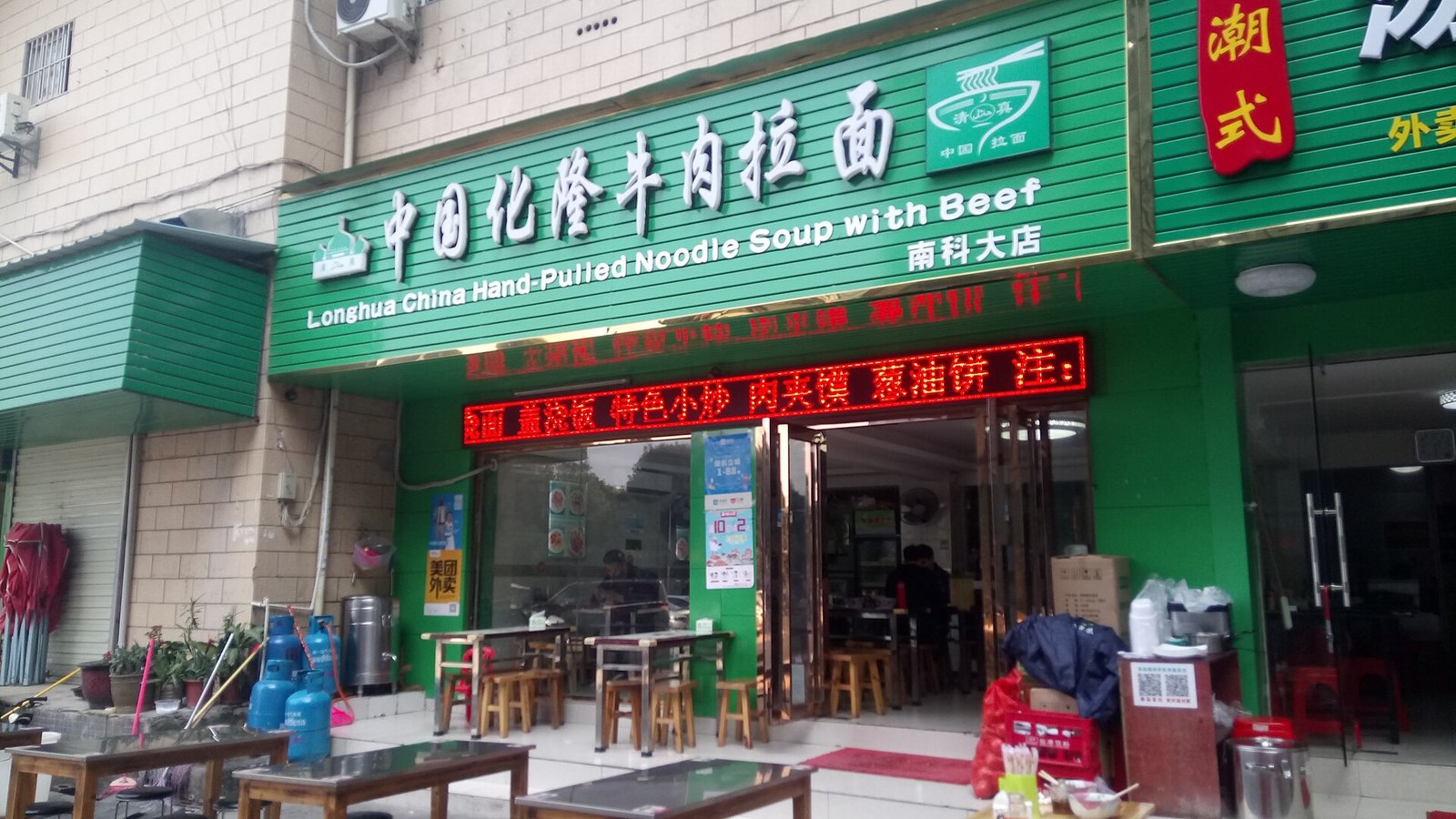
One footnote worth knowing before you travel: most of the “Lanzhou lamian” shops you will meet outside Gansu — the green-signboard chains in every Chinese city — are run by families from Hualong, a Hui county in neighbouring Qinghai, whose government subsidised locals to open shops nationwide from the 1980s onward. Their version is good, but locals insist the city’s own shops keep the clearer soup, and a morning spent comparing the two is a morning well spent. For what else the region cooks, the guide to Gansu cuisine and the Lanzhou food guide pick up where this bowl leaves off.
Frequently Asked Questions
Is Lanzhou beef noodle soup the same as pho or ramen?
No. It is a clear beef consomme with hand-pulled wheat noodles and no soy sauce — lighter than both, and built around the beef flavour rather than spice or broth aromatics. The nearest relative in a Western kitchen is a very clear consommé with noodles.
Why is my soup cloudy at home?
Almost always a rolling boil. Keep the surface at a bare simmer, skim the fat in the first hour, and never stir the pot once it is up to temperature. If it still clouds, blanch the bones first: a five-minute parboil in cold water, then rinse, removes most of the soluble proteins that cause the haze.
Can I make this without hand-pulling the noodles?
Yes, with compromises. Fresh thick udon or a dried 3 mm spaghetti is the closest shop-bought match for 二细; flat ribbons work for 韭叶. You lose the spring of an alkaline dough, but the soup carries most of the dish.
What is the best width for a first bowl?
三细 or 二细. They hold their texture longest and behave the same way whether you eat slowly or fast. Save 毛细 for when you have decided to eat quickly, and 大宽 for when you want the show.
Do I need the radish?
It is not optional in the classic bowl — 二白 is one of the five characters, and the radish also adds a gentle sweetness to the broth. Daikon is the same vegetable; if you cannot find Chinese radish, use that.
Is it really never made with soy sauce?
The classic Lanzhou bowl seasons with salt alone. Some shops add a splash of dark soy for colour, and the Hualong chains outside Gansu sometimes go further, but a truly clear bowl has nothing dark in it.
The Point
A bowl of Lanzhou beef noodle soup looks like the simplest thing on any Chinese menu — and it is five disciplines wearing one bowl: clear soup that never boiled, white radish cooked to translucency, red oil that stays red, herbs added at the last second, and noodles pulled to the width you asked for. Master the simmer and you have mastered most of it; the rest is practice at the counter, one width at a time. If chilli-oil noodle soups are your thing, the Sichuan approach to dan dan noodles takes the same idea in a fierier direction.