Lotus Root in Chinese Cooking: Crunchy and Beautiful
Last reviewed 31 October 2026 · China Food Way editorial team
The first time I cut a lotus root across its length, I put the knife down and simply looked. There, in perfect symmetry, were the holes: seven or nine of them arranged in a ring, like a wheel designed by someone who cared more about geometry than about food. I had eaten lotus root before, in a Chengdu restaurant, and remembered only the crunch. Seeing the architecture explained something — a vegetable that grows underwater and still arrives at the pan firm enough to snap has to be built differently from a carrot.
That crunch is the whole reason to buy it. Almost no other vegetable survives an hour of simmering and still has a bite; lotus root does it without trying.
I had my first proper lotus root dish years before I cooked one, in a Chengdu restaurant where it arrived as a cold salad — thin slices, blindingly white, dressed with vinegar and chilli oil — and I spent the meal trying to work out how something that raw-looking could crunch that hard. The answer was a three-minute blanch and a bowl of iced water, which is a very Chinese answer: the cooking is minimal, but it is precise.
When is lotus root in season in the UK?
Lotus root is in season from autumn into early winter, which is when Chinese and Asian grocers stock it freshest and cheapest. The rhizome is harvested as the ponds cool, so the best UK buying window runs roughly October through December, with imports filling the gap afterwards. Outside that window you will find it, but the segments are often older, drier at the cut face, and pricier per kilo. A practical note for shoppers here: buy it from an Asian supermarket rather than a mainstream one, where it is rarely stocked and never at a fair price. The honest catch is that a ‘fresh’ import can mean a fortnight in transit, so check the cut ends for wetness and a clean scent; a dry, dark end has already lost its crunch before you cook it.
What You Are Actually Buying
Lotus root is the rhizome of the lotus plant, Nelumbo nucifera, the sacred lotus of Asian art and cooking. It grows in the mud at the bottom of ponds, and those beautiful holes are air canals — aerenchyma, in the botanical term — that let the plant move oxygen between root and leaf while it sits underwater. You are buying plumbing. It is harvested from autumn into early winter, which is when the Chinese markets fill with it, tied in segments still caked in pond mud.
The distinction that matters at the market stall is seven-hole versus nine-hole, and it is worth learning because the two are not interchangeable:
| Seven-hole (七孔藕) | Nine-hole (九孔藕) | |
|---|---|---|
| Shape | Short, stout, almost barrel-like | Long, slim, tapered |
| Holes | Seven, larger | Nine or more, smaller |
| Texture | Starchy, tender, softens well | Crisp, snappy, stays firm |
| Best for | Soups, braises, stuffing with glutinous rice | Stir-fries, cold salads, quick pickles |
A stall holder will tell you this in one sentence if you ask, and will think you know something if you ask well.
Does the cooking method change how crunchy it stays?
Yes, the cooking method decides the crunch more than the variety does. Lotus root survives simmering that would collapse a carrot because its air-canal structure holds firm, but only if you respect the heat: a quick blanch of two to three minutes keeps it snappy, while a long braise softens it toward tenderness. The seven-hole type turns mealy in liquid; the nine-hole type stays crisp even after ten minutes of poaching. The honest rule is match the method to the hole count you can see. For stir-fries, cut thin and cook hot and fast so the slices stay audible. A practical catch — once sliced, the exposed surface oxidises within minutes, so drop pieces straight into acidulated water rather than leaving them on the board to grey.
Why It Stays Crunchy, and Why It Turns Black
The rhizome is starchy and fibrous rather than watery, and its cell structure holds together under heat that would reduce a courgette to rags. That is why a lotus root soup can simmer for ninety minutes and still have identifiable pieces in it, and why the same root stir-fried hard for three minutes is crisp rather than raw.
The other half of the story is the colour. Cut lotus root goes from pale cream to purple-black with remarkable speed, and the chemistry is simple: the flesh is full of polyphenols that oxidise on contact with air, and the compounds that form bind to iron — which is why a cast-iron pan or knife will blacken a cut root almost immediately. The fix is a five-minute soak in water with a splash of vinegar, which slows the enzymes down. I keep a bowl of vinegared water on the counter whenever I am prepping lotus, and I have never regretted the thirty seconds it costs.
Can I freeze lotus root, and does it keep its texture?
You can freeze lotus root, but only after blanching, and it will lose some of its raw snap. Whole or sliced, give it a two-minute blanch, cool it hard in iced water, dry it thoroughly, then seal out the air. Frozen this way it keeps for a couple of months and works well in soups and braises, where a softer bite is acceptable. The honest limit is texture: do not freeze it expecting the crisp salad crunch — that only comes from fresh root. For short storage, keep unpeeled segments in the fridge crisper wrapped in a damp cloth; they hold for about a week. A practical tip: peel only what you cook, because the skin shields the flesh from the air and slows the darkening that begins the moment you cut.
How to Pick, Prep and Store
Buy roots that feel heavy for their size, with sound joints and no dark, soft patches at the cut ends — those are where rot starts. The mud on the skin is not a problem; it is evidence of freshness. I once bought a cheap root that looked perfect and turned out woody all the way through, every slice threaded with fibre I had to chew around. Weight and firmness are the only reliable tests; the stall holder squeezing the root and hearing a dull thud rather than a hollow knock knows more than any label will tell you.
At home, wash rather than peel aggressively: a light scrape with the back of a knife removes the thin skin while keeping the shape intact, and the pinkish layer just underneath is where much of the colour lives.
Cut pieces go straight into the vinegared water. Once cut, the root keeps for two or three days in the fridge if submerged and refreshed; whole, unwashed roots wrapped in paper will last a week or two, which makes lotus root one of the more forgiving vegetables in a Chinese kitchen. It does not freeze well raw — the cell walls rupture and it turns mealy — so buy what you will use.
Which lotus root dish works best for a first try?
The best first dish is the cold vinegar salad: thin slices, a three-minute blanch, an ice-water shock, then dress with black vinegar, chilli oil and a little sugar. It is nearly impossible to ruin, shows off the crunch, and teaches you the blanch-and-shock rhythm that every other lotus recipe relies on. After that, move to a quick stir-fry with carrot and wood ear, or a braise stuffed with glutinous rice if you bought the stout seven-hole type. The honest order is ease first: the salad builds confidence, the stir-fry builds speed, and the stuffed braise is a weekend project. A practical note — taste the dressing before the slices go in, because lotus root is neutral and will only ever be as good as the vinegar and oil you pair it with.
The Three Ways I Actually Cook It
Stir-fried fast. Slice thin, heat the wok until it smokes, a little oil, maybe some wood ear and snow peas for contrast, and the lotus in for three to four minutes. Season with salt and a splash of Chinese black vinegar dashed down the side of the wok at the very end: the acid keeps the slices bright and adds a sour note that makes the sweetness of the root legible. This is the dish in the photograph above, and it is Tuesday food at its best.

In soup. Lotus root with pork ribs and ginger, simmered for an hour and a half, is a Cantonese home classic — the root softens without disintegrating, the broth turns faintly sweet, and the air canals fill with stock. I use 500 g of ribs parboiled and rinsed, two segments of root, and salt only at the end, because salting early keeps the flesh from softening properly. In Hubei, where the dish is practically a civic emblem, the ribs go in raw and the soup is served with a dish of black pepper at the table; both versions are right in their own kitchen. The same root can go into a red-braised dish for the last half hour, where it drinks up the sauce the way red-braised pork flavours anything it touches.
Cold and dressed. Blanch the slices for thirty seconds, plunge them into iced water, and dress with black vinegar, chilli oil, sesame oil and a little sugar. The iced shock is what makes the texture bounce, and the dressing is sharp enough to make the root’s own sweetness register. This is the salad from that Chengdu restaurant, and it takes ten minutes.
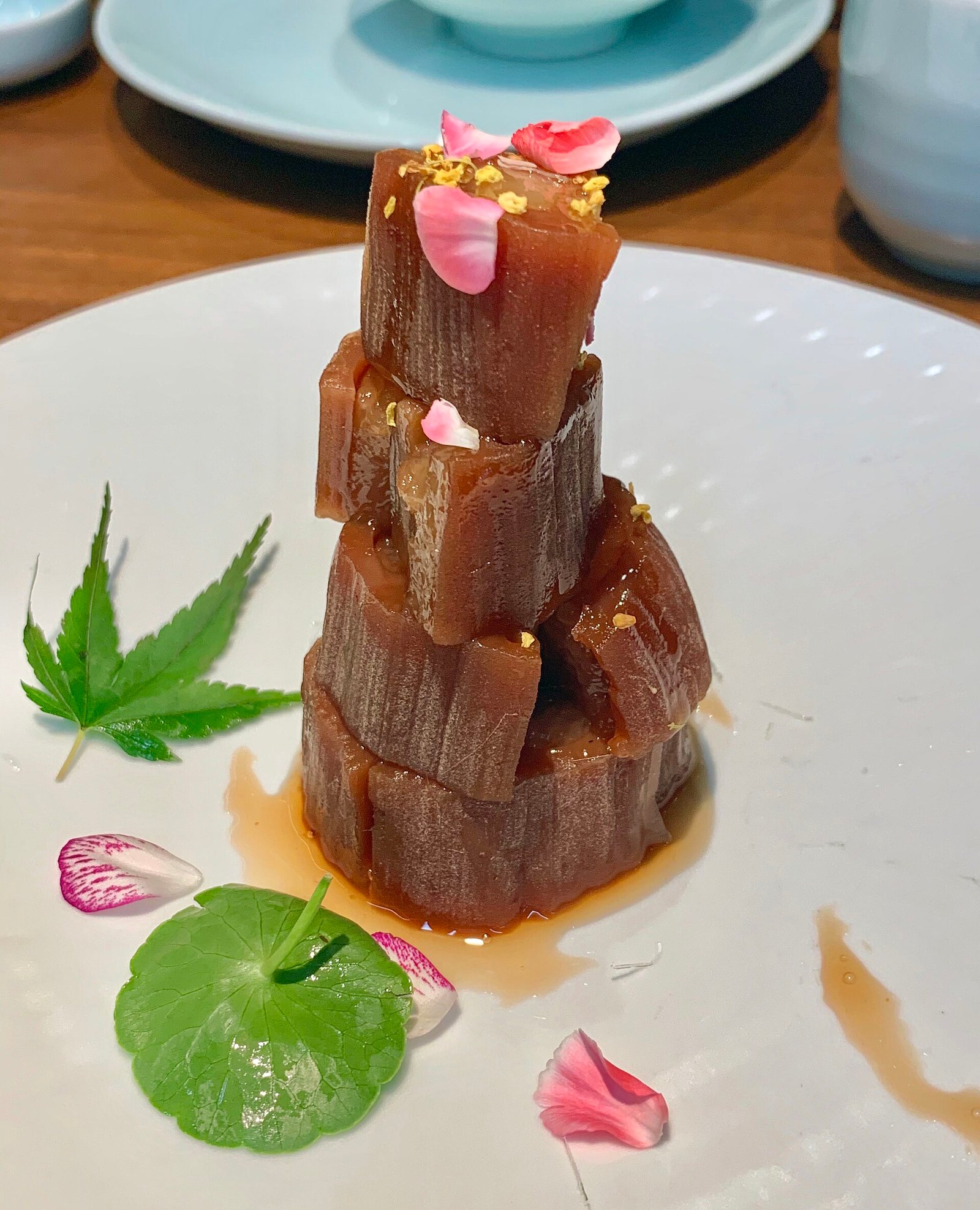
Sugar lotus root. The showpiece. Segments of the stouter seven-hole root have their holes stuffed with soaked glutinous rice — soaked four hours, packed in with the patience of a dentist — held in place with toothpicks, then braised for two hours or more in water and rock sugar until the syrup has reduced to a dark amber lacquer, with dried osmanthus flowers added at the end for a perfume that is half apricot, half honey. My first attempt failed because I under-soaked the rice: the grains swelled, split the root, and half of them floated off into a cloudy syrup. Sliced cold, the successful version gleams on the plate and the rice inside turns translucent. This is a Jiangnan dessert — a Suzhou tradition of slow sweetness — and it is the only lotus dish I make when I have an afternoon to spare.
One more use, less famous outside China: lotus root starch. The dried, ground starch (藕粉, ǒufěn) is cooked with hot water into a translucent, faintly grey jelly and eaten as a sweet soup with osmanthus and sugar. Jiangxi cuisine claims the most famous version, from Guangchang county, and it behaves nothing like cornstarch — a little goes a long way, and the gel it sets into is slippery rather than sticky.
Frequently Asked Questions
Why did my lotus root turn purple-black while I was prepping it?
Polyphenol oxidation, accelerated by iron. Soak the cut pieces in water with a splash of vinegar, and keep cast-iron pans and knives away from them.
Seven-hole or nine-hole — how do I choose without counting?
Look at the shape. Short and stout means starchy and soup-bound; long and slim means crisp and stir-fry-bound. If in doubt, ask the stall holder; it is a question they will enjoy answering.
How do I keep it crunchy in a stir-fry?
Cut evenly so the pieces cook at the same rate, keep the heat high, and take the pan off before you think you should — carryover heat finishes it. A splash of vinegar at the end sharpens the texture rather than softening it.
Can lotus root be eaten raw?
Yes, though raw root is starchy and faintly astringent from the tannins. Most recipes blanch it for thirty seconds first, which firms the surface and takes the edge off without cooking the crunch away.
Is lotus root starch a substitute for cornstarch?
Not one for one. Lotus root starch gelatinises differently — it needs less of it and sets to a smooth, almost glassy gel — so swap it in for dishes that want that texture, such as sweet soups, rather than for general thickening.
How should I store it?
Whole and unwashed, wrapped in paper in the fridge, for one to two weeks. Once cut, keep the pieces submerged in changed water and use them within a few days.
The Vegetable That Grows in Plumbing
I keep lotus root in the rotation because it behaves like no other vegetable on the shelf: architecture you can eat, a crunch that outlasts the cooking time, and a colour that politely turns black if you forget the vinegar. Buy a root in autumn, cut it into the vinegared water, and look down into the holes for a moment before you cook. It is the best argument in the market for the idea that vegetables were designed rather than merely grown.