Shandong Cuisine: The Northern Classic
Updated 31 October 2026 · reviewed by the China Food Way editorial team
The first Shandong meal I ate properly was in Jinan, in a banquet room with a lazy Susan and a host who kept filling my glass with a local liquor that tasted, charitably, of petrol. Course after course arrived: a fish in a sweet-and-sour sauce, a sea cucumber braised with scallions, a soup so clear it looked like tea, and a mound of shredded pork in a sauce I could not identify. It was only later, reading about the cuisine, that I understood what I had been shown. Shandong cooking is the oldest of the Chinese regional traditions — the root from which much of the rest grew — and what I had eaten was not novelty but ancestry. The clear soup in particular was a demonstration: that broth had taken a day to make, and it was the point of the entire meal.
Why is Shandong called the oldest Chinese cuisine?
Because its roots reach back more than two thousand years, to the state of Lu during the Spring and Autumn period, and Lu cuisine, lu cai (鲁菜), became the food of the imperial court once the North China Plain was China’s political centre. The Beijing kitchen that fed emperors was largely a refinement of Shandong technique, and the everyday food of northern China, the wheat noodles, steamed buns, vinegar and scallions, descends from that base. It is also the most technically conservative of the great traditions, resting on a small number of techniques done with extreme precision rather than on chilli or novelty, which is why the restaurants that do it well tend to be old, formal and quietly unphotogenic.
The Oldest Cuisine
Shandong cuisine — Lu cuisine, 鲁菜 — is generally considered the oldest of China’s classical traditions, with roots in the state of Lu during the Spring and Autumn period, more than two thousand years ago. Because the North China Plain was the political centre of China for most of its history, Shandong cooking became the food of the imperial court: the Beijing kitchen tradition that fed emperors was largely a refinement of Shandong techniques, and even today, the everyday food of northern China — wheat noodles, steamed buns, vinegar, scallions — descends from this base.
It is also the most technically conservative of the great traditions. Where Sichuan and Hunan use chili as architecture, Shandong uses salt, stock and fire. The cuisine’s fame rests on a small number of techniques executed with extreme precision, and the restaurants that do it well tend to be old, formal, and unphotogenic. It sits at the head of my overview of the eight great cuisines for a reason: historically, the list begins here.

What are the two stocks that define Shandong cooking?
A clear soup and a milky one, and the discipline of making both is the cuisine’s defining contribution. The clear version, qing tang (清汤), is clarified until it looks like tea and carries the pure taste of the bones and aromatics; the milky one is emulsified by long, hard boiling until it turns opaque and rich. Every serious Shandong kitchen keeps both on the go, because so much of the tradition is built on what the stock does rather than on what the wok does. A banquet is judged on the clarity of that clear soup more than on any single showpiece, and the patience it demands is the reason the cuisine respects the pot over the flame.
The Masters of Stock
Shandong’s defining contribution is its stock work. Every serious Shandong kitchen makes two stocks: 清汤 (qingtang, clear soup) and 奶汤 (naitang, milky soup). The clear stock is made by simmering chicken, duck and pork for hours, then repeatedly clarifying it with minced meat — a technique called 吊汤 — until it is transparent and intensely flavoured. The milky stock is boiled hard enough to emulsify the fat and collagen into a white liquid, used for richer dishes.
This stock obsession is why so many Shandong dishes taste deceptively simple: 葱烧海参 (sea cucumber braised with scallions) is sea cucumber and scallion in a master stock; the sea cucumber itself has almost no flavour. The dish is a vehicle for hours of work. The same logic applies to the cuisine’s famous sweet-and-sour carp, where the sauce matters more than the fish.
Which Shandong dishes should a first-timer recognise?
The ones that show technique rather than heat. A whole fish in sweet-and-sour sauce demonstrates the knife work and the vinegar glaze; sea cucumber braised with scallions shows the stock discipline and the local affection for alliums; and a soup so clear it looks like tea is the quiet centrepiece of a proper banquet. What unites them is restraint: Shandong uses salt, stock and fire where Sichuan uses chilli, and the fame rests on precision executed by old kitchens rather than on spectacle. The best entry dish is whatever lets the broth speak, because once you taste a well-made clear soup the rest of the cuisine starts to make sense.
Signature Dishes
| Dish | What it is | What it teaches |
|---|---|---|
| Tang cu li yu (糖醋鲤鱼) | Yellow River carp, scored and fried, in sweet-and-sour sauce | The sweet-sour balance that spread across China |
| Cong shao hai shen (葱烧海参) | Sea cucumber braised with Shandong scallions in master stock | Stock as the entire flavour base |
| Jiu zhuan da chang (九转大肠) | Pork intestines braised in a complex sweet-sour-spicy sauce | Offal, refined; the dish divides diners instantly |
| Dezhou pa ji (德州扒鸡) | Dezhou braised chicken, falling off the bone | Slow braising; a street food that became a classic |
| Si xi wan zi (四喜丸子) | Four large pork meatballs, braised | The northern love of meatballs, banquet-scale |
| Jia cai rou si (芥菜肉丝) | Shredded pork with pickled mustard greens | Everyday Shandong; salt and crunch |
The sweet-and-sour tradition that began here travelled south and evolved — it is the ancestor of the Cantonese sweet and sour pork that the world knows, which traded the carp for belly and sharpened the sauce into something brighter.
Scallions, the Local Signature
Zhangqiu scallions — 章丘大葱 — are a point of provincial pride: white, thick as a wrist, and sweet enough to eat raw. Shandong cooking uses them in quantity, both as an aromatic and as a vegetable in their own right. The cuisine’s 葱烧 technique — scallions fried until sweet and collapsed, then used to braise a neutral ingredient like sea cucumber — has no real equivalent elsewhere in China. If you visit in autumn, the scallion harvest is worth watching; the fields run for kilometres.
The other local obsession is vinegar. Shandong sits in China’s vinegar belt, and the local style — darker, maltier and less sharp than the Shanxi variety that most Westerners encounter — gets drizzled over noodles, used in dipping sauces for dumplings, and drunk in small glasses by old men who insist it is medicinal. Whether or not that is true, the combination of wheat, vinegar and scallion is the everyday flavour of northern China, and it all has roots on this plain.
The Wheat North
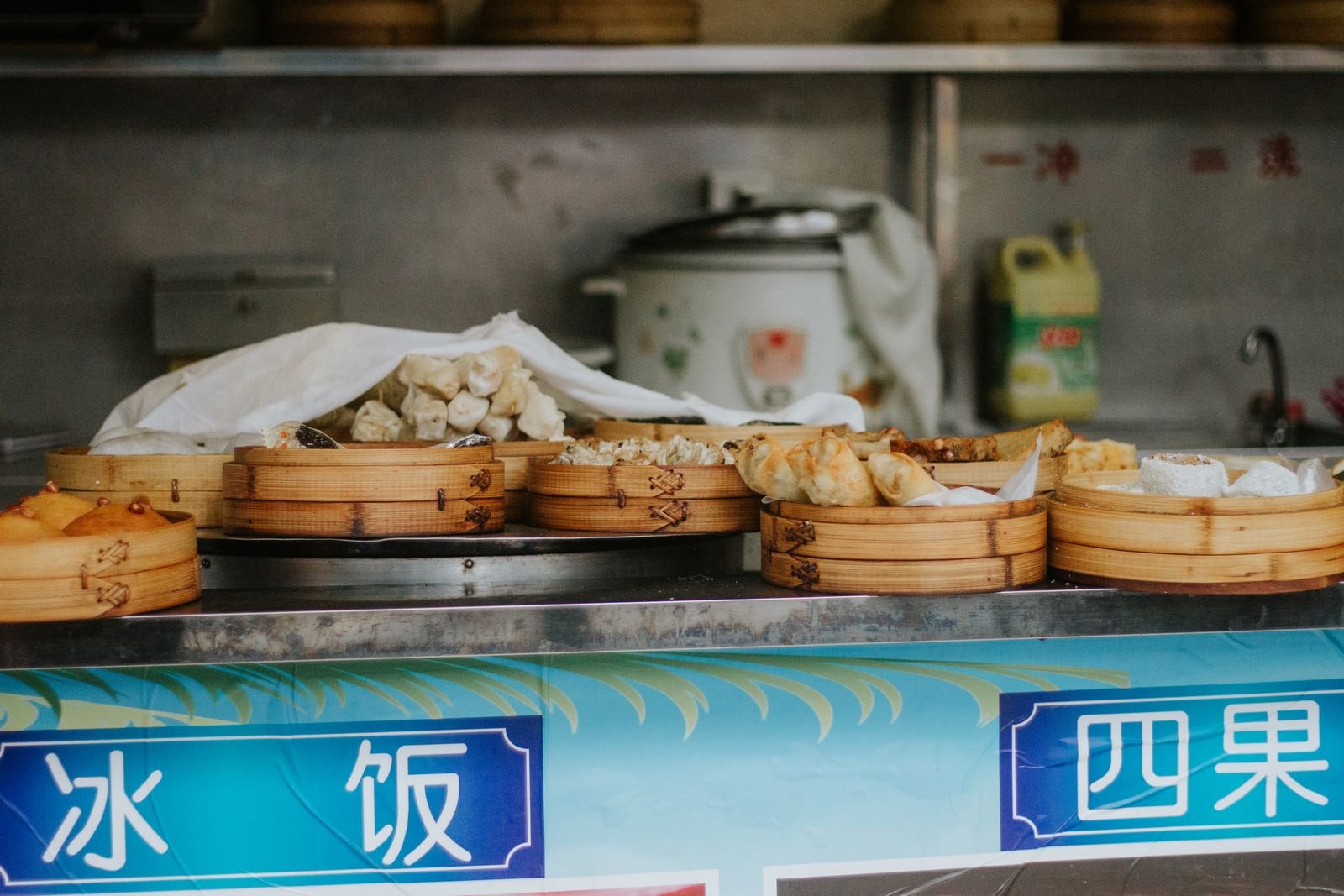
Shandong is also where China’s wheat culture is most visible. The province grows wheat on the same plain that grows its famous scallions, and the everyday food reflects it: 煎饼 (jianbing), the thin savoury crepe made from a batter of coarse grain flour, is the breakfast of the province and has since conquered the rest of the country in a sweeter, egg-filled form that would confuse a Jinan native. Steamed buns — 大包子, the size of a fist, filled with pork and cabbage or with shrimp — are the northern staple that my guide to making Chinese dumplings touches on from the jiaozi side: same dough tradition, different shape, same wheat-eating culture that defines the north of the country.
Then there is the vinegar. Shandong produces one of China’s great vinegars — darker and maltier than the Shanxi style that westerners usually encounter — and northern diners use it liberally, dipping dumplings and drizzling it over noodles. The combination of wheat, vinegar and scallion is the everyday flavour of northern China, and it all has roots on this plain.
What does modern Shandong food look like beyond the classics?
It splits between the coast and the street. The shoreline, from Qingdao to Yantai, leans on the seafood the province has always had, and a Yantai seafood guide will show the cold-water catches that define the northern table. Inland, the newer story is barbecue: skewers and flatbreads cooked over charcoal, the casual counterpoint to the formal banquet cooking that made the cuisine famous. The old technique has not gone anywhere, but the everyday eating is louder and quicker than the white-tablecloth version, and a visitor who only sees the banquet misses the half of Shandong that eats standing up with a skewer in one hand.
Shandong Today: Coast and Barbecue
The coastal half of the province — Qingdao, Yantai, Weihai — cooks a simpler food: steamed fish, razor clams, sea urchin, and the famous青岛啤酒 (Tsingtao beer) that the Germans left behind and the Chinese perfected. A plate of 辣炒蛤蜊 (chili-fried clams) with a bag of fresh beer is the Qingdao summer, and it is one of the great simple meals of China. The northern wheat tradition also survives intact: Jinan and the countryside eat 煎饼 (jianbing, the savoury crepe that became a national breakfast), hand-pulled noodles, and steamed buns the size of fists.
And then there is Zibo. In 2023 this unremarkable industrial city briefly became the most talked-about food destination in China on the strength of its barbecue — small charcoal grills, skewers rolled out on thin pancakes with scallions and sauce. It is not classical Shandong cuisine; it is a local street tradition that went national. Both exist, side by side, which is the most Shandong thing about it: the province is confident enough in its own history to let the new stuff happen without ceremony.
The honesty of the food matches the honesty of the portions. Nobody in Shandong is trying to trick you with architecture — the fish arrives whole, the meatballs arrive the size of your fist, and the bill is what it appears to be. After the refinement of the banquet tradition, this plainness is the cuisine’s other face, and arguably the one that has fed more people over its long history.
For the contrast, my Beijing food guide shows what happened when Shandong cooking met the imperial court, and my Cantonese cuisine guide shows the opposite pole — restraint of a different kind, at the other end of the country. Even the north’s wheat culture, which my guide to making Chinese dumplings covers, descends from this plain.
Frequently Asked Questions
Why is Shandong cuisine less famous abroad than Sichuan or Cantonese?
Largely emigration history. The Cantonese and Sichuan diasporas built the world’s Chinatowns; Shandong migrants went to Beijing, where the cuisine became part of the court tradition rather than an export. Also, Shandong food is subtle in a way that does not survive industrial cooking — its brilliance is in stocks that take a day to make.
Is it very salty?
More savoury than spicy, certainly. The saltiness is in the stocks and braises, and the cuisine balances it with vinegar at the table, the same way northern diners everywhere drink vinegar or dip dumplings in it.
What is the best entry dish for a first-timer?
Sweet-and-sour carp if you are at a proper restaurant, or Dezhou braised chicken, which is available everywhere and genuinely good. Avoid starting with nine-turn intestines unless you are certain.
Is Shandong food the same as “northern Chinese food”?
It is the ancestor of it. Beijing, Tianjin and the northeastern provinces all descend from Shandong techniques, adapted to local ingredients — which is why a Beijing banquet tastes like a Shandong banquet with better manners and more duck.
Shandong cuisine rewards the patient eater: it is quiet, technical, and built on stocks that cannot be rushed. If you would like to taste it where it was invented — from Jinan banquet rooms to Qingdao harbours — tell us what you would like to eat and we will build the trip.