Twice-Cooked Pork Recipe: Sichuan Classic
Last updated 31 October 2026 · checked by the China Food Way editorial team
The first time I ordered twice cooked pork in Chengdu, I was convinced the kitchen had made a mistake. The slices arrived curled into little cups, edges blistered and brown, sitting in red oil, and my honest reaction was that someone had cooked the pork far too hard. It took me a year of cooking it at home — badly at first, then adequately — to understand that the curl is the entire point, and that this is not a stir-fry. It is a two-stage piece of engineering in which the wok is the shortest, least important half. Once I accepted that, the dish went from a coin toss to the most reliable thing I cook from Sichuan.
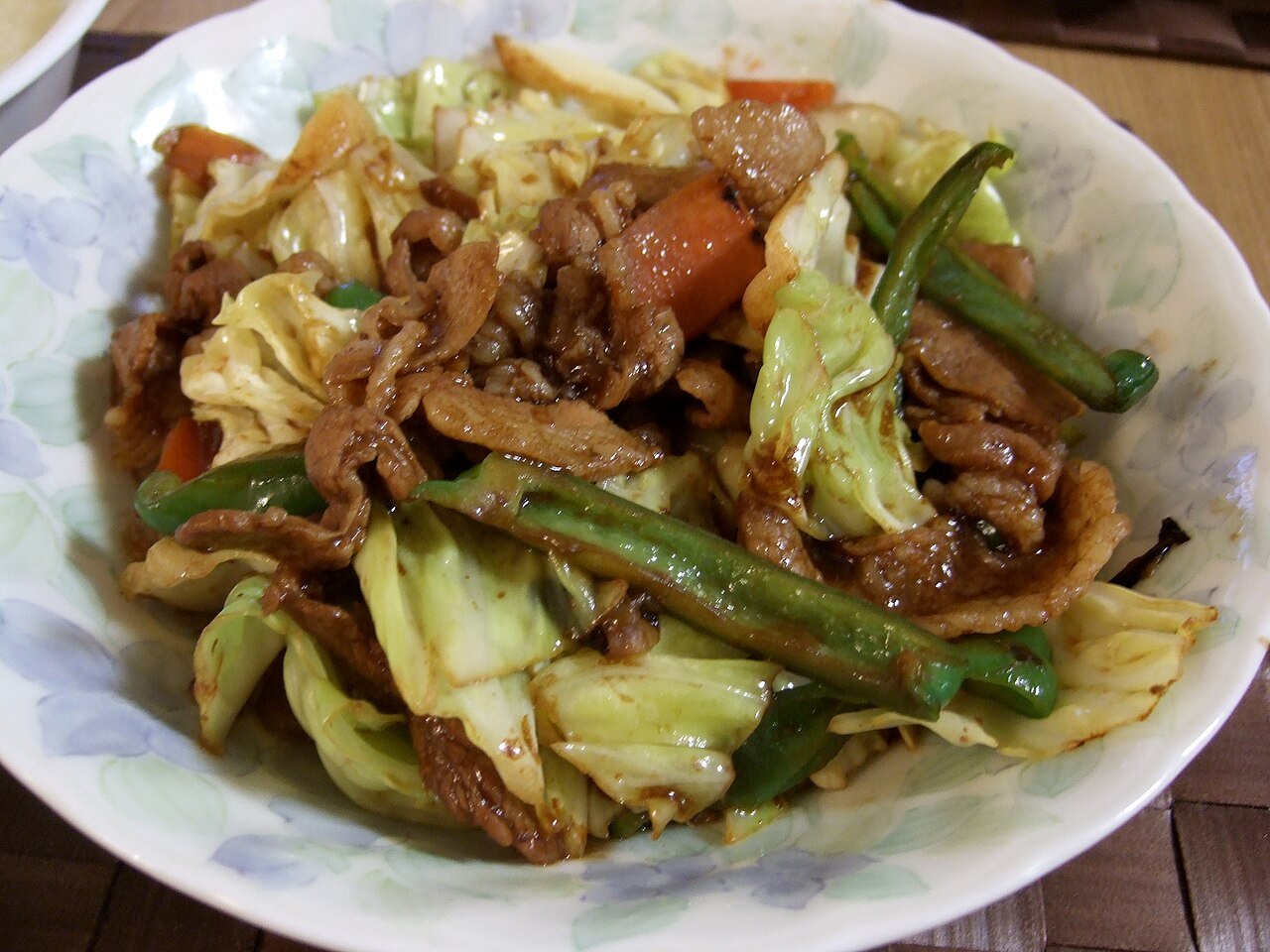
Almost every English-language version of this recipe gets the first stage wrong. It tells you to slice raw pork belly thin and throw it into a hot pan. What you get is either grey and rubbery — because the pan cools and the pork steams in its own moisture — or blackened at the edges with a cold, waxy layer of fat still inside. The traditional method solves both problems before the wok is ever switched on: you poach the pork whole, chill it, slice it paper-thin, and then fry it briefly in its own rendered fat. The boiling step is not a shortcut and it is not optional. It is the reason the dish works.
How long should the poached pork chill before I can slice it cleanly?
Give it at least two hours in the fridge, and ideally overnight, before the knife goes near it. Warm pork belly tears and squashes under the blade; chilled belly, firm from the rendered fat setting, slices at the two millimetres this dish needs without shredding. I poach the whole piece for about twenty minutes, let it cool in its own liquid, then chill it uncovered so the skin does not go slimy. If you are short on time, thirty minutes in the freezer works, but check it often, because a half-frozen block gives you ragged edges. One honest caveat: slice against the grain, or the curls split.
Why You Boil the Pork First
A piece of pork belly is roughly forty per cent fat, and most of that fat sits in a dense layer directly under the skin. Fat renders slowly. If you put raw slices in a wok, you have to choose between cooking them long enough to render the fat — by which point the lean meat is overcooked — or cooking them fast and leaving the fat as a chewy, opaque strip that no amount of sauce will rescue. Poaching does the rendering in advance, gently, in water, where nothing can burn.
It does four jobs at once. It renders and softens the subcutaneous fat so that a short fry later can take it from soft to crisp. It firms the meat enough to slice at two millimetres without the slice shredding apart. It seasons from the inside out, because the poaching liquid carries ginger, spring onion, Sichuan peppercorns and Shaoxing wine into the meat as it cooks. And it converts the collagen in the skin into gelatine, which is what allows the slice to bend into a curve rather than crack. Skip it and you are not making hui guo rou (回锅肉) — you are making fried pork with bean paste.
The practical payoff is wok time. Because the pork is already cooked, it needs ninety seconds to two minutes in the pan. That window is short enough that the doubanjiang never has time to scorch, and long enough for the slices to blister. Every home version I have eaten that tasted harsh and bitter was a version where the cook tried to do everything at once in one pan.
Choosing the Cut
You want a single piece of skin-on pork belly, about 500g, roughly four centimetres thick, with a fat cap of around one and a half centimetres. Ask the butcher for one piece rather than a pack of pre-sliced streaky rashers. Rashers are too thin: you will end up with slices of pure fat and slices of pure lean, and neither curls.
If belly is unavailable, a piece of pork shoulder with the rind left on is a decent second choice. It is leaner, so reduce the poaching time to eighteen minutes and accept that the dish will be slightly less unctuous. Avoid loin entirely — it has no fat architecture to speak of, and the finished dish will be dry no matter how much oil you add.
How much doubanjiang should go into a single plate?
About one tablespoon per portion of pork, and rarely more than two for a whole wok. doubanjiang (豆瓣酱) is roughly eighteen per cent salt, so the paste seasons the dish as much as it colours it, and the instinct to add a generous spoonful is what leaves home versions harsh and one-note. I start with a scant tablespoon for 300 grams of belly, fry it in the rendered fat for a full minute to cook off the raw fermented edge, and taste before adding a second. Fry the paste, never just stir it in: that minute is the difference between a flat, salty sauce and a rounded red one. Brands vary a lot in salt, so treat the number as a ceiling, not a target.
Ingredients
| Ingredient | Quantity | Notes |
|---|---|---|
| Skin-on pork belly, one piece | 500g | About 4cm thick; keep the rind |
| Water | 1.5 litres | Enough to cover by 2cm |
| Ginger | 4 slices, 3mm thick | For the poaching liquid |
| Spring onions | 2, cut into 5cm lengths | Whites in the pot, greens later |
| Sichuan peppercorns | 1 tsp whole, plus ¼ tsp ground to finish | Toast the ground portion yourself |
| Shaoxing wine | 2 tbsp for poaching, 1 tsp for the wok | Dry sherry works in a pinch |
| Garlic sprouts (suanmiao) | 200g | Substitute garlic chives or leek tops |
| Long green peppers | 2 medium | Cubanelle or mild Anaheim, not hot |
| Doubanjiang (fermented broad bean chilli paste) | 1½ tbsp, finely chopped | Pixian brand if you can find it |
| Tianmianjiang (sweet flour paste) | 2 tsp | Rounds out the salt; not optional |
| Light soy sauce | 1 tsp | Measured, not poured |
| Caster sugar | ½ tsp | Balances the fermented sourness |
| Neutral oil or lard | 1 tbsp | Lard is better; the dish is pork |
Method, Step by Step
1. Poach from cold. Put the belly in a saucepan with 1.5 litres of cold water, the ginger, the spring onion whites, 1 teaspoon of Sichuan peppercorns and 2 tablespoons of Shaoxing wine. Bring to the boil, skim the grey scum that rises, then drop to a bare simmer — around 90–95°C, so the surface barely trembles. Twenty-two minutes for a four-centimetre piece. The centre should reach 72–75°C.
2. Shock it. Transfer the pork straight into a bowl of iced water for five minutes. This stops the carryover cooking and firms the fat so it slices cleanly. I learned this the hard way: hot pork belly under a knife smears rather than slices.
3. Slice thin. Cut against the grain into slices two millimetres thick — thin enough that you can almost see through the lean. Every slice should carry lean, fat and skin. A slicing knife or a very sharp chef’s knife; a serrated blade will tear the rind.
4. Cut the vegetables. Slice the garlic sprouts on the bias into four-centimetre lengths, keeping the tender tops separate from the firmer bottoms. Cut the peppers into bite-sized pieces. Blister the peppers in a dry wok for thirty seconds first if you want the smoky edge restaurant versions have; it is worth the extra pan.
5. Render. Wok over medium heat with 1 tablespoon of oil or lard. Add the pork in a single layer and let it work for three to four minutes. The fat will run, the slices will begin to cup, and the edges will turn gold. Resist the urge to turn the heat to maximum — medium is what produces the curl instead of carbon.
6. Drain the excess. Once the slices have curled, tilt the wok and spoon out the rendered fat until roughly one tablespoon remains. This is the step that separates a crisp dish from a greasy one, and it is the reason the fat rendered during poaching matters: there is plenty to spare.
7. Fry the paste. Push the pork up the side of the wok, add the chopped doubanjiang to the hot fat, and stir for thirty to forty seconds until the oil turns a clear red and the raw, metallic smell turns toasty. Add the tianmianjiang, the teaspoon of wine, the soy sauce and the sugar, and stir everything together for another ten seconds.
8. Finish fast. Return the pork to the centre, raise the heat to high, add the garlic sprout bottoms and the peppers, and toss for forty-five seconds. Add the tender green tops, toss for fifteen seconds more, and take it off the heat. Finish with a quarter teaspoon of freshly ground Sichuan peppercorn. Serve immediately with plain rice.
Getting the Curl: The “Lamp Shade”
The shape has a name — deng zhan wo (灯盏窝), the little cup that held the oil in an old lamp — and it is the mark of a cook who got the technique right. The mechanics are simple once you see them: the lean and the fat layers shrink at different rates as they heat, and because the outer surface dries faster than the interior stays moist, the slice bends inward instead of staying flat.
Three things have to be true for that to happen. The slice must be thin, around two millimetres; at three millimetres or more it is too stiff to bend. The slice must contain all three layers, because the curl is produced by the differential between them. And the heat must be medium, not screaming — a wok surface of roughly 160–180°C, where a slice sizzles steadily rather than snapping and popping. If you are unsure, listen: steady sizzle is right, crackling fury is too hot.
The other half of the equation is crowding. Five hundred grams of sliced belly is more surface area than it looks. If your wok is a thirty-centimetre home model, fry in two batches. Overcrowding drops the temperature, the pork releases liquid instead of rendering, and you get pale, flat, boiled-tasting slices — the exact failure the poaching step was supposed to prevent.
Does the dish need sugar, and what does it actually do?
Yes, a small amount, and its job is to round off the salt rather than sweeten the plate. A level teaspoon of sugar for a wok serving two is enough; the finished dish should read savoury, with the sugar sitting behind the chilli and vinegar like a shadow. I add it to the paste as it fries, so it dissolves and caramelises slightly against the hot fat, rather than stirring it in at the end where it stays grainy. Some Chengdu cooks use a spoonful of sweet bean paste instead, which does the same work with more body. The caveat: overshoot and you lose the clean, hot edge that makes the dish refreshing.
Balancing the Doubanjiang
Pixian doubanjiang is a salt bomb. It typically runs somewhere between twelve and eighteen per cent salt by weight, which means a tablespoon and a half — about twenty-five grams — carries three to four grams of salt into a dish that feeds three people. That is most of a day’s worth, before you have added anything else. My rule is uncompromising: no added salt, ever, and soy sauce measured in teaspoons rather than splashed from the bottle.
Salt is only half the problem. Raw doubanjiang tastes harsh, sour and faintly metallic. It needs fat and heat to become what it should be: deep, savoury, fruity. That is why step seven exists, and why the paste goes into hot fat alone rather than being stirred into the finished dish. Thirty to forty seconds is the window. Under twenty seconds and it still tastes raw; past a minute and the sugars in the paste begin to bitter.
Chop it, too. The paste sold in tubs contains whole fermented beans, and a whole bean in the pan stays raw at the centre no matter how long you fry it. Run your knife through it until it is a coarse pulp.
| Tasting problem | What it means | Fix, next time |
|---|---|---|
| Harsh, metallic edge | Paste was under-fried | Give it a full 40 seconds in fat alone |
| Bitter, scorched background | Paste fried too long or heat too high | Medium heat; add paste after lowering |
| Salt-sharp, no depth | Too much paste, no sweetener | Add 1 tsp tianmianjiang and ½ tsp sugar |
| Flat, one-dimensional | No aromatic lift | Finish with ground Sichuan peppercorn off heat |
| Cloying, jammy | Too much sweet bean paste | Cut tianmianjiang to 1 tsp; add a splash more wine |
If you want to understand the paste properly rather than treat it as a red mystery ingredient, read our guide to Sichuan doubanjiang; the difference between a six-month paste and a three-year one changes how much you need by nearly half. The same paste is the backbone of a proper mapo tofu, where it is asked to do exactly the same job against a much milder backdrop.
Where the Dish Sits
Twice cooked pork is one of the plainest dishes in the Sichuan repertoire, and that plainness is deliberate. There is no stock, no cornflour slurry, no long braise. There is pork, a fermented paste, a green vegetable and heat. It is the dish Sichuan cooks use to judge each other, in the same way a French kitchen judges an omelette.
Order it in any neighbourhood restaurant in Chengdu and you will get a version with thinner slices and more oil than the one above, because restaurant woks run at temperatures a home burner cannot reach. What travels well from those kitchens is the seasoning logic, not the flame. A final dusting of freshly ground Sichuan pepper, added off the heat so the aroma survives, is what makes a home plate taste like it came from somewhere else.
Why did my pork turn grey and rubbery instead of curling?
Because the pan was not hot enough, so the slices steamed in their own moisture instead of frying. This is the single most common failure, and it happens when you crowd the wok or drop cold, wet pork into a film of oil that has not begun to shimmer. A domestic burner will hold maybe 150 grams of sliced belly in one layer; do two batches rather than one. Pat the slices dry first, get the rendered fat to the point where a scallion tip sizzles on contact, and leave the pieces alone for thirty seconds before tossing. Resist stirring, because every stir drops the temperature and brings you straight back to grey.
Mistakes and Fixes
- Slices stay flat: they were cut too thick, or the lean and fat separated because you used pre-sliced rashers. Buy one piece, chill it hard, and slice at 2mm.
- Blackened edges, raw-tasting centre: heat too high. Medium heat for the render, high only for the last minute.
- Greasy, heavy plate: you did not spoon off the rendered fat. You should be draining two to three tablespoons.
- Salt bomb: someone added salt. Doubanjiang plus soy sauce is already enough; season only by adjusting the paste next time.
- Tough, chewy pork: over-poached, or boiled hard rather than simmered. A rolling boil tightens the muscle fibres; 90–95°C does not.
- Soggy vegetables: garlic sprouts went in too early. Bottoms for 45 seconds, tender tops for the final 15.
- No aroma: the Sichuan pepper went in over the flame and burnt. Grind it fresh and add it off the heat.
Frequently Asked Questions
What does “twice cooked” actually refer to? The two cooking stages: the pork is poached whole first and then fried in slices. Not leftovers, and not reheated pork, though the dish almost certainly began as a way to use the boiled pork that every Sichuan household had sitting in the pot after a festival.
Can I use pork loin or shoulder instead of belly? Shoulder with the rind on, yes, with eighteen minutes of poaching. Loin, no — there is not enough fat to render, and the slices will neither curl nor stay moist.
What can I substitute for garlic sprouts? Garlic chives are closest. In a real pinch, use the green tops of leeks sliced thin and added at the very end. Do not use ordinary chives; they are too thin and collapse.
Is doubanjiang the same as chilli bean sauce or gochujang? No. It is fermented broad beans with chilli and salt, and it is much saltier and less sweet than gochujang. Substituting Korean paste will give you an entirely different, sweeter dish.
Can I make it ahead? The poach, yes — up to two days, which makes this an excellent dinner party dish. Slice and fry at the last minute. Fried leftovers reheat badly; the curl collapses and the fat goes greasy.
How spicy is it, really? Moderate. The heat in a well-made plate is rounded and savoury rather than aggressive, because the chilli is carried in fat. If you are cooking for children, cut the doubanjiang to one tablespoon and compensate with an extra teaspoon of sweet flour paste.
The Short Version
Poach a 500g piece of skin-on pork belly for twenty-two minutes at a bare simmer with ginger, spring onion, peppercorns and wine, chill it in iced water, and slice it two millimetres thick. Render those slices over medium heat for three to four minutes until they curl, drain off the fat until a tablespoon remains, then fry a tablespoon and a half of chopped doubanjiang in that fat for forty seconds before adding sweet flour paste, a teaspoon of soy, half a teaspoon of sugar and a splash of wine. Toss the pork back through, add garlic sprouts and green peppers for one minute, and finish off the heat with ground Sichuan pepper. No salt. Ever.