Luosifen: Liuzhou Snail Rice Noodles – Fen si noodles – Luo shi fen
Last updated 31 October 2026 · checked by the China Food Way editorial team
I opened my first vacuum-packed luosifen in a shared kitchen in Manchester and a flatmate came out of his room to ask whether something had died in the bin. I had read about the smell — everyone writes about the smell — so I was expecting something strong. What I was not expecting was how quickly it filled three rooms, or how it clung to my jumper for the rest of the day. The joke among Liuzhou people is that the noodles taste better than they smell, which is true but not the whole story: the person complaining has usually never eaten it, and within a year half of them are ordering it themselves.
The thing nobody tells you at the start: there is no snail in the bowl. The name 螺蛳粉 (luó sī fěn) refers to how the broth is made — from river snails simmered with pork bones and spices — and the bits you occasionally find are incidental fragments, not the point. The famously aggressive aroma comes from somewhere else entirely, and understanding that changes how you build the dish.
How long do the bamboo shoots ferment before they go in?
Luo shi fen
Luo shi fen deserves a closer look. Last updated 31 October 2026 · checked by the China Food Way editorial team In the sections below we cover what travelers and home cooks actually need to know.
Anywhere from ten days to several months in lightly salted water, and the length is what decides how aggressive the bowl will be. The bamboo is cut into strips and left to ferment, which produces the sulphur compounds people compare to old drains; a short ferment stays mild and crisp, a long one turns genuinely funky and sour. That same fermentation is why a proper bowl tastes alive rather than merely spicy. I learned to check the packet for a ferment time after one batch filled three rooms and clung to my jumper for the rest of the day. The honest caveat: you cannot judge strength by colour alone, and some of the strongest-smelling shoots taste surprisingly gentle once they hit hot broth.
The Smell Is Pickled Bamboo Shoots
Fen si noodles
Fen si noodles deserves a closer look. I opened my first vacuum-packed luosifen in a shared kitchen in Manchester and a flatmate came out of his room to ask whether something had died in the bin. I h In the sections below we cover what travelers and home cooks actually need to know.
The offending ingredient is 酸笋 (suān sǔn): bamboo shoots cut into strips and fermented in lightly salted water for anything from ten days to several months. The fermentation produces the sulphur compounds that remind people of drains, of old drains specifically, and it is also the reason a bowl of luosifen tastes sour, funky and alive rather than merely spicy. Take it out and you have a pleasant noodle soup nobody would write home about.
It is worth knowing what happens to bamboo when you pickle it, since dried and fresh bamboo shoots behave quite differently in a pan — the fragrance that gets concentrated in a Sichuan braise is the same family of aromatics that goes feral in a Liuzhou pickle jar. Unlike most preserved Chinese vegetables, good suān sǔn is pale and firm, not brown and mushy; it should still have some snap, and if the jar smells like nail polish remover rather than sour wood, it has gone too far.
There are two ways to buy it. Vacuum-packed sachets are mild — manufacturers tone them down for the mass market. Jars from a Chinese grocer, kept in the fridge, are considerably louder and considerably better. Rinse either briefly under cold water if you want to soften the edges, though purists would be appalled.
The Broth: Snails, Bones, And A Long Simmer
A restaurant version starts the previous afternoon. River snails (石螺, the small dark ones skimmed from Guangxi’s rivers and rice paddies) are soaked overnight in water with a little oil so they expel grit, then scrubbed and cracked slightly so their flavour escapes. They go into a stockpot with pork bones, sometimes a chicken carcass, ginger, garlic, star anise, cassia bark, liquorice root, tsaoko (草果), dried chilli, and often a small bag of more obscure aromatics like sand ginger (山奈). It simmers for four to six hours, sometimes overnight. The broth that comes out is brown, thin in body, deep in flavour, and tastes of river rather than of pork.
| Approach | Time | Depth | Realistic? |
|---|---|---|---|
| Snail and pork bone stock from scratch | 5–6 hours | Genuine | Weekend project, needs live snails |
| Pork bone stock + a jar of cooked snails | 2 hours | Good | The sensible home version |
| Concentrated luosifen soup base sachet | 5 minutes | Decent, salty | Weeknight reality |
| Vegetable stock + extra pickle brine | 30 minutes | Thin | Emergency only |
For a home bowl I take a middle path: 1 kg of pork neck bones simmered for two hours with the usual aromatics, plus a small tin or vacuum pack of cooked river snails (Chinese grocers stock them, and if not, the frozen ones used for the Vietnamese and Thai markets work) added for the last forty minutes. Then I add two spoonfuls of suān sǔn brine to sharpen it. It will not fool anyone from Liuzhou, but it tastes like the right dish.
Why are the noodles made from aged rice rather than fresh?
Old rice has lost moisture and much of its surface starch, so the strands stay firm and slightly chewy in a hot, sour broth instead of going slimy or breaking apart. Freshly harvested rice is too soft and sticky for this; it makes noodles that swell and disintegrate. The aged grain is ground, mixed with water into a slurry, and extruded into the round strands that give luosifen its bounce. I only understood this after a packet batch turned to mush because I boiled them like wheat noodles. Cook them until they float plus thirty seconds, then straight into the bowl. The caveat is that ‘fen si’ on some packets refers to mung bean glass noodles, which are a different thing entirely, so check the ingredient list.
The Noodles Are Made From Old Rice
Liuzhou rice noodles are thin, round and remarkably chewy, and the chew comes from a detail most people never think about: they are made from 陈米 (chén mǐ), rice that has been stored for at least a year. Aged rice has lost moisture and its starch has reorganised, which means the extruded noodle holds together through boiling and stays firm rather than going soft in a hot broth. Fresh-season rice makes a noodle that dissolves.
Dried is better here than fresh. Liuzhou packets contain dried rice noodles that need ten minutes in boiling water, sometimes after a cold soak; fresh rice noodles from a chiller cabinet will do but lack the bounce. Cook them in plenty of water, taste after eight minutes, and drain thoroughly — wet noodles dilute everything else in the bowl.
Ten Toppings, Added In A Fixed Order
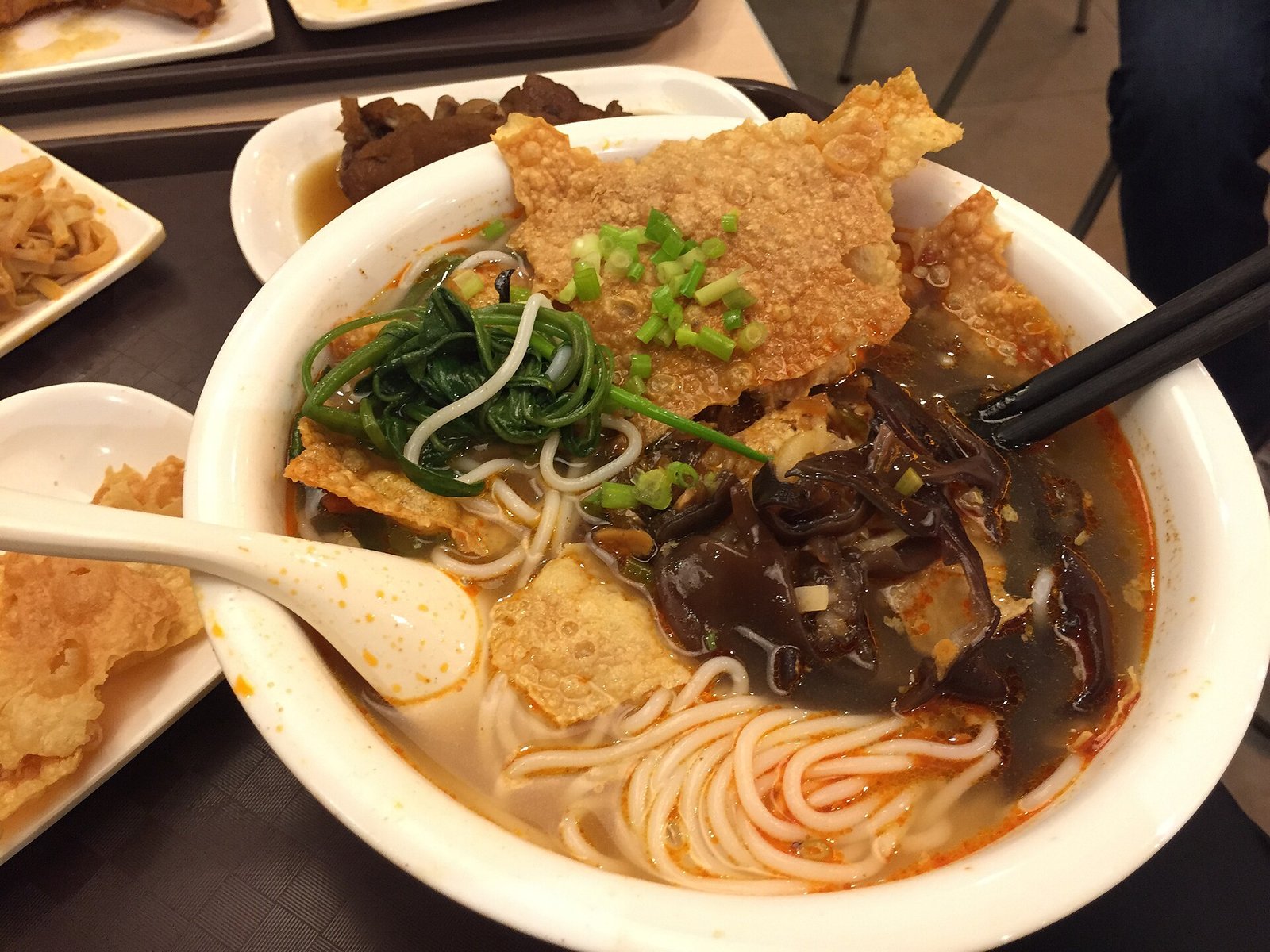
The assembly line in a Liuzhou shop is a point of local pride, and the sequence is not random: dry things first so they stay crisp, wet things next, oil last so it floats.
- Cooked noodles into the bowl, 200–250 g per person.
- Pickled bamboo shoots, a generous handful. This is the defining topping.
- Fried tofu skin (腐竹, fǔ zhú) — deep-fried sheets dropped into the broth to soften halfway. Ask for extra; shops will add more for a couple of yuan.
- Peanuts, fried and salted, and ideally still crisp.
- Wood ear mushrooms, shredded, for crunch rather than flavour.
- Pickled long beans (酸豆角, suān dòu jiǎo) — sour, snappy, cut into short lengths.
- Preserved mustard tuber (榨菜, zhà cài), finely chopped, for salt and a faint sweetness — the same pickle worth reading up on separately as the zha cai that northern kitchens use in entirely different dishes.
- Fresh greens — usually water spinach (空心菜), blanched for thirty seconds.
- Chilli oil, and this is the red layer on top: chilli powder scalded with very hot oil, sometimes in two or three batches, always abundant.
- Vinegar, offered at the table rather than added in the kitchen. Guangxi shops put out a local rice vinegar rather than the Zhenjiang pot, but if you already keep Chinese black vinegar in the cupboard, a teaspoon in the bowl does the same job of cutting the fat.
Some people finish it with chilli crisp as well as the chilli oil. Others consider that gilding. Both positions are held by adults.

Is a fresh Liuzhou bowl noticeably better than a packet?
A fresh bowl is livelier, but a good vacuum packet gets close enough that the gap is smaller than the smell would suggest. The broth in a packet is concentrated and often better than anything I can build at home in an evening, because the real version simmers river snails with pork bones for hours. What a packet loses is texture: the pickled bamboo shoot softens in storage, the peanuts lose their snap, and the greens are usually dried. I add fresh bean sprouts and a handful of roasted peanuts to close that gap. The honest caveat is that the flat I cooked my first packet in had the windows shut in January, and my partner banned the dish for a fortnight, so convenience comes with a ventilation cost.
Fresh Versus Packet: An Honest Comparison
Instant luosifen went from a regional curiosity to a national phenomenon with startling speed — by the early 2020s the bagged versions were being sold in the hundreds of millions across China, and the Liuzhou local government had registered the craft. Whether that counts as progress depends on what you want at 11pm.
| Packet version | Restaurant / scratch version | |
|---|---|---|
| Broth | Salty, MSG-forward, recognisably luosifen | Deep, thin-bodied, more sour than salty |
| Noodles | Dried; decent chew if you drain well | Superior bounce and flavour |
| Suān sǔn | Present but timid | The loudest thing in the bowl |
| Toppings | Five to seven small sachets, adequate | Dozens of options, added fresh and crisp |
| Price | Two or three pounds | Six to ten yuan in Liuzhou |
| Verdict | Excellent emergency dinner | The actual dish |
I always keep a packet in the cupboard. I also always double the pickled bamboo from my own jar and add extra peanuts, which closes about sixty per cent of the gap.
What order should I assemble the bowl in at home?
Noodles and broth first, then the pickled bamboo shoot and the heavier pickled vegetables, then the fried tofu, wood ear and peanuts, with leafy greens and spring onion last. The fixed order is not fussiness: hard, oily things go into the hot broth early so they soften and release flavour, while delicate greens and crisp peanuts would turn to sludge if they sat there. A tray of extras arrives with a street bowl precisely so the eater controls this. At home I lay everything out in that sequence before I boil the noodles, because once the broth is hot there is no time to start sorting. The caveat: chilli oil goes on at the table, to taste, since the broth itself is not what makes a bowl spicy.
Building One At Home, In Order
For two people, assuming you have made the broth:
- Bring 600 ml of broth to a rolling boil with a spoonful of suān sǔn brine in it. Taste and salt.
- Boil 250 g of dried Liuzhou rice noodles for eight to ten minutes, drain hard, divide between two deep bowls.
- Ladle the broth over — enough to come nearly to the top of the noodles.
- Arrange the toppings in islands rather than stirring them in: bamboo shoots, tofu skin, peanuts, wood ear, pickled beans, zha cai, greens.
- Finish with two tablespoons of chilli oil down the side of the bowl so it floats, and a scattering of chopped coriander if you like it.
Serve with vinegar and extra chilli on the table. The proper technique for eating it involves digging from the bottom with chopsticks and hoisting — it is intended to be eaten quickly, before the noodles surrender.
Frequently Asked Questions
Is there really snail meat in luosifen?
Rarely, and only as fragments. The snails flavour the broth. If a shop offers 螺肉 as an extra topping that is exactly what it sounds like, and it is usually excellent — pickled and spicy, eaten separately.
Can I make it without the smell?
You can reduce it substantially by rinsing the pickled bamboo shoots and using less brine, and it will still be recognisably luosifen. Removing the suān sǔn entirely produces a completely different and much duller bowl.
Is it meant to be sour?
Yes. The sourness comes from the fermented bamboo and sometimes added vinegar, and it is the structural opposite of the fat in the broth. A bowl without sourness is a bowl someone has made incorrectly.
How spicy is authentic luosifen?
The broth is red but the heat is moderate and builds slowly; Guangxi chillies are aromatic rather than numbing or brutal. Most shops let you specify your chilli level, and “微辣” is a perfectly respectable adult choice.
Where does it come from originally?
Liuzhou, in Guangxi. Regional rivalries being what they are, neighbouring Guilin will insist its rice noodles are the better and older tradition — see any Guilin eating guide — but Guilin’s are the milder, broth-and-beef cousin. Liuzhou’s got the national stage.
Why Anyone Outside Guangxi Cares
Luosifen solved a problem that most regional Chinese noodle dishes have not: it travels. The combination that makes it distinctive — sour bamboo, red oil, chewy old-rice noodles — is exactly the combination that survives being dehydrated and sealed in a bag, which is why a dish from a second-tier industrial city in southern China became a national obsession remarkably quickly. The details of that rise are worth reading for anyone who assumes the bagged packets and the city’s own version are the same thing. It also helps that it is cheap, and that admitting you like it has become slightly funny. Open one in a shared kitchen and see who complains. They will usually be back for the second bowl.
Frequently Asked Questions
What are Fen si noodles?
Our guide to Luosifen: Liuzhou Snail Rice Noodles covers this directly: I opened my first vacuum-packed luosifen in a shared kitchen in Manchester and a flatmate came out of his room to ask whether something had died in the bin. The sections above walk through the practical details.
Related reading
Glass Noodles (Fen Si): Mung Bean, Sweet Potato and the Clear Strand · Luosifen Recipe: River Snail Rice Noodles