Wood Ear Mushrooms: Crunchy Texture, Real History – Rock ear mushroom
Updated 31 October 2026 · reviewed by the China Food Way editorial team
The first time I ate wood ear mushroom, I thought something in my bowl was off. It was in a bowl of hot and sour soup in a canteen in Xi’an, and I had spent a year in China assuming that anything dark and ear-shaped in a soup was there to make the broth taste of something. I bit down expecting shiitake depth and got — nothing. Just a rubbery, cartilaginous crunch between my teeth, like a jellyfish that had wandered into the wrong bowl. I fished the rest of them out and left them on the rim of the bowl, which I now know is roughly the equivalent of removing the croutons from a salad because they do not taste like lettuce.
Why does wood ear mushroom taste of almost nothing?
Because it is a texture ingredient, not a flavour one. Wood ear — mu er (木耳), sold in the West as black fungus — is an Auricularia jelly fungus that grows on dead wood, and its taste is so faint most people cannot describe it; what it contributes is crunch, gloss, and the ability to hold sauce in its folds. Botanically it is the Chinese answer to water chestnuts: a bite that survives cooking, takes on the sauce around it, and gives a soft dish something to push back against. The dishes that use it best are built on contrast — silken tofu against rubbery ear in hot and sour soup, soft egg against snapping strips in a stir-fry, cold jelly against warm dressing in a summer salad. Accept that it will not taste of mushroom and it becomes easy to use.
The Mushroom That Refuses to Taste Like Anything
Rock ear mushroom
Rock ear mushroom deserves a closer look. Updated 31 October 2026 · reviewed by the China Food Way editorial team In the sections below we cover what travelers and home cooks actually need to know.
Wood ear — 木耳 (mù’ěr, literally “wood ear”), sold in the West as black fungus — is a texture ingredient. Its flavour is so faint that most people cannot describe it at all; what it contributes to a dish is crunch, gloss, and the ability to hold sauce in its folds. Botanically it is an Auricularia, a jelly fungus that grows on dead wood, and the species most often cultivated in China is Auricularia cornea, with its European cousin Auricularia auricula-judae supplying the older Latin name — “Judas’s ear”, from the legend that Judas hanged himself from an elder tree and these ear-shaped growths sprang from it.
That is the whole flavour story, and once you accept it the mushroom becomes easy to use. Think of it as the Chinese answer to water chestnuts: a crunch that survives cooking, takes on the sauce around it, and gives a soft dish something to push back against. The dishes that use it best are precisely the ones built on contrast — silken tofu against rubbery ear in hot and sour soup, soft egg against snapping strips in a stir-fry, cold jelly against warm dressing in a summer salad.
How long has wood ear been eaten in China?
For well over a thousand years, and the history is genuine rather than marketing. Wood ear has been gathered from fallen wood in China since long before records were kept, with cultivation documented back to the Tang dynasty, and it has stayed in continuous use because it is cheap, keeps indefinitely when dried, and does a job no other ingredient does. It travelled with Chinese migration across East and Southeast Asia, where it remains a staple of the cold dish and the soup alike. Unlike the showier mushrooms, it never became a delicacy or a status ingredient — it is the workhorse of texture, the thing you add so the soft things in the bowl have something to answer to. That humble, documented pedigree is exactly why it sits in every Chinese pantry and almost no Western one.
A Short, Real History
The history is genuine rather than marketing. Wood ear has been gathered from fallen wood in China for well over a thousand years, with cultivation records reaching back to the Tang dynasty, and it was almost certainly the first mushroom to be cultivated commercially anywhere in the world — earlier even than the shiitake, whose own documented cultivation is a thousand years old. For most of that history it was a foraged and farmed food of the poor, growing free on logs in the hills, which is part of why so little was written about it: nobody was composing poems about the crunch.
Traditional Chinese medicine adopted it early, prescribing it for complaints of the blood and circulation, and it is still sold in that spirit today. Those traditional claims are beliefs, not findings I can verify, and I would not eat wood ear expecting a medical result — but the reputation explains why it appears in so many restorative-sounding soups and slow-cooked dishes across the country. The culinary fact is simpler and older: it dehydrates to almost nothing, reconstitutes in an hour, and lasts a year in a cupboard, which made it the perfect winter vegetable in an age before refrigerated transport.
How do you rehydrate dried wood ear properly?
Soak it in warm water until it expands and softens, which takes twenty to thirty minutes for the typical dried slice, then trim the tough base where it grew on the tree and slice or tear to size. Dried wood ear is dramatically smaller than the reconstituted version — a handful of brittle slices balloons into a bowlful — so resist the urge to use much, and remember that a little goes a long way in a stir-fry or soup. Buy it in a sealed pack from an East Asian grocer rather than loose and dusty, and check that the pieces are whole and dark, not pale and broken. Once rehydrated it keeps a day or two in the fridge, but the crunch is best the day you soak it.
How to Buy and Rehydrate
Dried wood ear comes in three forms, and the form matters more than the brand:
| Form | What it is | Best for |
|---|---|---|
| Whole ears | Single dried mushrooms, 3–8 cm across | Stir-fries, salads — you control the size |
| Strips or pieces | Pre-cut, machine- or hand-torn | Soups and fillings where shape does not matter |
| Compressed cakes | Ears pressed into a 20 g wafer | Emergency pantry item; reconstitutes into a surprising amount |
Buy ears that are dark brown to blackish on the outside, brittle enough to snap, and free of grey mould at the base. Avoid anything that feels leathery or damp — damp is the enemy, and a bag that has sat in a humid shop will not keep.

To rehydrate, cover with room-temperature water and wait one to two hours; the ears swell to roughly five times their dried weight. Then trim off the hard, woody knot where the mushroom was attached to the log — that little base does not soften no matter how long you cook it, and finding it in a bowl of soup is like finding a stone in a rice pudding. The soaking water, unlike the shiitake water I once nearly poured away, is worth nothing: wood ear gives its crunch to the water and keeps its secrets to itself. Strain it, discard it, and treat the mushrooms as a blank canvas.
One safety rule, and it is not optional. Do not soak wood ear overnight, and do not eat it raw. There have been serious poisonings in China from fungus left soaking in warm water for many hours, because bacteria multiply on the soaked surface and can produce toxins that survive cooking. Soak for an hour or two, refrigerate if you must soak longer, cook the mushrooms before eating, and throw away anything that smells sour or slimy. The same rule applies to the compressed cakes, which are easy to forget in a bowl of water on the counter.
Which dishes benefit most from wood ear?
The ones built on contrast, where a soft element needs something to answer to. Hot and sour soup is the classic: silken tofu and egg against the rubbery, sauce-holding ear, each spoonful different from the last. Stir-fries with egg or soft vegetables gain a snapping strip that keeps the texture honest, and cold salads — wood ear dressed with chilli oil and vinegar — turn the crunch into the whole point. It also belongs in moo shu and in braised dishes where it stays resilient through a long cook. The rule is simple: reach for wood ear whenever a dish risks being uniformly soft, and let it be the bite that pushes back. Used that way, its lack of flavour stops being a problem and becomes the reason to add it.
Where the Crunch Belongs
The classic uses, in rough order of how often I cook them:
- Hot and sour soup — the canonical pairing. Wood ear supplies the crunch against silken tofu, bamboo shoots, and egg ribbons in what is probably the most texturally interesting soup in the Chinese canon. The hot and sour soup method is the one to start from, and do not skip the vinegar at the end: the sourness is what makes you notice the crunch.
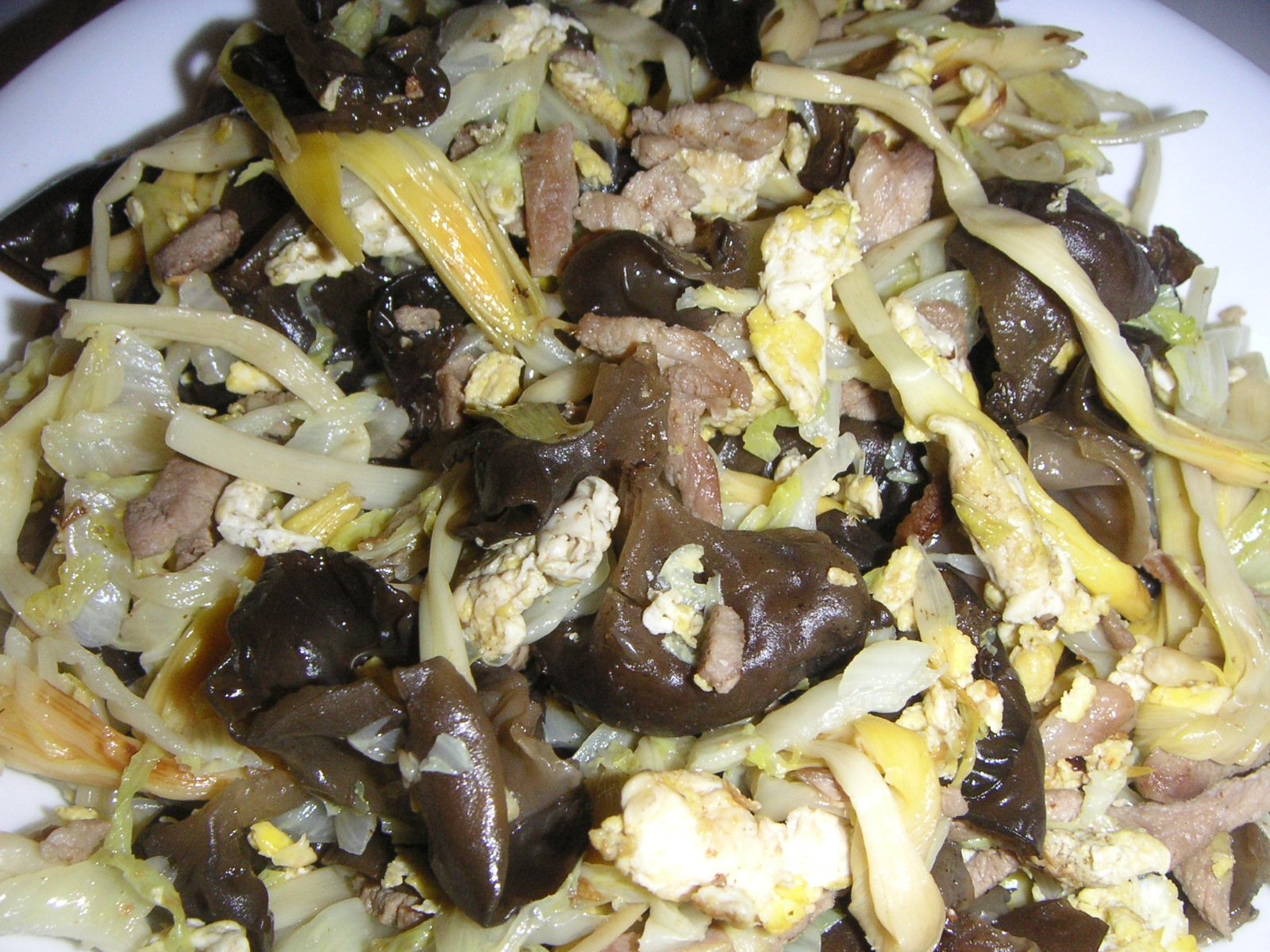
- Mu xu rou — the home-style stir-fry of pork, egg, and cabbage, where wood ear is the third texture in every bite. The moo shu pork tradition it belongs to took the dish to America and kept the mushrooms in it, which is more than can be said for most of the substitutions that journey involved.
- Cold dressed salads — 凉拌木耳, wood ear blanched, chilled, and tossed with garlic, black vinegar, and a thread of chilli oil. The closest thing in Chinese cooking to a salad course, and the crunch is completely different from any leaf.
- Dumpling and bun fillings — a small handful of rehydrated, finely chopped wood ear lifts a pork filling the way breadcrumbs do, without the pastiness. It is a quiet component of many jiaozi fillings, rarely mentioned in the list of ingredients and always missed when absent.
- Temple vegetarian cooking — where meat is absent, wood ear and its cousin shiitake do the structural work. Chinese Buddhist vegetarian cuisine uses wood ear for mouthfeel in dishes that would otherwise be an undifferentiated softness.
The rule of thumb: use wood ear when a dish needs something to bite, and reach for dried shiitake when a dish needs depth. The two are pantry partners, not competitors — most Chinese kitchens keep both bags, and a soup that uses both at once, like the winter mushroom and wood ear broths of the northeast, tastes like it has meat in it without any meat at all.
Storage
Kept airtight in a cupboard, dried wood ear lasts about a year, and it does not go off so much as go quiet — old ears reconstitute into a paler, tougher version of themselves. The real enemy is moisture: a bag left open in a humid kitchen will soften, and softened ears should be dried out in a low oven immediately or discarded. If you buy the compressed cakes, keep them in their sealed foil until you need one; once opened, the whole cake should be used within a few weeks.
Frequently Asked Questions
Do I need to cook wood ear before eating it?
Yes. Blanch rehydrated ears for two to three minutes in boiling water before adding them to cold dishes, and cook them properly in anything hot. Raw wood ear is indigestible and, if soaked too long before eating, genuinely unsafe.
Why is my wood ear so tough?
Three possibilities: you did not trim the woody base, you did not cook it long enough after soaking, or the ears were old. For stir-fries, blanch first; for soups, add them early enough to soften but not so early that they disintegrate — twenty minutes in a simmering soup is plenty.
Is wood ear the same as shiitake?
No. Shiitake is a gilled mushroom grown on logs, dried for depth of flavour; wood ear is a jelly fungus, dried for texture. They look similar in the bag if you squint, and they do completely different jobs.
Can I use fresh wood ear instead of dried?
Yes, if you can find it — it is common in Chinese markets in season. Fresh ears need no soaking, just a rinse and a trim, and they cook faster. The flavour and crunch are the same; only the shelf life suffers.
How much dried wood ear do I need per dish?
A small handful, about 10 g, feeds two people in a soup or stir-fry. It expands enormously, and wood ear is one ingredient where more is not better — too much and the dish turns into a bowl of rubber bands.
The Crunch Worth Keeping
Wood ear will never be the ingredient you buy for its own sake. It is the mushroom you buy for what it does to the other things in the bowl — the snap in a soft soup, the resistance in a salad, the bite inside a dumpling. A 100 g bag costs almost nothing and lasts a year, and the first time a bowl of hot and sour soup crunches the way it should, you will understand why it has been in the Chinese pantry for a thousand years.
Frequently Asked Questions
What is Rock ear mushroom?
Our guide to Wood Ear Mushrooms: Crunchy Texture, Real History covers this directly: Updated 31 October 2026 · reviewed by the China Food Way editorial team The sections above walk through the practical details.
Related reading
Rock Sugar (Bing Tang): The Clear Sweetener of Braises · Dried Shiitake and Wood Ear Mushrooms