Chinese Wedding Food: Symbolism on the Banquet Table
Last reviewed 31 October 2026 · China Food Way editorial team
The first Chinese wedding banquet I sat through properly was my friend’s in Guangzhou, and I made the classic outsider’s mistake of filling up on the opening cold cuts. By the time the suckling pig came out — the dish everyone had been waiting for — I could only manage a sliver. No one explained the menu that night. I just noticed nearly every plate arrived in pairs, a whole fish was set down and pointedly not finished, and the aunties kept muttering about “good meaning” (好意头). Years and many banquets later, I asked a Cantonese uncle to walk me through it. What follows is what he told me, since confirmed at Hakka, Shanghainese and northern weddings.

How do lucky homophones shape a Chinese wedding banquet menu?
A Chinese wedding menu is built on homophones as much as on flavour: dishes are chosen because their names sound like lucky words. Fish, yu (鱼), sounds like surplus, so a whole fish broadcasts ‘may you have extra every year’. Seeds rhyme with son, and a pomelo or tangerine nods at luck. The kitchen knows a fixed set of these puns by heart, and the couple’s parents are paying for the luck as much as the meal. This is why two banquets can look nearly identical — the food is a script of wishes, not a chef’s improvisation. A Western guest sees a sequence of courses; a Chinese guest hears a sentence about fertility, prosperity and a full house, repeated in food. The homophone, not the recipe, is the real menu being served.
The Menu Is a List of Wishes
Chinese wedding banquet food
Chinese wedding banquet food deserves a closer look. The first Chinese wedding banquet I sat through properly was my friend’s in Guangzhou, and I made the classic outsider’s mistake of filling up on th In the sections below we cover what travelers and home cooks actually need to know.
A Western wedding dinner is built around a centrepiece and a choice. A Chinese wedding banquet is built around a script. Ten or twelve courses are expected, and the kitchen chooses them less for balance of flavour than for the luck they broadcast. The dish matters, but the homophone matters more. A cook could technically serve anything, but the couples and their parents are paying for a specific set of puns, and the kitchen knows the set by heart.
The logic is phonetic. Mandarin and Cantonese are both packed with words that sound like other, luckier words, and a wedding menu is a greatest-hits of them. Fish (鱼, yú) sounds like surplus (余, also yú). The word for seed (籽, zǐ) rhymes with son or child (子, zǐ). A pomelo or a tangerine nods at the word for luck. This is not decoration layered on top of the food; it is the reason the food was chosen. The whole habit is older than the restaurant banquet — as the encyclopaedic record of Chinese marriage shows, the betrothal gifts and the wedding feast have long been two halves of one ritual, both built on the same puns.
Why is the suckling pig the opening centrepiece of the banquet?
The suckling pig opens the banquet because its crisp golden skin reads as prosperity and its wholeness reads as unity — two wishes the family wants on the table first. Traditionally the head is turned to face the principal guests as a sign of respect, and the skin, carved thin and crackling, is the part everyone waits for. It is served early for a practical reason too: a whole pig is at its best within minutes of carving, and the room is hungriest at the start. Later courses are richer and slower, so the showpiece leads. If you fill up on the cold cuts beforehand, as many outsiders do, you will miss the dish the banquet was partly built around. Save room, and take the skin first while it is hot.
The Suckling Pig Comes Out First
The roast suckling pig is the one dish that announces the banquet has properly begun. It arrives whole, skin lacquered to a deep red-brown, often with an apple or a tangerine in its mouth, and it is carved at the table. The red skin is the point — red is the colour of joy and good fortune, and a crisp, unbroken sheet of it is the kitchen showing off.
I have now eaten suckling pig at perhaps eight weddings, and the ritual is identical each time: the pig is paraded, photographed, and only then broken down into piles of skin, fat and meat. The skin is the prize. At the Guangzhou wedding I mentioned, the carving was done by a chef who treated the pig like a violin, drawing the blade along the backbone so the crackling came off in one piece. That first night I read it as theatre; it is partly that, but also the family announcing abundance in the most expensive way they can afford.
Fish, and the Art of Not Finishing It
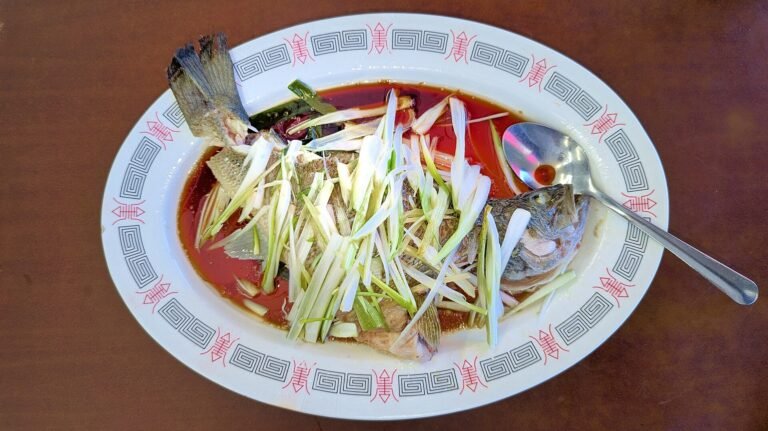
The whole fish is the dish outsiders find most puzzling, because no one finishes it. It is placed on the table pointing at the guest of honour, admired, and then left more than half full. Walking away from food at a banquet feels rude until someone explains that the surplus is the point. The fish represents 年年有余 — “may you have surplus year after year” — and you are not supposed to eat the surplus. Leave it, and you are wishing the couple a future with more than they need.
The “don’t finish it” rule holds almost everywhere, and it is the most common faux pas I see visiting friends commit — eat the fish to the bone and you have, symbolically, eaten the couple’s surplus.
Why does chicken represent the phoenix in a wedding banquet?
Chicken stands for the phoenix because in the dragon-and-phoenix pairing the bird is the female half of an auspicious couple, balanced against the dragon, usually a lobster or prawn, as the male. Serving both on one table speaks a wish for a harmonious marriage and, by extension, sons to carry the line. The phoenix chicken is often a crisp or drunken bird, presented whole to echo the unity theme shared with the fish and pig. The pairing is old court symbolism filtered into a banquet that is partly a blessing and partly theatre. A guest who understands it reads the chicken not as a course but as half a sentence about the new household — the other half arriving with the dragon dish a course later, completing the metaphor on the table.
Chicken, and the Dragon-and-Phoenix Pairing
Chicken turns up everywhere at a wedding, and usually in the company of another protein, because the pairing itself is the symbol. The dragon (龙) and phoenix (凤) are the classic couple: the dragon is the groom, the phoenix the bride, and a dish that sets them side by side — dragon-phoenix chicken, or chicken paired with prawns or duck — is a wish for a harmonious marriage.
A dish I underestimated for years is braised chicken feet. It looks like an afterthought next to the pig, but at a Cantonese banquet it is a staple, and it earns its place through that same dragon-phoenix logic when served alongside a prawn or a duck course. The feet are braised until the collagen goes soft and glossy, usually in a black bean and fermented soy sauce. I used to skip them; now I understand they are there as part of a deliberate pair, not as filler.
Lotus Seeds, Longan, Peanuts: the “Early Son” Bowl
The most pointed symbolism on the table is a small bowl of snacks that doubles as a pun so direct it is almost cheeky. Red dates (红枣, hóng zǎo), peanuts (花生, huā shēng), longan (龙眼, lóng yǎn) and lotus seeds (莲子, lián zǐ) are set out together. Read the first character of each — 早 (zǎo, early), 生 (shēng, birth), 贵 (guì, precious), 子 (zǐ, son) — and you get 早生贵子, “may you soon give birth to a precious son.”
This is the one wedding wish that has not aged gracefully; at modern urban banquets you will sometimes see the lotus seeds left out. But the bowl is still common at traditional, family-led banquets. The lotus carries its own wish too: its seeds mean continuity, its roots an unbroken family line.
The Tea Ceremony Snacks
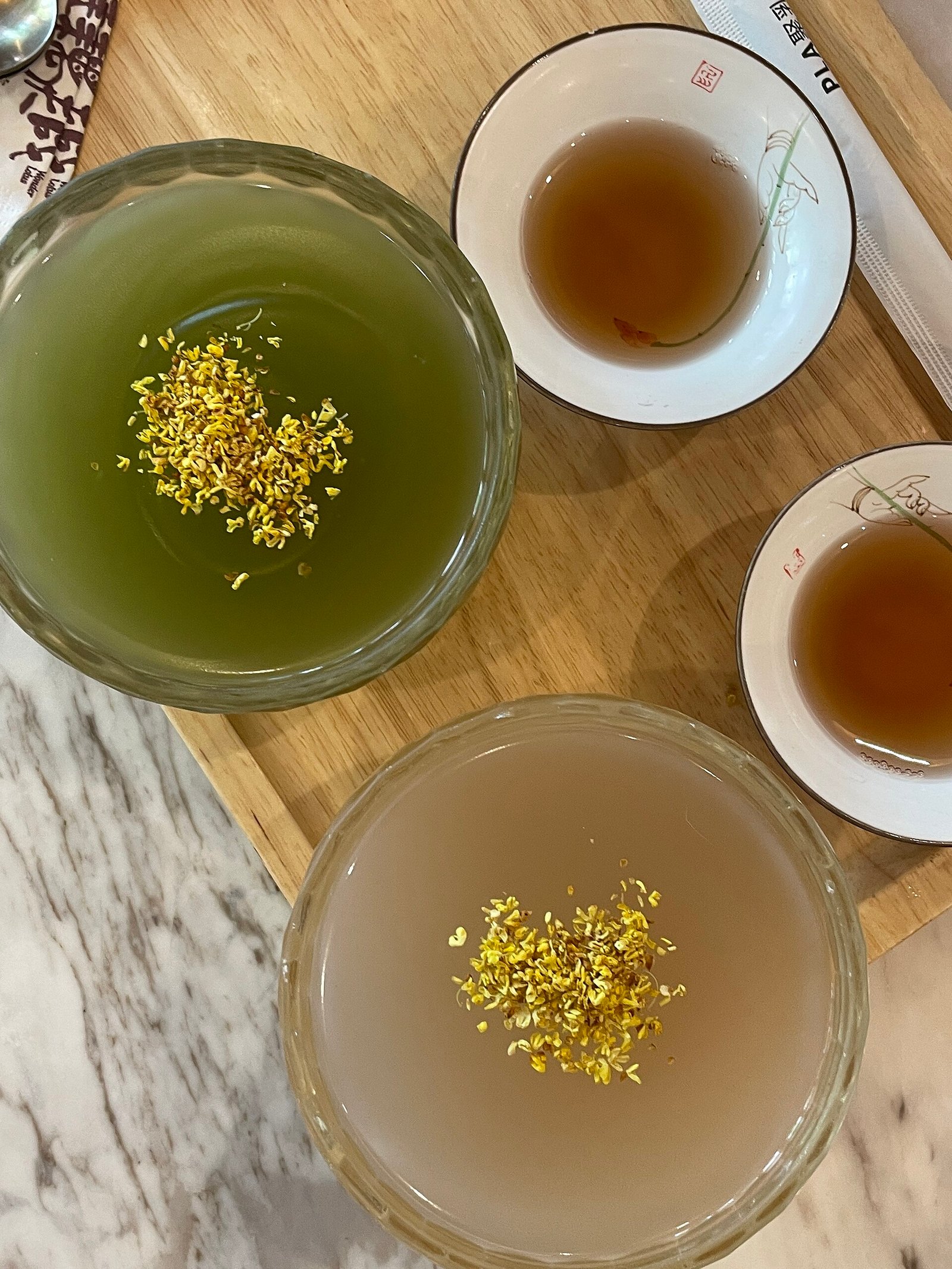
Before the banquet, at the tea ceremony, the food is different and quieter. The couple serves tea to their elders in exchange for red envelopes, and the table holds small sweet things — sugared lotus seeds, ripe guava, or little puffed pastries — chosen because sweetness is a wish for a sweet marriage. The snacks are not the point of the ceremony, but they reinforce it: you eat something sweet, you receive a blessing, you hand over a red envelope.
I have been roped into the tea ceremony twice as a token elder, and the food is always the least memorable part and the most telling. The point is the bow, the tea, and the envelope. The sugar is just the flavour of the wish.
Why the Courses Come in Even Numbers
Walk into any Chinese wedding banquet and count the courses: you will almost always land on an even number, usually ten or twelve. Odd numbers are for funerals; even numbers, and especially pairs, belong to celebrations. A menu built on pairs — two soups, two whole proteins, a matched vegetable and a matched starch — is the kitchen signalling that this is a happy occasion, not a sombre one.
This is the rule that explains most of the apparent repetition on a banquet menu. Two similar-looking braised dishes are not laziness. They are the menu keeping its promise of evenness. As I explored in Chinese food culture, the banquet is the most formal expression of a dining culture that is always speaking in symbols, and the wedding is its most concentrated version.
The Dishes and What They Mean
Here is the short version of the code, the dishes you will meet at nearly every banquet and the wish each one carries:
| Dish | Mandarin | The wish it carries |
|---|---|---|
| Roast suckling pig | 烤乳猪 (kǎo rǔ zhū) | Abundance and celebration, announced in red lacquered skin |
| Whole steamed fish | 蒸全鱼 (zhēng quán yú) | Surplus year after year — do not finish it |
| Dragon-phoenix chicken | 龙凤鸡 (lóng fèng jī) | A harmonious marriage of groom and bride |
| Lotus seed snack bowl | 早生贵子 (zǎo shēng guì zǐ) | “Soon a precious son” — traditional, increasingly optional |
| Longevity noodles | 长寿面 (cháng shòu miàn) | A long, unbroken life together |
| Sweet red date pastry | 红枣糕 (hóng zǎo gāo) | A sweet start to married life |
How does a wedding banquet menu differ from a Lunar New Year dinner?
A wedding banquet and a Lunar New Year dinner share the lucky-food grammar but push different wishes. The wedding menu centres on union and fertility — whole fish for surplus, phoenix-and-dragon for the couple, peanuts and lotus seeds for ‘early son’ — and it is a large, fixed, paid banquet. The New Year table leans toward prosperity and long life: dumplings shaped like ingots, a sticky rice cake for rising years, a whole chicken for family completeness, and dishes whose names promise wealth. Weddings are loud and public; New Year is domestic and repeated annually. Both avoid anything whose name sounds like loss or separation. The overlap is real, but a wedding spreads fertility puns thick while New Year spreads prosperity puns thick, and the guest who knows both eats each with a different ear. The Chinese banquet explains the course order behind both.
How It Differs From the New Year Table
If the menu looks familiar, that is because the wedding borrows from the same symbolic vocabulary as the New Year table. The fish, the dates, the noodles all appear at Spring Festival too. The difference is tone. New Year food is domestic and forgiving — anyone’s grandmother can make it. Wedding food is restaurant food, ordered by the course, and the symbolism is performed for an audience of relatives who are grading the family on generosity as much as taste.
The Chinese banquet as a whole operates on these rules, but the wedding is where they are least flexible. You can skip the phoenix at a business dinner. You do not skip it at a marriage.
A Note on the Communal Setting
None of this reads the same if you forget how the food is served. Dishes arrive in the centre of a rotating table and are shared, which means the symbolic dish is also a social one: the fish is pointed at the guest of honour, the pig is carved for everyone, and the noodles are lifted from a single bowl. The communal eating etiquette that governs every Chinese meal is turned up to full volume at a wedding, where who gets served first is its own small ceremony. For a deeper look at the root vegetable behind the lotus-seed symbolism, see our lotus root guide.
Frequently Asked Questions
Why is there always a whole fish at a Chinese wedding?
Because the word for fish, 鱼, sounds the same as the word for surplus, 余. The fish is a wish that the couple will have more than enough. It is traditionally left partly uneaten so the surplus is not “consumed”, which is why finishing it can read as bad luck.
What are the red dates, peanuts, longan and lotus seeds for?
They are a pun. The first characters of the four foods spell 早生贵子, “may you soon have a precious son.” It is a traditional fertility wish, and you will see it less at modern urban weddings than at traditional family ones.
Why do wedding banquets have so many courses, and always an even number?
Even numbers signal celebration; odd numbers are reserved for funerals. Ten or twelve courses, often in pairs, let the kitchen show generosity and keep the menu’s promise of a happy occasion.
Is the roast pig actually necessary?
At a Cantonese or Hakka banquet, yes — it is the headline dish and a measure of how grand the family wanted the wedding to be. At northern or simpler weddings it might be replaced by a different showpiece, but something red and celebratory will take its place.
Can a guest eat the symbolic dishes freely?
Mostly yes. The main rule is not to finish the whole fish. Otherwise the symbolic foods are there to be eaten; the symbolism is in their presence and their name, not in leaving them untouched.
Does the tea ceremony count as the meal?
No. The tea ceremony happens before the banquet and involves only small sweets and tea. The real meal is the banquet that follows, usually in the evening, with the full set of courses.
Frequently Asked Questions
What is Chinese wedding banquet food?
Our guide to Chinese Wedding Food: Symbolism on the Banquet Table covers this directly: The first Chinese wedding banquet I sat through properly was my friend’s in Guangzhou, and I made the classic outsider’s mistake of filling up on the opening cold cuts. The sections above walk through the practical details.
Related reading
Luoyang Food Guide: The Water Banquet City · Honey Walnut Prawns: The Banquet Prawns You Can Actually Make at Home