Steamed Bun Dough: The Base Recipe Under Every Bao
At half past six on a winter morning in Xi’an, I stood watching a woman feed a steamer stack the size of a filing cabinet. Plain white mantou went out by the dozen, wrapped in plastic bags, handed over with coins dropped in a biscuit tin. Not one bun had a wrinkle on it. I had already made steamed buns at home three times by then, and every one of mine came out wrinkled, dense or collapsed, so I asked her what flour she used. She looked at me as if I had asked what air she breathed, and said: the same as everyone. That was the day I stopped blaming ingredients and started studying the dough itself.
The point of this article is that there is one base dough under almost everything steamed in China — plain mantou, pork buns, vegetable buns, sweet filled ones — and once you can make that dough reliably, every filled variation becomes a topping decision. As Wikipedia’s entry on baozi documents, filled steamed buns have centuries of history and dozens of regional names, but they all begin with the same flour, water, yeast and sugar.
Why One Dough Feeds a Whole Country
The genius of the base dough is its neutrality. It carries no flavour of its own beyond a faint sweetness, which is exactly why the same batch can become breakfast mantou, a lunchtime pork bun, or a dessert red bean bun without changing a gram of the recipe.
For a structured starting point, my Baozi Recipe shows the filled version built on exactly the dough I am about to describe. But learn the dough first. Filling hides a bad dough for exactly one bite; after that, the crumb tells on you.
My working quantities are simple: 500 grams of plain flour, 260 millilitres of warm water, 5 grams of instant yeast, 25 grams of sugar, and a pinch of salt. That is roughly 52 percent hydration, drier than a bread dough, and the dryness is deliberate — I will explain why in a moment.
The Flour: Protein Is the Whole Story
Chinese home cooks use medium-gluten flour, which sits between British plain flour and strong bread flour. The protein level decides everything about the crumb:
| Flour type | Protein | Crumb result | My verdict |
|---|---|---|---|
| Chinese medium-gluten (中筋) | 9–11% | Soft, fluffy, slightly chewy | The intended target |
| British plain flour | ~9% | Tender but weaker structure | Workable; handle gently |
| Strong bread flour | 12–14% | Chewy, tighter, denser feel | Fine, but knead less |
| Wholemeal | ~12% | Heavy, greyish, dense | Blend it, do not use alone |
The dryness of the dough — that 52 percent — exists because steamed dough must hold its own weight. Unlike an oven-baked loaf, a bun sits in a humid cloud and expands freely; too much water and it slumps sideways into a cushion instead of rising into a dome.
Kneading matters as much as flour choice. The dough needs eight to ten minutes by hand — longer than most people expect — until it is smooth as a cheek and springs back slowly when poked. Under-kneaded dough produces a bumpy, torn-looking surface after steaming.
Water Temperature and Yeast: The Two Decisions That Matter
The water is where beginners lose the plot, and where I lost my first three batches. Yeast is a living thing with a narrow comfort zone: liquid at around 35°C wakes it up, liquid above roughly 50°C kills it outright. If in doubt, test the water on your inner wrist, where it should feel like nothing at all.
Sugar in the dough is not there for sweetness, or not only. Twenty-five grams per 500 grams of flour gives the yeast immediate food, speeds the rise, and adds the faint sweetness that makes mantou taste like mantou rather than steamed cardboard.
Salt, just a pinch, tightens the gluten so the dome holds. Skip it and the flavour goes thin, though nothing structural collapses.
The Two Risings, With Poke Tests
The dough rises twice, and each rise has a different job and a different test.
The first rise happens in the bowl: cover the dough and leave it somewhere warm for about an hour, until it has doubled. The reliable test is the poke — flour your finger, push it in about two centimetres, and watch. If the hole springs back immediately, keep waiting. If the hole stays open and the dough around it does not slump, it is ready. If the surface starts to wrinkle and smell sharply of alcohol, you have gone too far.
The second rise happens after shaping, and it is shorter and easier to miss: twenty to thirty minutes, with the shaped buns sitting in the steamer, before any heat goes near them. This proof is what fills the crumb with the fine, even bubbles that make a steamed bun tear into layers rather than chew like glue. The test here is gentler: lift a bun and it should feel noticeably lighter than it did, almost like holding air in a cloth.
Skipping the second rise is the most common shortcut, and it produces exactly the dense, heavy bun people complain about when they say steamed buns never work for them. I did it for months before I understood the connection.
Shaping and Steaming
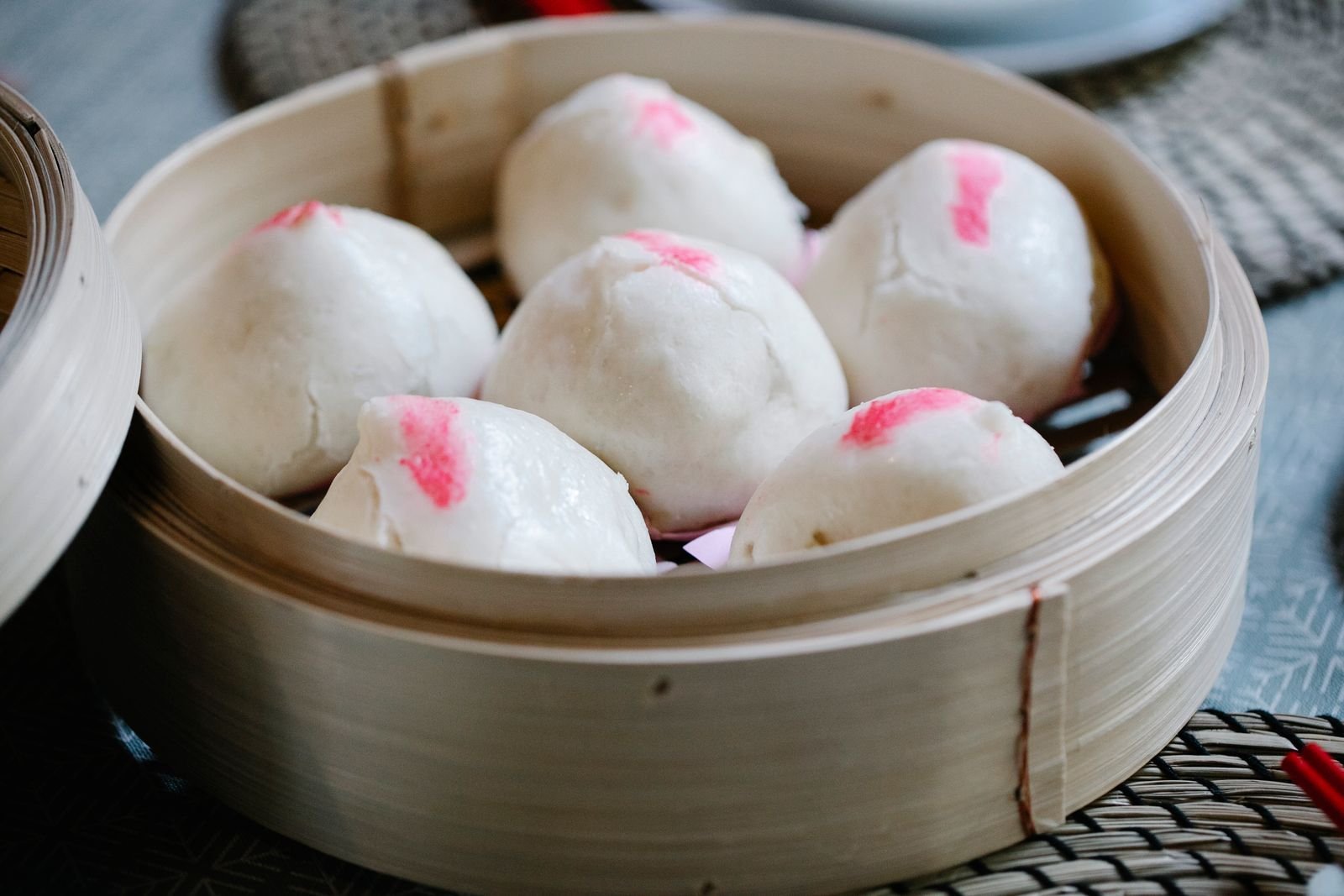
Shaping a plain mantou is a brief lesson in patience: roll the dough into a log, cut portions, and roll each piece under a cupped hand until the surface is taut and smooth. Any seam or fold gets steamed into a visible scar.
Steaming timing depends entirely on size, so here is the table I keep on my kitchen shelf:
| Bun type | Size | Steam time (from cold water) | Rest before lifting lid |
|---|---|---|---|
| Small mantou | 35 g each | 10 minutes | 3 minutes |
| Standard mantou | 50 g each | 12 minutes | 3 minutes |
| Filled bao, meat | 60 g with filling | 15 minutes | 4 minutes |
| Filled bao, sweet | 60 g with filling | 12 minutes | 4 minutes |
Two steaming rules matter more than timing. First, start from cold water unless your recipe says otherwise: the slow temperature climb acts as a final proof. Second, do not lift the lid the moment the timer ends. A sudden rush of cold air onto hot, fragile dough collapses it in seconds — the wrinkled, deflated bun that haunted my early batches.
The steaming logic transfers far beyond buns, too. Everything delicate that goes into a Chinese steamer obeys the same gentle-heat discipline; my notes on a proper take on chinese steamed fish cover the savoury end of that same principle, where an over-fierce steam ruins the texture just as it ruins a bun.
Four Failures I Have Personally Produced
Consider this my museum of mistakes, each one diagnosable:
| Symptom | Cause | Fix |
|---|---|---|
| Wrinkled, collapsed after steaming | Over-prooved first rise, or lid opened too soon | Shorten the first rise; rest before lifting the lid |
| Dense, heavy crumb | Skipped second rise, or yeast killed by hot water | Never skip the proof; test water temperature on your wrist |
| Bumpy, torn surface | Under-kneaded dough | Knead a full eight minutes; the dough should feel like a earlobe |
| Yellowish, flat-tasting buns | Old yeast, or flour too weak | Buy fresh yeast; blend plain flour with strong flour |
Every one of these produces a bun that is safe to eat and disappointing to serve, which is the worst combination in home cooking: no drama, no salvage, just quiet disappointment at the table.
Where the Same Dough Goes Next
Once the base dough behaves, the whole steamed-bun world opens up, and it is worth mapping a few directions so you know where to travel first.
Filled savoury buns are the obvious next step, and the fillings carry regional accents you will recognise from the wider cuisine. If you have read my comparison of Hunan Vs Sichuan, you know how differently the two provinces treat chilli and numbing pepper — and those same flavour logics show up inside bun fillings, from fiery pork to peppery beef.
Sweet fillings are gentler territory and a good place to start folding, because nobody mind a slightly ugly dessert bun. My guide to everything you need to know about red bean bun covers the classic sweet paste version, which was the first filled bun my daughter ever helped me shape, mostly by eating the filling.
For something more refined, the folded and pleated styles belong to the eastern tradition — the cuisine around Shanghai and the Yangtze delta. A look at Huaiyang Cuisine gives the context: that is the cooking culture where delicate wheat-based dumplings and buns became an art form, and where the pleat count on a bun is a point of professional pride.
And when the buns come out of the steamer alongside a proper dinner rather than standing in for one, they do best next to bold, saucy mains that give them something to absorb. A plate of kung pao chicken does exactly this job; my notes on all about kung pao chicken include the sauce-heavy version I make for exactly that pairing — plain bun in one hand, saucy chicken in the other, no cutlery required.
Frequently Asked Questions
Can I use instant yeast and dried yeast interchangeably? In the same quantities, no. Instant yeast mixes straight into the flour and needs about three-quarters the quantity of active dried yeast, which prefers a five-minute soak in the warm water first. I use instant yeast exclusively now, mostly because I have ruined dried yeast with water that was too hot more times than I want to admit.
Why are my buns yellow instead of white? Old yeast, over-long fermentation, or wholemeal contamination in the flour. Commercial white buns also use bleached flour, which home bakers cannot easily replicate. Fresh yeast, a shorter first rise and pure white flour get you most of the way; the last shade of whiteness is not worth chasing.
Can I freeze steamed buns? Yes, and honestly, make double and freeze half. Freeze them fully cooled in a sealed bag, then re-steam straight from frozen for about eight minutes — no need to thaw. The re-steamed buns come back remarkably close to fresh, which is more than I can say for most bread.
My dough rose fine but the buns deflated after steaming. What happened? Almost certainly the lid came up too fast, or the second proof ran long. Turn off the heat and wait three to four minutes before opening, then crack the lid slowly. If that does not fix it, shorten the shaped-bun rest by ten minutes next batch.
How do I know the second proof is finished without poking a shaped bun? Weight is the honest test: lift one gently and judge whether it feels lighter than when you shaped it. You can also watch the surface — it should look slightly puffy and the creases from shaping should have softened, not disappeared.
Do I need a bamboo steamer? No, though it helps. Bamboo lids breathe, so condensation drips less onto the buns. With a metal steamer, drape a tea towel over the lid or wrap the lid in muslin to catch drips — the same principle, achieved differently.