Beef Chow Fun: Dry-Fried Rice Noodles
Reviewed 31 October 2026 by the China Food Way editorial team
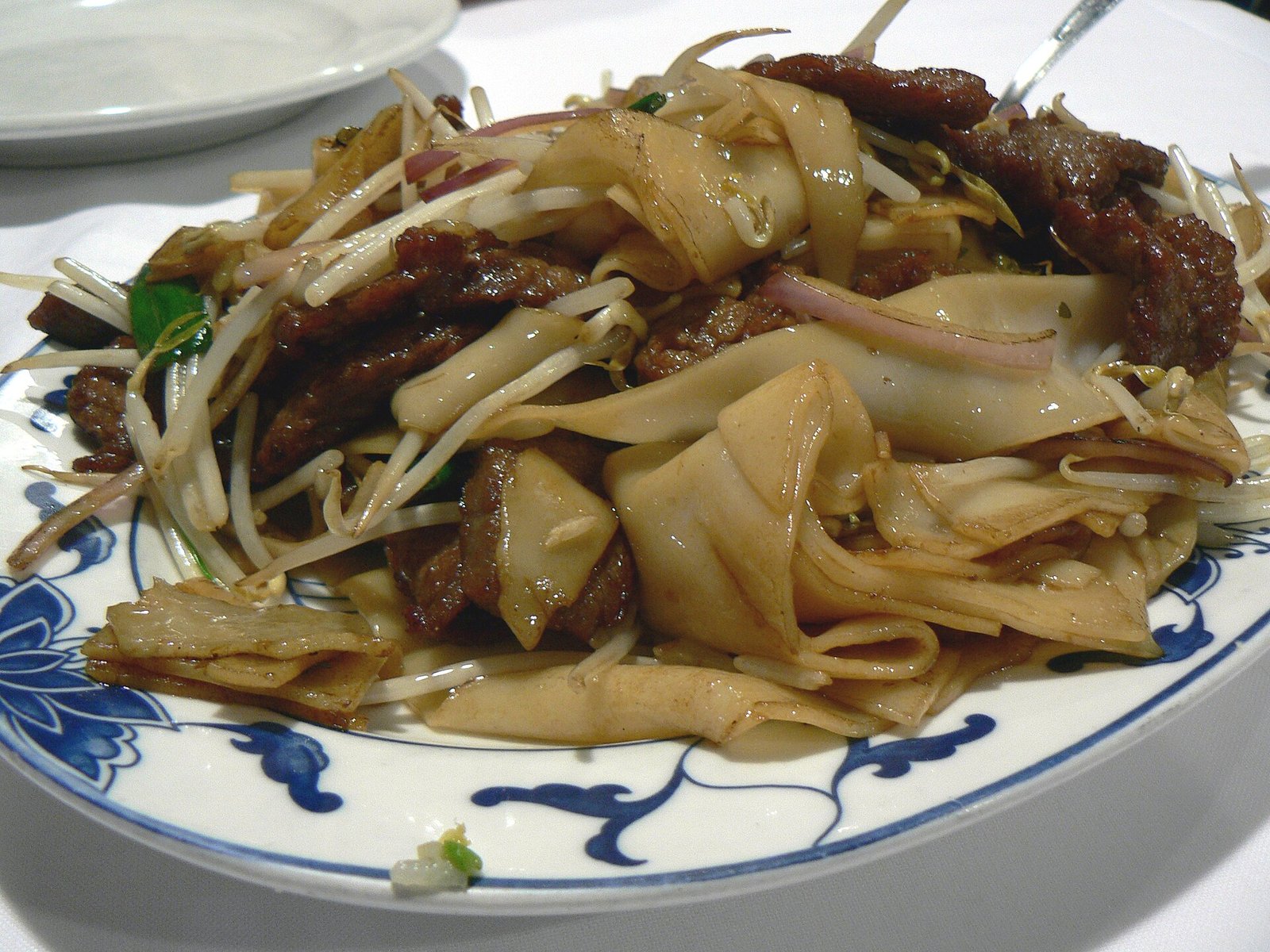
The first time I made beef chow fun at home, the noodles welded themselves into a single grey slab and the beef came out pale and stewed. I remember lifting the whole thing out of the wok with a spatula in one piece, like a rice-noodle frisbee, and quietly deciding that some dishes were restaurant dishes. It took two more attempts and one wasted packet of noodles to understand what the wok had been trying to tell me. 干炒牛河 (gon chow ngau ho, “dry-fried beef rice noodles”) is not a stir-fry in the way a broccoli-and-beef stir-fry is a stir-fry. It is a searing problem wearing noodles, and every step below exists to solve it. As Wikipedia’s overview of the dish notes, it is a Cantonese classic built on hor fun, the wide rice noodles that anchor the region’s wok cooking — the same slippery noodle family that gives chow mein its mahogany gloss on the wheat side of the kitchen.
How long can I keep fresh hor fun in the fridge?
Two to three days, uncovered or loosely covered, is the sweet spot — long enough to dry the surface, short enough that the rice starch has not started to sour. A fresh 400 g block bought in the morning is wet, slack and dusted with loose starch that turns to glue in hot oil, so an overnight rest in the fridge is the single change that makes it fryable. Past three days it smells faintly fermented and the strands break the moment you toss them. If you need them sooner, spread them on a tray for two or three hours at room temperature, turning once. Never seal a warm block in its plastic; the trapped condensation undoes the whole point.
The Noodles: Why Day-Old Changes Everything
Fresh hor fun (河粉) — wide, flat rice noodles — come coiled in plastic trays at any Asian grocer, usually in blocks of about 400 g. Bought that morning, they are at their worst for frying: wet, slack, and dusted with loose surface starch that turns to glue the instant it meets hot oil. Left overnight in the refrigerator, uncovered or barely covered, they lose just enough surface moisture to become fryable.
The change is physical, not mystical. A fresh noodle carries condensation and free starch on its surface, and in the pan that surface steams the noodle from the outside while the interior stays raw. A day-old noodle has a drier skin, so it blisters on contact with the metal instead of boiling in its own steam. This is the single most important variable in the dish, and it is the one most home recipes skip.
If you cannot plan a day ahead, spread the noodles on a tray for two or three hours at room temperature, turning once. Handle them gently throughout — pull the coils apart with your fingers, never with a knife, and never rinse them “to separate” them, which just adds water back.
Wok Hei at Home: What You Can and Cannot Recreate
Wok hei (镬气, roughly “wok breath”) is the smoky, faintly bitter edge that separates a restaurant plate of chow fun from a competent home one. It comes from aerosolised oil and food particles catching fire on a surface far hotter than a domestic hob usually reaches — the wok’s shape exists to make that easy — and doing it properly needs a commercial burner. You are not going to replicate that. What you can do is get close enough that nobody complains.
Three adjustments get a home kitchen most of the way there:
- Use a carbon-steel wok, not a non-stick pan. Non-stick coatings are damaged by the heat the job actually requires, and they do not conduct enough. A seasoned carbon-steel wok costs the price of two takeaway dinners.
- Heat the wok dry for two full minutes before the oil goes in. A bead of water should skate across the surface and vanish instantly. If it sits and sizzles, the wok is not ready and your noodles will pay for your impatience.
- Cook in two batches. One layer of noodles, with space between them, is the difference between searing and steaming. The second batch takes four minutes, not eight, because the wok stays hot.
Work with the kitchen window open and the extractor on — the process legitimately smokes, and the smoke is where part of the flavour lives. This is the heat logic that makes Cantonese cooking so wok-dependent, and why the region’s chefs talk about breath and fire the way French cooks talk about sauce.
How much oil is too much for chow fun?
More than about two tablespoons for a 400 g block of noodles, and the plate turns greasy and heavy rather than slick. Too little is just as bad: under a tablespoon and the bare metal grabs the rice starch, the noodles tear, and you are tempted to keep adding oil mid-fry, which cools the pan. I use roughly one and a half tablespoons of a neutral, high-smoke-point oil — groundnut or rapeseed — swirled to coat the wok, then pour off any excess before the beef goes in. The noodles should hiss and blister, not swim. A final few drops of toasted sesame oil go on at the table for aroma, never into the frying.
The Oil Barrier: Three Components, One Combination
The architecture of the dish is separate cooking. The beef is seared alone and removed. The noodles are fried alone. They meet in the final thirty seconds, already cooked, so nothing has to steam in company. Most failed chow fun is a failure of architecture — everything in one pan at one time, everything stewing in everyone else’s juice.
The oil barrier is the part home cooks doubt. Before the noodles go in, the wok gets 1 tablespoon of oil, swirled to coat, and the noodles get a light toss in a teaspoon of oil before they meet the metal. That film is not there for flavour. It is a physical separator — a slick surface that keeps loose starch from bonding noodle to wok and noodle to noodle, so a toss separates them instead of tearing them.
| Component | Quantity | Time in the wok | Its one job |
|---|---|---|---|
| Beef | 250 g, velvetted | 40 seconds | Sear and remove |
| Hor fun | 400 g, day-old | 2–3 minutes | Blister and drink the sauce |
| Finish | Beef back, sprouts, chives | 30 seconds | Combine and steam through |

How thin should I slice the beef?
Two to three millimetres, cut across the grain, which is thin enough to cook in the forty seconds the recipe allows and thick enough to stay juicy. The easiest way to hit that is to put the steak in the freezer for twenty minutes first; a half-frozen piece holds its shape against the knife instead of squashing, and the slices come out even. Thicker strips stay pink in the middle while the noodles overcook, and shavings so thin they tear will simply vanish into the sauce. I slice a 200 g flank steak into roughly a dozen pieces and keep them in a single layer so they hit the pan separately. Pat them dry first.
The Beef: Thin, Against the Grain, Forty Seconds
Use 250 g of flank, sirloin or flat iron — anything with visible marbling and enough chew to survive the wok. Slice it 3 mm thick, and slice it against the grain: run a fingernail along the meat, and cut across the lines you see, not along them. This one detail decides whether the beef is tender or leathery more than any marinade does.
Velvet it: 1 teaspoon light soy sauce, 1 teaspoon Shaoxing wine if you have it, 2 teaspoons cornstarch, 1 tablespoon water, and finally 1 tablespoon oil stirred through to seal. The starch gives the slices a silky coating that protects the surface during the short sear and thickens the sauce a fraction as it cooks. Fifteen minutes of marinating is enough; longer just pickles the meat.
Sear the beef in 1 tablespoon of oil taken to the first wisp of smoke, in a single layer. Forty seconds, one turn, then out. It will look underdone — it finishes in the noodles, and anything past medium-rare becomes tough by the time the plate reaches the table.
The Sauce: Two Soy Sauces, One Job Each
Mix the sauce in a small bowl before the wok is hot, because once it is hot you will have no free hands. The classic proportion is 2 tablespoons light soy sauce, ½ teaspoon dark soy sauce, 1 tablespoon oyster sauce, ½ teaspoon sugar and 1 teaspoon toasted sesame oil.
The two soy sauces are doing different jobs, and this is where the light vs dark soy sauce split earns its keep: the light soy is the seasoning, the salt-and-umami layer that has to be present in every bite; the dark soy is a paint, contributing colour and gloss and almost no salt. A chow fun with too much dark soy tastes fine and looks like wet cardboard; one with none tastes fine and looks pale. Half a teaspoon is the whole job. If you have ever wondered why Chinese kitchens keep both bottles, this dish is the demonstration — two sauces, one wok, forty seconds of cooking between them.
Putting It Together: The Sequence
Timings assume a screaming-hot wok and everything prepped within arm’s reach — chow fun is a four-minute dish that needs ten minutes of mise en place.
- Sear the beef. Wok smoking hot, 1 tablespoon oil, beef in a single layer. Forty seconds, one flip, out to a plate.
- Fry the noodles. Add 1 tablespoon oil. Noodles in, spread into an even layer, and leave them alone for twenty to thirty seconds. Let them catch. Then toss, and toss again every half minute, for two to three minutes, until they are slick and flecked with blister.
- Sauce. Pour the sauce down the side of the wok — not onto the noodles — and toss hard for thirty seconds. The sauce caramelises on contact with the metal; hitting the noodles directly just makes them soggy.
- Finish. Beef back in, 150 g bean sprouts and a handful of cut garlic chives or scallions on top. Two or three tosses, thirty seconds, and out onto a warm plate. The residual heat wilts the chives and steams the sprouts just enough.
Serve straight from the wok while the noodles are separate and glossy. If they have fused into a mat on the plate, the noodles were too wet or the wok was too full.
Can I use dried rice noodles instead of fresh?
You can, but soak them — never boil them — and expect a more fragile result. Cover flat dried rice noodles, around 8 mm wide, with warm water for twenty to thirty minutes until they bend, then drain and spread them on a cloth to dry for ten minutes, because wet noodles spatter and steam. Boiling drives water right through the strand and it will break into short lengths the instant you toss it. Dried noodles also lack the surface starch of fresh hor fun, so they never blister in quite the same way. I keep a packet for emergencies and accept a slightly softer plate. Fresh cheung fun rolls are a better substitute if your grocer has them.
If All You Have Is Dried Noodles
Dried wide rice noodles are a workable substitute, not an equal. Soak them per the packet instructions — usually ten to fifteen minutes in hot water until pliable but still firm at the centre — then drain thoroughly and toss with a teaspoon of oil. Do not boil them to softness; they will finish cooking in the wok and will disintegrate if they arrive already tender. The texture will be chewier and slightly less slippery than fresh hor fun, and the strands are more fragile, so toss them less. For the wider picture of the noodle families, the guide to Chinese noodles covers the families chow fun belongs to.
Frequently Asked Questions
Why do my noodles always stick and break?
Three causes, in order of likelihood: the noodles were too fresh and wet, the wok was not hot enough, or there was too much noodle for the surface. Day-old noodles, a two-minute dry heat, and two batches fix all three. The breaking happens because stuck noodles have to be forced apart — a slick noodle in a hot wok separates on its own.
What is the best cut of beef?
Flank, sirloin or flat iron, sliced thin against the grain. Avoid cuts that are too lean, like eye of round, which go gritty in a forty-second sear, and avoid pre-cut “stir-fry strips” unless you can see they were cut thick enough to stay juicy.
Can I make this without a wok?
Yes, with compromises. A large cast-iron skillet works — preheat it for four minutes, use a smaller batch, and accept slightly less sear. What will not work is a lightweight non-stick pan, which cannot hold the heat to blister a wet noodle.
Can I add more vegetables?
Bean sprouts and garlic chives are the tradition, and they are there for crunch against the soft noodle. You can add shredded cabbage at the noodle stage, but watery vegetables like courgettes will steam the noodles and undo the whole architecture. If you want a vegetable-heavy version, the Cantonese habit is to order it alongside, not inside.
Why is my beef tough?
Either it was sliced along the grain, or it cooked past medium-rare. The wok cook is forty seconds on the first side — the meat is supposed to look underdone when it leaves the wok, because it finishes in the noodles for another thirty seconds.
The Point
Beef chow fun is a dish with no hiding place: the noodles announce whether you planned ahead, the beef announces whether you sliced it properly, and the plate announces whether the wok was hot enough. Get the three right and it takes four minutes and tastes like a Guangzhou side street, which is where the dish still does its best work. The reward is a plate that tastes of fire rather than soy sauce — and once you have made it properly, takeaway versions start tasting like the grey slab from my first attempt.
Frequently Asked Questions
What is Beef chow fun?
Our guide to Beef Chow Fun: Dry-Fried Rice Noodles covers this directly: Reviewed 31 October 2026 by the China Food Way editorial team The sections above walk through the practical details.
Related reading
Taiwanese Beef Noodle Soup: Red-Braised Broth from Scratch · Taipei Food Guide: Night Markets and Beef Noodles