m05-chinese-breakfast-ideas.html
Updated 31 October 2026 · reviewed by the China Food Way editorial team
The alarm goes off at six-forty and there is no time to think about breakfast, only to grab it. For most of my adult life that meant toast, or nothing, and a mid-morning slump that I blamed on the job rather than the food. Two years ago, on a work trip to Guangzhou, I watched a hotel kitchen put out forty covers of hot congee before seven and realised the savoury morning was not a treat but a system.
Back home in Leeds I started copying it, badly at first. The first batch of congee stuck to the bottom of a cheap pan and the jianbing I attempted in a non-stick frying pan tore into ribbons. But the principle held: a Chinese breakfast is built from a few forgiving components that you can make ahead, and it keeps you full until lunch in a way cereal never did.

Why the Savoury Morning Stays With You
A western breakfast is usually sugar or starch up front, which means a spike and a crash. The Chinese version leads with warm liquid, protein, and fermented or pickled sides, so the energy arrives slowly and the fridge does most of the work the night before. I am not claiming it is a health cure, only that I stopped snacking at eleven once I switched, and my partner stopped buying pastries for the office.
The other advantage is cost. A packet of dried shiitake, a bag of rice, a bottle of soy, and a dozen eggs cost less in a Chinese supermarket than a single box of branded granola, and they feed the same two people for the better part of a fortnight. The gear you need is already in your kitchen, with two exceptions I will come back to.
What ratio of rice to water gives the right congee texture?
One part round-grain rice to roughly eight parts water, simmered low for about forty minutes with a stir now and then so it does not catch. You are after a loose porridge somewhere between soup and pudding, not a thick paste; if it tightens in the fridge overnight, a splash of water when you reheat brings it straight back. Short-grain or broken rice breaks down faster than long-grain, which is why I use old jasmine stock rather than buying anything special. The base is deliberately plain — the toppings do the work: a soft-boiled egg, a teaspoon of soy, leftover greens and a crumble of youtiao. I keep a container in the fridge for four days and freeze single portions, so a weekday breakfast becomes a two-minute microwave job.
Congee, or Zhou, the Bowl That Forgives
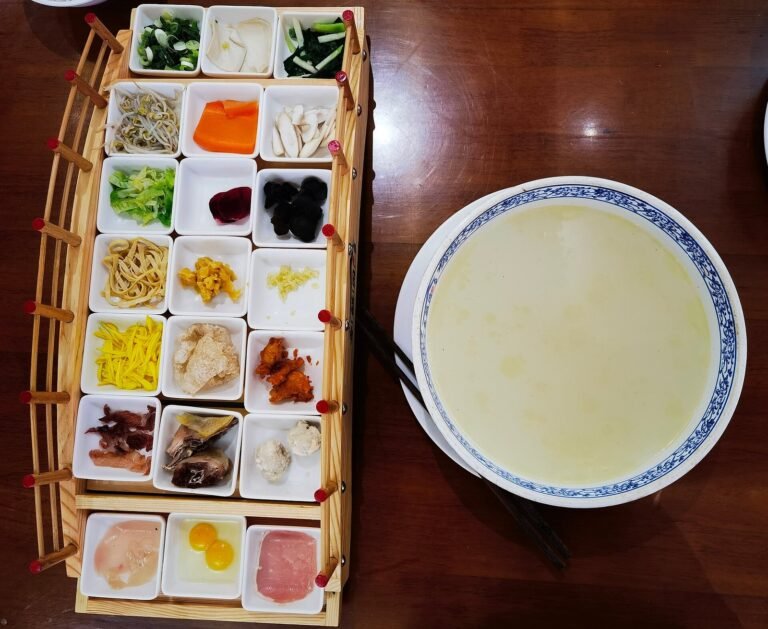
Congee, or zhou (粥), is the backbone of the southern Chinese breakfast and the easiest place to start because it is almost impossible to get wrong. You take one part round-grain rice to roughly eight parts water, bring it to a boil, then simmer it low for about forty minutes, stirring now and then so it does not catch. The texture you want is a loose porridge somewhere between soup and pudding, and if it tightens in the fridge overnight you just add a splash of water when you reheat.
What makes it worth the effort is the topping bar. A soft-boiled egg, a teaspoon of soy sauce, a few hundred grams of leftover greens, and a crumble of youtiao on top turn a plain bowl into a meal. I keep a container of cooked congee in the fridge for four days and freeze the rest in single portions, which means a weekday breakfast is a two-minute microwave job. For the base method and a few flavour variations, our plain congee recipe is the one I cook from.
The rice matters less than you would think, but a short-grain or broken rice breaks down faster. I buy a five-kilo sack of ordinary jasmine for roughly £8 and use the old stock for congee, which is honestly what it is best at.
Jianbing, the Ten-Minute Street Ritual
Jianbing (煎饼) is the northern street breakfast: a thin batter pancake cooked on a flat griddle, smeared with egg, brushed with a sweet bean sauce and chilli, then folded around a crisp fried cracker. In Beijing I ate one from a cart near Wangfujing most mornings for about six yuan, and the man running it had the flip down to eleven seconds. At home you cannot match the speed without the right surface, but you can get close enough to make it a weekend treat rather than a daily grind.
The batter is the only fiddly bit, made from mung bean flour and wheat flour mixed with water the night before so it rests. Everything else is assembly: crack an egg, spread it, add sauce, fold, done in under three minutes once the griddle is hot. Our proper jianbing recipe gives the batter ratios I finally stopped adjusting, and a flat electric griddle that holds a steady heat is the one piece of kit that genuinely helped.
Why do youtiao and soy milk belong together?
Because the pair is built on contrast, and sugar would flatten it. Doujiang is faintly nutty and barely sweet, so tearing a crisp, salty fried dough stick into hot soy milk gives you sharp against soft, and you use the youtiao to fish the last of the liquid from the bowl. Sweetened carton soy milk turns the whole thing into a dessert and misses the point. Fresh soy milk takes only soaked beans, a blender and a short boil, and keeps three days in the fridge. Deep-frying at seven in the morning is unrealistic, so I make a batch on Sunday, freeze them, and re-crisp two in a hot oven. They lose their crunch after day one; a toaster oven recovers most of it.
Youtiao and Soy Milk, the Dunking Pair
Youtiao (油条) are long golden dough sticks, deep-fried so they come out hollow and chewy rather than bready. The classic move is to tear one in half and dunk it into hot soy milk, doujiang (豆浆), which is unsweetened and faintly nutty, nothing like the sweet carton stuff. Eaten together the contrast is the point: crisp salt against warm soft liquid, and you use the youtiao to fish the last of the milk from the bowl.
Deep-frying at seven in the morning is unrealistic for most of us, so I make a batch on Sunday, freeze them, and re-crisp two in a hot oven while the soy milk warms. Fresh soy milk takes only a soaked-soy and a blender, then a short boil, and it keeps three days in the fridge. The fried sticks lose their crunch after the first day but recover well in a toaster oven, which is the honest compromise I have landed on.
Steamed Buns and Mantou From the Freezer
Steamed buns, baozi (包子), are the filled version with pork, chicken, or red bean inside, and mantou (馒头) are the plain steamed bread rolls with no filling at all. Both freeze beautifully, which makes them the most forgiving thing on this list. I steam a dozen on a lazy Sunday, cool them on a rack, then bag and freeze; on a weekday I put two straight into a best bamboo steamer from frozen and they are hot and fluffy in eight minutes.
The plain mantou are the sleeper hit. Split one and press it into a fried egg, or use it to mop up congee, and you have a breakfast with no cooking at all. If you would rather fill your own, our steamed baozi recipe walks through the dough and the pleating, though I will be honest that the folding took me a dozen attempts before it looked like anything but a closed fist.
How long can tea eggs sit in their broth before they go off?
About five days in the fridge, and they improve for most of that time. Hard-boiled eggs are cracked so the shells craze, then simmered in black tea, soy and star anise until the liquid seeps through the cracks into dark veins; the longer they sit in that broth, the deeper the marbling and the flavour. I put a pot on Sunday evening, leave it to cool, and eat one cold each morning with congee or mantou. Five eggs and a tablespoon of tea will see you through most of a working week. Beyond five days the white toughens and the salt creeps up, so do not push it. Serve them at room temperature — there is no timing pressure, which is the whole value of the dish.
Tea Eggs, Made While You Sleep
Tea eggs, chaye dan (茶叶蛋), are hard-boiled eggs cracked gently so the shells craze, then simmered in a broth of black tea, soy, and star anise until the liquid seeps through the cracks into dark veins. They sit in the fridge in that broth for days and only get better, which makes them the perfect make-ahead protein. I put a pot on Sunday evening, leave it to cool, and eat one cold each morning with congee or mantou.
The spice shop near me sells a tea-egg mix for about two pounds, but the homemade version costs pennies and you control the salt. Our Chinese tea eggs recipe is the one my mother-in-law grudgingly admitted was close to her mother’s, which is about the highest praise in that family. Five eggs and a tablespoon of tea will see you through most of a working week.
A Week of Breakfasts
The trick is not cooking every day but cooking the right things once. Below is the rhythm I actually keep, with what gets made ahead and how long each component survives in the fridge or freezer. The numbers are rough and depend on your fridge, but they have held for me across a cold Leeds winter.
| Component | Make it on | Keeps for | Finish fresh with |
|---|---|---|---|
| Congee base | Sunday | 4 days fridge, 2 months frozen | Soy, egg, youtiao crumble |
| Tea eggs | Sunday evening | 5 days in broth, fridge | Eaten at room temperature |
| Steamed buns, mantou | Monthly batch | 1 month frozen | Steam from frozen, 8 minutes |
| Scallion oil | Sunday | 2 weeks, jarred | Spread on griddle or noodles |
| Fresh soy milk | Daily or Sunday | 3 days fridge | Warmed, with youtiao |
| Jianbing batter | Saturday night | 2 days, rested | Egg and sauce, cooked to order |
Two bits of gear actually earned their place on my counter. A reliable rice cooker with a congee setting removes the stirring and the catching, and a bamboo steamer makes the buns and mantou feel like a treat rather than a chore. Neither is expensive: a decent cooker runs roughly £35 to £60, and a two-tier steamer is about £12. Everyone else I know manages with a saucepan and a colander, so treat these as nice-to-haves rather than the gate to entry.

How do I stop a Chinese breakfast routine becoming boring?
Rotate three anchors and let the background items run continuously. I eat congee on Monday and Tuesday, steamed buns and mantou midweek, and jianbing at the weekend when I have time to stand at the griddle; tea eggs and soy milk are always in the fridge regardless, so there is a protein and a drink ready whatever the anchor. After a month of this I stopped thinking about breakfast entirely, which is the real win. The failure mode of every breakfast plan is not effort but repetition, and a fixed daily menu is what kills it. If someone at the table expects something sweet, a small pot of red bean or sliced fruit on the side closes the gap without abandoning the savoury base.
Building a Rota You Will Keep
The failure mode of every breakfast plan is boredom, so I rotate three anchors: congee on Monday and Tuesday, buns and mantou midweek, and jianbing on the weekend when I have time to stand at the griddle. Tea eggs and soy milk run continuously in the background, so there is always a protein and a drink ready regardless of the anchor. After a month of this I stopped thinking about breakfast entirely, which is the real win.
If you are feeding children or a partner who expects something sweet, a small pot of red bean or a sliced fruit on the side closes the gap without abandoning the savoury base. The point of a Chinese breakfast is not authenticity for its own sake, it is a warm, cheap, filling start that the fridge and freezer do most of the work for.
Frequently Asked Questions
Can I make congee without a rice cooker? Yes, a heavy-bottomed saucepan on the lowest heat works fine, you just stir it every ten minutes and keep an eye on the bottom. A cooker with a congee setting saves you the stirring, but it is not required to get a good bowl.
Is soy milk from a carton acceptable? For convenience it is perfectly fine, though the fresh version has a rounder flavour and no added sugar. If you buy cartoned, choose an unsweetened plain variety and warm it rather than drinking it cold with youtiao.
How do I stop frozen buns going soggy? Steam them from frozen with the water already at a rolling boil, and lift the lid for a few seconds once they are done so condensation does not drip back on the dough. Eight minutes is usually enough for two or three from frozen.
Are tea eggs very caffeinated from the tea? Not in any meaningful sense. The eggs sit in a weak tea broth and only a trace of caffeine crosses the shell, far less than a cup of the same tea would contain.
Can I prep jianbing batter further ahead? You can rest it overnight and cook the next morning, but much longer and the mung bean flour starts to smell sour. Make it the evening before and use it within two days kept cold.
What is the cheapest way to start? Congee and tea eggs need nothing you do not own, so begin there. Add a steamer and a cooker only once you know you will use them, and buy the steamer second-hand if you can, because they turn up often at that price.
The Short Version
A Chinese breakfast is a small system of make-ahead components rather than a cooked-to-order plate, and the two that do the heavy lifting are congee and tea eggs, both of which keep for days in the fridge. Build around them with frozen steamed buns and mantou, fresh soy milk, and a weekend batch of jianbing, and you get a warm filling start with almost no morning cooking. The only gear worth buying is a rice cooker with a congee setting and a bamboo steamer, and even those are optional if you already own a saucepan and a colander.