Chinese Restaurant Etiquette for Visitors: 20 Rules That Matter
Fact-checked and reviewed 31 October 2026 · China Food Way editorial team
My first dinner in China was in a small restaurant near Chengdu’s Wuhou district, and I spent the first ten minutes doing nothing. I had been told to wait to be seated, then handed a menu, then asked what I wanted. None of that happened. I was shown a table, given a cup of tea, and left alone. Every few minutes the waiter walked past without acknowledging me. It took a kindly stranger at the next table — who watched me squirm, laughed, and simply called out “fúwùyuán!” at normal volume — to teach me the first rule of Chinese restaurants: the service is not absent, it is on-demand, and it is activated by you.
Everything else followed from that. Over the following years I learned that a Chinese restaurant is not a slower version of a European one; it is a louder, faster, more communal machine with its own controls. Here are the twenty rules that actually matter, in the order you will need them.
How do I get a waiter’s attention in a Chinese restaurant?
Call out ‘fúwùyuán’ at normal volume — it is the standard summon and nobody thinks twice about it. In Cantonese-speaking areas the word is ‘m̀h-gòi’, used as an excuse-me; raising a hand with a small wave works in smarter places. At busy, cheap spots queue-jumping at tables is normal, and if you are unsure, ask ‘yǒu wèizi ma?’ (‘is there a table?’). One hard rule: never snap your fingers — it reads as summoning a dog and marks you instantly. Shouting ‘waiter!’ in English actually works in tourist areas, but it is a tell. The service is on-demand and activated by you, not by hovering staff, so waiting passively just means a long, quiet evening.
Getting Attention and Getting Seated
Rule 1 — Call the waiter out loud. “Fúwùyuán” (服务员, “server”) at conversational volume is the standard summon. In Cantonese-speaking regions it is “m̀h-gòi” (唔好, literally “don’t”, used as “excuse me”). Raising a hand with a slight wave works in nicer restaurants; shouting “waiter!” in English works surprisingly often in tourist areas but marks you instantly. Finger-snapping does not work anywhere — it reads as summoning a dog.
Rule 2 — Queue-jumping is normal at busy places. At popular restaurants, especially cheap ones, diners stand at tables and sit down when a space opens. If you are unsure, ask “yǒu wèizi ma?” (有位置吗, “is there a table?”). Hostesses at chain restaurants will seat you properly; at a family-run place, sitting yourself down is expected.
Rule 3 — Share tables when the restaurant is full. In small canteens, the staff may seat a stranger at your table. It is not an insult and not a conversation invitation. Nod, carry on eating.
How many dishes should I order per person?
Roughly one dish per person, plus a soup, plus shared staples. A table of four ordering four dishes and one soup is a normal meal; four people ordering one main each and nothing else will be quietly judged as skimpy. Staples — rice, noodles, dumplings — arrive last and are shared, not served individually, so ask for ‘zhǔshí’ when you want them. Cold dishes (‘liángcài’) come first and hot (‘rècài’) follow, so request a starter specifically if you want one rather than expecting the sequence to happen by itself. One honest caveat: at chain places the menu is often a QR code and a WeChat mini-programme, so type dietary needs into the order — but nobody reads the notes, so say it aloud to a person too.
Ordering
Rule 4 — There may be no menu at all. Wall menus, chalkboards, and the “point at what the neighbours are eating” method are all standard. In my Chengdu ordeal, the menu was a laminated poster by the kitchen door; nobody was going to bring it to me. If there is no English and no pictures, the fallback is the photo album many kitchens keep for exactly this purpose.
Rule 5 — Picture menus and kiosks are taking over. Chain restaurants increasingly seat you at a touchscreen or hand you a QR code for a WeChat mini-programme. You tap pictures, pay by phone, and take a number. The upside is that dietary requirements can be typed rather than mimed; the downside is that the “no garlic” request has to go through the same interface, and nobody reads the notes.

Rule 6 — Order roughly one dish per person, plus a soup, plus staples. A table of four ordering four dishes and one soup is a normal meal; a table of four ordering one main each and nothing else will be quietly judged as skimpy. Staples — rice, noodles, dumplings — arrive last and are shared, not individual. Ordering “zhǔshí” (主食, “staple food”) is the cue for rice or noodles to appear.
Rule 7 — Cold dishes and hot dishes come as separate courses. “Liángcài” (凉菜, cold dishes) arrive first; the hot “rècài” follow. If you want a starter, say so when ordering rather than expecting the sequence to happen by itself.
Rule 8 — Say dietary restrictions when you order, not when the food arrives. “Wǒ bù chī zhūròu” (我不吃猪肉, “I don’t eat pork”) or “wǒ duì huājiào guòmǐn” (我对花椒过敏, “I’m allergic to Sichuan pepper”) at the ordering stage gives the kitchen a chance to adapt. Halal requests (“qīngzhēnyí” 请清真, “please make it halal”) are widely understood and often honoured in cities with Muslim communities.
Rule 9 — Dishes come as they are ready. There is no course synchronisation. The first dish may land while you are still ordering the rest. Do not wait for the whole table to be served before eating; the person who starts first is not rude, they are hungry.
Who pays the bill in a Chinese group meal?
Usually one person insists on the whole bill, and the polite dance around it is part of the meal. Whoever called the gathering, or the most senior person, tends to settle it, and guests who grab for the bill are performing good manners, not necessarily expecting to win. The actual payment is often settled away from the table; the server may bring a machine or you pay at a counter. Tapping fingers near your cup is the quiet thank-you for a top-up, not a summon. One honest caveat: splitting the bill Western-style is increasingly accepted among younger diners, but in a traditional setting it reads as cold, so let the host lead unless they clearly invite otherwise.
Tea, Water and the Bill
Rule 10 — Never pour your own tea first. Fill the cups around you, oldest or most senior first, and expect someone to refill yours. When someone pours for you, tap two fingers on the table twice as thanks — the gesture stands in for a bow and is traced to a Qianlong-era emperor whose servants could not kneel without giving him away. As Wikipedia’s overview of Chinese tea culture notes, the pouring order and the finger-tap both encode the same respect grammar.
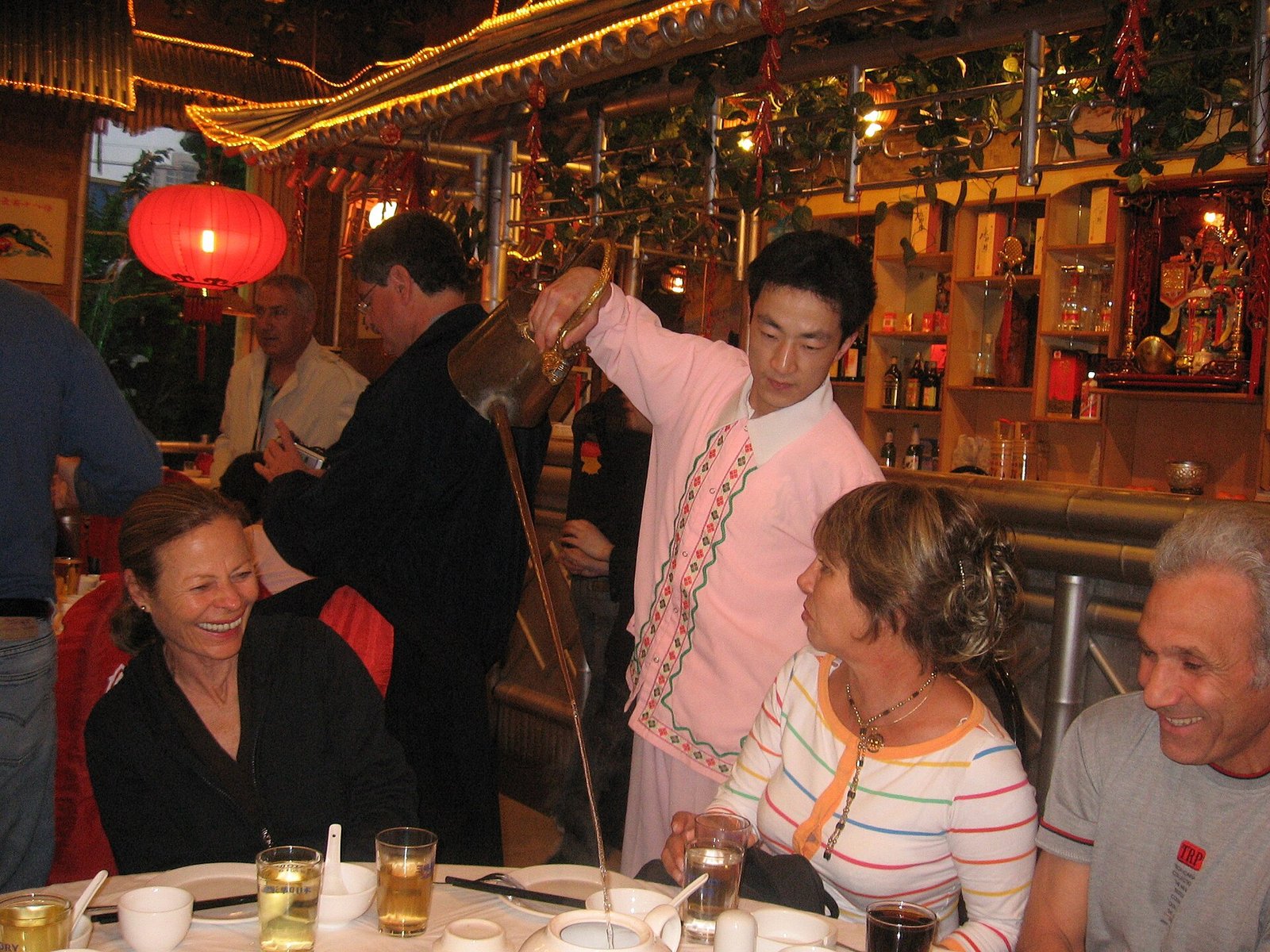
Rule 11 — To signal a refill, leave the lid off the pot or rest it askew. In Cantonese teahouses, an upturned lid or one perched on the rim means “more hot water, please”. In the north, simply catching the waiter’s eye works. Either way, tea is free bottomless water at most restaurants, not a product.
Rule 12 — Call the bill the same way you called the waiter. “Mǎidān!” (买单, “settle the bill”) or “jiǎngdān” in the north. The bill comes to the table; payment is usually by phone scan, sometimes at a counter by the door.
Rule 13 — Tipping is not expected. Restaurants, taxis and barbershops do not expect tips, and a cash tip can produce genuine confusion. Rounding up on a phone payment is not a thing; just pay the amount. The exception is high-end international hotels and restaurants catering to tourists, where a service charge may already be on the bill.
Rule 14 — Fighting for the bill is a social performance. Whoever invites pays. The guest makes a sincere show of insisting, and loses gracefully. Among friends, the convention rotates — the person who paid last time is exempt. Splitting evenly by app is common among younger urban groups but never spring it on a formal dinner. The full theatre is described in my guide to communal eating in China, where the bill fight sits alongside seating and serving rules.
Is it rude to leave food on the plate?
Not in the way Western manners warn against, but the etiquette runs the other way. In a Chinese meal dishes are shared and placed in the centre, so your own bowl should not be piled high; taking a little from several dishes is normal, and finishing your personal rice is fine. What reads as off is flipping chopsticks upright in the rice — that mimics a funeral offering — or pointing them at someone. Leaving a spoonful of shared food uneaten is unremarkable; cleaning a communal dish to the bone can signal the host under-ordered. One honest caveat: toothpicks at the table are normal, but cover your mouth, and never stick one in your mouth while talking.
At the Table
Rule 15 — Chopsticks upright in rice is the one genuine taboo. It resembles incense at a funeral and is read as a death wish, not a joke. Rest them on the rest or across the bowl. Passing food chopstick-to-chopstick carries the same association and is avoided for the same reason.
Rule 16 — Take from the far side of shared dishes. Do not dig for the best piece, and do not put back food you have already touched. Serving spoons appear more and more often since the SARS era; use them when they are there. The wider system of shared plates is set out in the round-table rules of the Chinese banquet, from lazy Susan direction to toast glass height.
Rule 17 — Slurping, burping and bones on the table are all fine. Slurping noodles is normal; a small belch is tolerated; shells and bones go on the plate or the table edge, not in a napkin. Blowing your nose loudly at the table is the one universally condemned act, along with talking with your mouth full.
Rule 18 — Photograph the food freely, the people never. Food photography is now completely normal, and nobody will think you odd. Photographing other diners, or the staff without asking, is where the line sits.
Rule 19 — A toast is drunk together. Gānbēi (干杯, “dry the glass”) means the glass is emptied, not sipped. Hold your glass lower than a senior’s when you clink. Refusing a toast outright is rude; a murmured “wǒ bù huì hē” (我不会喝, “I can’t drink”) plus a tea cup raised instead is the graceful exit, and it works.
Rule 20 — Take the leftovers home. Doggy bags are normal and expected; a packed box signals the meal was valued. The one exception is a formal banquet, where abundance is the message and packing undercuts it.
Rude, Fine, and Somewhere Between
Not everything that feels awkward to a Westerner is actually rude, and the reverse is also true. The gap is worth internalising:
| Behaviour | Verdict | Notes |
|---|---|---|
| Chopsticks upright in a rice bowl | Genuinely offensive | Funeral association; the one absolute rule |
| Finger-snapping at staff | Rude | Reads as animal-handling |
| Digging through a shared dish | Rude-ish | Take from the near edge, not the centre |
| Loud talking, laughing | Fine | A lively table is a compliment to the food |
| Slurping noodles | Fine | Even expected; it cools the noodles |
| Asking for a fork | Fine | They will bring one without judgement |
| Finishing every grain of rice | Fine | Some read an empty bowl as “not enough food was served” |
| Photographing your own food | Fine | Completely normal now |
| Blowing your nose at the table | Rude | Step away |
| Tipping | Confusing, not rude | Pay the bill amount exactly |
Frequently Asked Questions
What if I cannot use chopsticks at all?
Ask for a fork (chāzi 叉子) or a spoon (sháozi 勺子) — no one minds, and many restaurants keep them. You can also request a plate and use the serving spoons. Nobody will comment beyond a friendly offer to teach you the grip.
How do I know when a restaurant is good?
Watch the occupancy at 7pm, look at what the regulars order, and check whether the kitchen is visible. Empty restaurants with picture menus near tourist sites are the ones to avoid; crowded ones with handwritten specials boards are the ones to enter. A day of eating in Chengdu will teach you this faster than any list.
Is it rude to eat only the rice and not taste the dishes?
Among friends, slightly — the shared-plate format assumes grazing across the table. If you are genuinely full, leave rice rather than picking at dishes. The etiquette of the shared table is the subject of Chinese dining culture more broadly.
Can I bring my own drinks?
No, not in restaurants — unlike some other countries, bringing outside alcohol is generally not accepted, and there is usually a corkage-style rule against it. Buy the beer or the tea; both are cheap.
What if the waiter speaks no English and I speak no Chinese?
Pointing, numbers on the menu, and the phrasebook app on your phone solve 95% of meals. Learn four phrases — “this one” (zhège), “how much” (duōshao qián), “delicious” (hǎochī), and “bill please” (mǎidān) — and the rest is gestures. For tea and dim sum rituals specifically, the tea and food pairing guide covers what to order and in what order.
The Point
Chinese restaurant etiquette is not a minefield; it is a short list of signals, most of which you already half-know. Call for service, order by pointing, pour tea for others, keep the chopsticks out of the rice bowl, let the host pay, and take the box home. Do those six things and you will eat better than most visitors, because the staff will relax around you — and a relaxed Chinese kitchen is the best kitchen in the world.