Pork Lard (Zhu You): The Cooking Fat That Was Replaced and Should Not Have Been
Fact-checked and reviewed 31 October 2026 · China Food Way editorial team
The first time I asked a British butcher for pork back fat, he looked at me as though I had requested something indecent. “You want the fat,” he repeated, slowly, as if my English had failed me. “For the dog?” He eventually produced a modest tray of trimmings from the back of the shop, charged me very little, and I went home and rendered them into the most useful cooking fat I own. What follows is several years of that habit, plus one scorched pot.
The Fat That Ran Chinese Kitchens
Before the supermarket shelf filled with bottles of rapeseed, sunflower and soybean oil, the cooking fat of a Chinese kitchen was animal: pig fat, rendered from the back and kidneys. Pigs convert household scraps into fat efficiently, fat keeps without refrigeration, and a jar of lard means you never need to buy cooking oil at all. Every region used it, from the red-braised dishes of the south to the wheat-flatbread kitchens of the north-west.
Lard is simply pig fat separated from its tissue by heat — a process called rendering. As Britannica’s overview of the fat notes, the finest grade, neutral lard, comes from the leaf fat around the kidneys, while back fat gives a slightly more flavoured render; the crispy residue has its own name in English: cracklings. Lard is not a novelty ingredient or a heritage fetish. It is a practical fat with a job that oil does badly.
My own reason for returning to it was not nostalgia. It was a fried green vegetable.
Why Lard Behaves Differently From Oil
Lard is roughly 40 per cent saturated fat, most of the remainder monounsaturated — the same oleic acid that dominates olive oil. That gives it two properties that matter in a wok.
It is a soft solid at room temperature and melts cleanly, so it becomes part of a dish rather than sitting on it: a spoonful stirred into a hot bowl of noodle soup disperses into a faint haze that carries flavour across the broth. It also takes high heat without breaking down as fast as polyunsaturated oils do — its smoke point sits around 190°C — and its flavour is neutral enough that it seasons rather than competes. Butter scorches; rapeseed oil survives the heat but contributes nothing.
| Pork lard | Rapeseed oil | Butter | |
|---|---|---|---|
| State at room temperature | Soft solid | Liquid | Soft solid |
| Smoke point | ~190°C | ~200–230°C | ~150°C |
| Saturated fat | High (~40%) | Low (~7%) | High (~50%) |
| Flavour | Neutral, faintly sweet | Neutral, sometimes grassy | Milky, rich |
| What it adds to a dish | Coating, body, gloss | Nothing but fat | Its own flavour |
| Good for | Stir-fries, noodle bowls, pastry | Deep-frying, neutral cooking | Baking, finishing |
In short: lard is not a magic fat, and oil is not a poison. But for quick, dry, high-heat cooking of vegetables and noodles, lard does a job that oil visibly fails at. Once you have seen the difference on a plate of greens, you cannot unsee it.
How do I render lard at home without it burning?
Keep the heat low and leave a little water in the pot until the fat has fully melted. For dry rendering, cut pork back fat into 1 cm cubes, add a tablespoon of water to a heavy pot, and set it over a low flame with no lid. The water steams off in the first ten minutes, then the fat melts slowly; after 45 to 60 minutes the cubes shrink, sink and turn golden, which is the moment to stop. Wet rendering — cubes covered with 2 cm of water — is slower but cannot burn and gives whiter lard. The oven method, fat in a dish at 120°C for two hours with an occasional stir, is the safest of all. My first hob batch tasted of a burnt candle and went in the bin, so trust the low heat over the clock.
Rendering Lard at Home
Buy pork back fat (背膘 bèibāo, sold as “fatback” or pork cutting fat) from a butcher who cuts whole carcasses; Asian butchers stock it, and Chinese supermarkets sell it pre-cut. You want fat that is firm, white, and smells of nothing at all; any greyness, any smell of the shop floor, and you walk away.
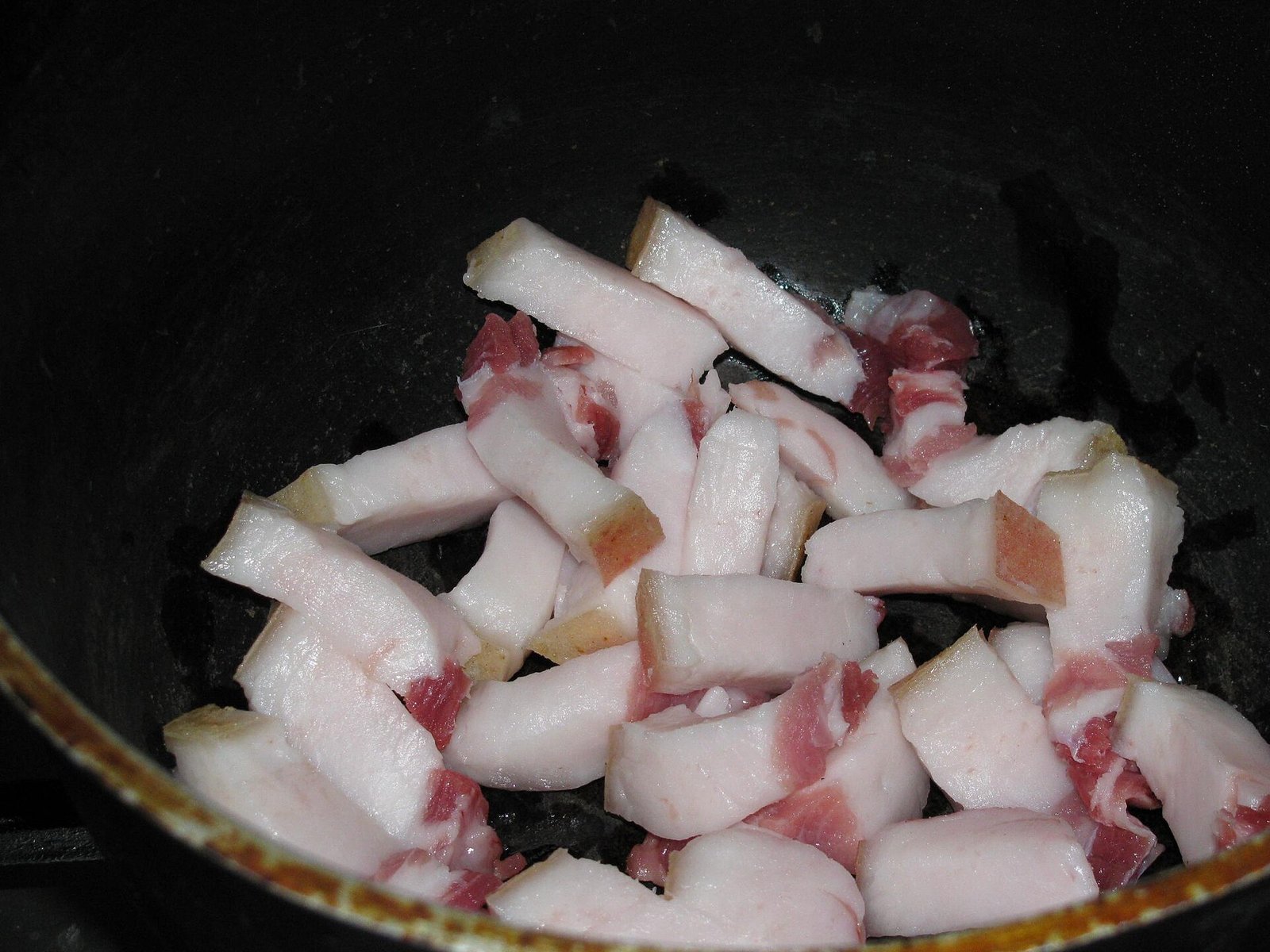
There are two methods, and they produce different lard.
Dry rendering — cut the fat into 1 cm cubes, put them in a heavy pot with a tablespoon of water, and set over a low flame, no lid. The water steams off in the first ten minutes; after that the fat melts slowly. Stir every few minutes at first, then more often as the liquid deepens. After 45 to 60 minutes the cubes shrink, sink, and turn golden: that is the moment to stop. Strain through a fine sieve for pale gold lard with a toasted edge — roughly 80 per cent of the fat’s weight.
Wet rendering — the same cubes, covered with about 2 cm of water, simmered gently until the water evaporates. Slower, but it cannot burn, and the result is a whiter, more neutral lard — the one for dishes where the fat should disappear.
The oven method — fat in a heavy dish, 120°C, two hours, an occasional stir — is the safest of all. This is the voice of experience: my first attempt on the hob produced lard that tasted of a burnt-out candle, and I threw the whole batch away.
Pour the strained lard into a clean, dry glass jar while hot and let it set uncovered, turning from amber to ivory white as it cools — the moment cooks photograph and post.
What can I do with the cracklings besides snacking?
Eat them warm and salted, or use them as a garnish — binning yóuzhā (油渣), the cracklings, is a small waste. Straight from the sieve they taste like a cross between pork scratchings and popcorn. Stir-fry them with garlic chives and light soy, the northern habit; fold chopped cracklings into fried rice in place of char siu; or scatter them fine over plain noodles. The dish that made me a convert takes five things and no cooking: hot white rice, a spoonful of lard, a few crumbled cracklings, and a splash each of black vinegar and light soy. They are also the ancestor of the lard-and-rice bowls now charged at a premium in restaurants, so the cheapest supper in the house is worth keeping.
The Cracklings (Zha You Zha)
The crispy bits left in the sieve are 油渣 (yóuzhā) — cracklings — and throwing them away is a small crime. Eat them warm, salted: they taste like a cross between pork scratchings and popcorn. They are also a cooking ingredient in their own right.
Stir-fry them with garlic chives and light soy — a dish that appears on northern tables — or fold them into fried rice in place of char siu; chopped fine, they scatter well over plain noodles. The classic use is the one that made me a convert: a bowl of hot white rice, a spoonful of lard, a few cracklings crumbled over, and a splash of black vinegar and light vs dark soy sauce. Five ingredients, no cooking, better than most things you can order. That small bowl is the ancestor of 猪油拌饭 (zhūyóu bàn fǎn, lard mixed with rice), a poor household’s supper that restaurants now charge a premium for.
Where does a spoonful of lard actually improve a dish?
Lard earns its place in four specific moments, and nowhere else. In noodle soup, stir ½–1 teaspoon into the empty bowl before the broth; it melts into a haze that turns soup into broth. For stir-fried greens, use 1 teaspoon with the garlic at the start so the leaves glaze instead of sitting in oil. In layered bread — scallion pancakes, shaobing — work 1–2 tablespoons of solid lard into the dough; because it is firm at room temperature it holds the layers apart until heat melts them, where oil simply soaks in. Last, a bare ½ teaspoon of lard off the heat at the end of fried rice gives the grains a faint richness without tasting of pork. Use it in those spots and the difference is visible on the plate.
Where Lard Earns Its Place
A spoonful of lard goes into my kitchen at four specific moments, and nowhere else.
In a bowl of noodles before the soup. This is the northern habit, and the most convincing use. The lard melts in the hot broth, and the difference between the bowl with and the bowl without is the difference between soup and broth. It works the same way in any bowl of chinese noodles.
In the wok, for greens. Heat a teaspoon of lard in a hot wok until it shimmers, then flash-fry Shanghai greens, choi sum, or water spinach with garlic. The greens come out glossy and coated rather than slick, with no oil pooling on the plate. This is where the heat-and-motion principle of a wok matters most: the fat must be hot enough to sear on contact, so the lard goes in first and the greens follow within seconds.
In the dough for layered bread. Scallion pancakes and flaky shaobing get their layers from a flour-and-lard paste rolled between folds. Oil works; lard works better, because it is solid at room temperature and holds the layers apart until the heat melts them. Most Chinese bread is steamed or griddled rather than baked, and the fat inside it was traditionally lard.
A spoonful in fried rice, at the end. Not enough to taste, just enough to give the grains a faint richness — half a teaspoon per portion.
| Use | Amount | When it goes in | What it changes |
|---|---|---|---|
| Noodle soup | ½–1 tsp | In the empty bowl, before the broth | Body and aroma across the whole broth |
| Stir-fried greens | 1 tsp | With the aromatics, at the start | Gloss and coating, no oily plate |
| Layered bread dough | 1–2 tbsp per portion | Rolled into the dough | Flakiness, tenderness |
| Fried rice | ½ tsp | Off the heat, at the very end | Richness on the grains |

How long does home-rendered lard keep in the fridge?
Stored properly, home-rendered lard keeps about three months in the fridge and far longer frozen. Pour it hot through a fine sieve into a clean dry glass jar and leave it uncovered until set; a uniform ivory colour and a neutral smell are the marks of good lard, and the ingredient list on a bought tub should read only ‘pork fat’. Avoid anything with preservatives, antioxidants or added flavour — that is industrial shortening dressed up. Leaf lard, bǎnyóu (板油), from around the kidneys, is milder and whiter than back-fat lard and worth seeking. One honest caveat: if the jar ever smells off or shows greyness, throw it out rather than tasting it, because rancid fat will not recover.
How to Choose, Store and Substitute
Choosing. If you are buying rendered lard rather than making it — Chinese supermarkets sell it as white blocks or tubs, sometimes with a cracklings layer — look for a uniform ivory colour, a neutral smell, and an ingredient list that reads simply “pork fat”. Anything with preservatives, antioxidants, or added flavour is industrial shortening dressed up as lard, and it will not perform the same way. Home-rendered lard from back fat has a faint porkiness; leaf lard (板油 bǎnyóu, from around the kidneys) is the premium grade, milder and whiter, worth seeking out.
Storing. Fridge, always, in a sealed jar — it keeps six months. Freeze it in ice-cube trays if you render more than you will use. Never soften lard in the microwave; it renders unevenly and the edges cook. A spoon dipped in hot water cuts a clean scoop from a cold jar. Rancid lard smells like old paint or crayons and yellows at the surface. When that happens, it goes in the bin, not the wok.
Substituting. Honestly: nothing substitutes for lard’s combination of flavour, texture and heat tolerance. If you are avoiding pork, the closest stand-ins are butter (flavour, but a lower smoke point and a milkiness that shows) and refined coconut oil (solid at room temperature, high smoke point, but a sweetness that suits only some dishes). For layered bread dough, vegetable shortening is an acceptable technical substitute, though a bland one. If a recipe simply calls for cooking fat and you have no reason to avoid pork, use lard — it is cheaper than butter and better behaved than most oils.
The Health Narrative, Re-examined
I am not a nutritionist and this is not health advice, so here is only the cooking part. The lard-should-never-be-eaten narrative was built in the twentieth century, just as industrial shortenings — hydrogenated to be solid, full of trans fats — replaced both lard and butter in commercial food. Natural lard, unhydrogenated, contains no trans fat. The subsequent half-century of research has complicated the simple “saturated fat equals harm” story considerably; the careful current consensus is far less certain than the confident 1980s version. What nobody disputes is that any fat is a calorie-dense food to be eaten in sensible amounts. My own position is culinary: I use lard where it performs, which is perhaps three meals a week, and not where oil does the job just as well.
Frequently Asked Questions
Is lard the same as schmaltz or dripping?
No. Schmaltz is rendered chicken fat, and dripping is the fat that collects under roasted meat, usually beef. Lard is pig fat specifically, and the only one of the three neutral enough for these uses.
Can I use bacon fat instead?
You can, and it is delicious, but it is not lard. Bacon fat carries smoke and salt, so it seasons whatever it touches. Fine for fried eggs and cabbage; wrong for a sweet pastry dough or a clear soup.
My rendered lard went grey and smelly. What happened?
It was either strained incompletely — protein particles in suspension spoil fast — or stored too warm for too long. Strain carefully through a fine sieve or cheesecloth, keep the jar in the fridge, and always use a clean, dry spoon.
Do I need to add anything to preserve it?
No. Properly rendered and strained lard keeps for months in the fridge without any additive. Room-temperature keeping is the traditional method — render it hard and store it covered in a cold cellar — but the fridge is simpler and safer.
Is leaf lard worth hunting down?
If you bake Chinese-style layered pastries or want the mildest fat for sweet doughs, yes: finer-grained, whiter, almost flavourless. Back-fat lard is perfectly good for everyday cooking, which is what most of us need.