Sesame Chicken: Batter, Sauce, and the Sesame Question
Last reviewed 31 October 2026 · China Food Way editorial team
The first time I made sesame chicken, the crust survived for about ninety seconds. It came out of the fryer properly crisp — I had heard about cornstarch, I had done the reading — and then I poured over a sauce I had made too thin, carried the plate to the table at walking pace, and watched the coating absorb every drop of it and turn into wet breadcrumbs. My girlfriend ate it politely and said it tasted “saucy”. I have never been so clearly managed.
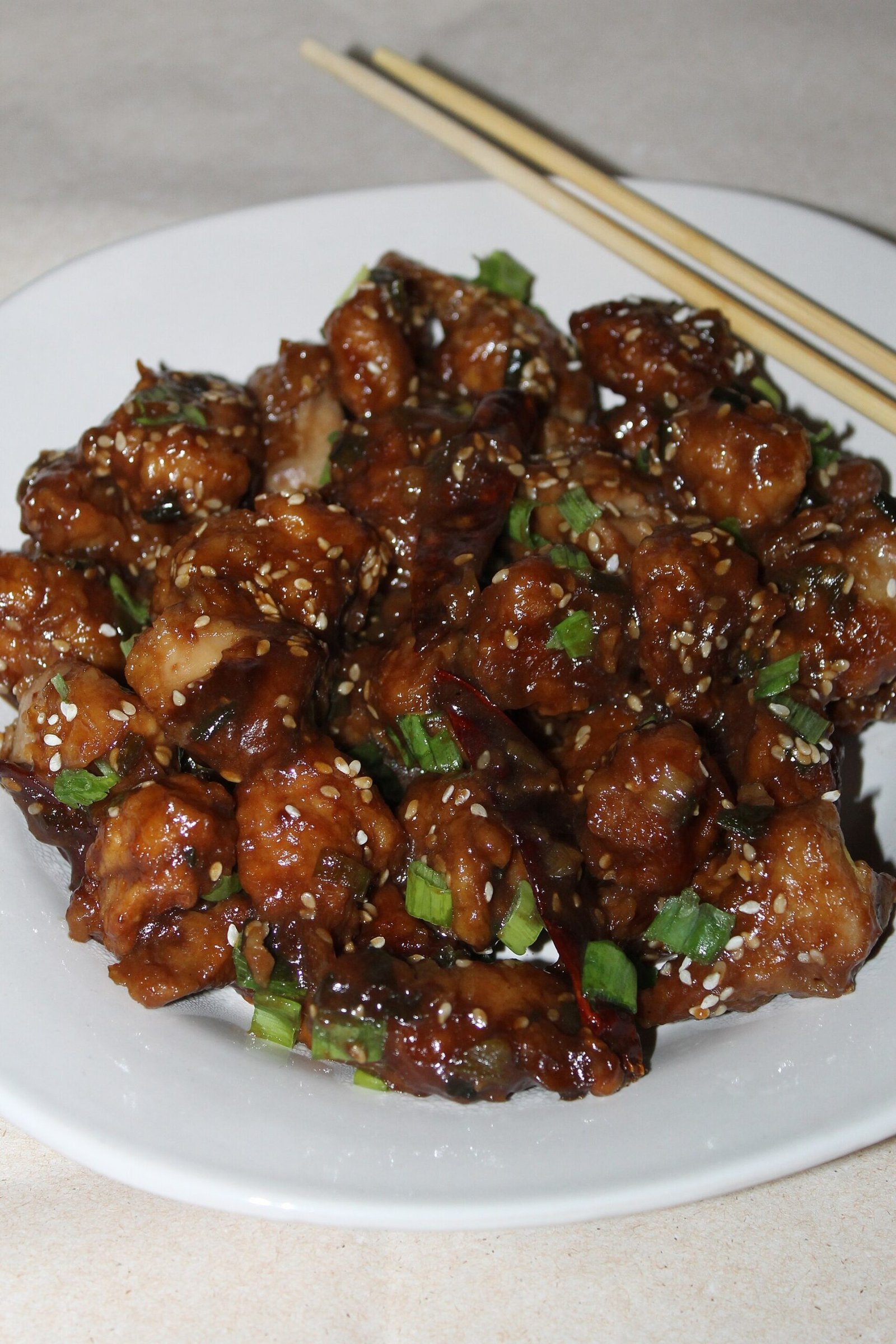
The sesame was the other lesson. I had scattered raw seeds over the top, because the picture I was working from had sesame on it and nobody had mentioned toasting. Wikipedia’s entry on the dish is almost smug about this: the seeds, it notes, “may or may not be toasted, hence the name sesame chicken.” A sentence that reads like a sigh from someone who has eaten a great deal of bad sesame chicken. Between that raw garnish and my soggy crust, the dish I had grown up ordering was not the dish I had made. Three fixes later, it is.

Can I use black sesame seeds instead of white ones?
You can, but they are harder to read in the pan and slightly earthier, so I stick with hulled white for this dish. The trouble is colour: toasted white seeds go from pale gold to burnt in about fifteen seconds of inattention, and black seeds give you no visual warning at all. Toast them two or three minutes in a dry pan over medium heat until they start to pop and jump, then pull them immediately and tip them onto a cold plate so they stop cooking. Black sesame also stains the pale sauce a muddy grey if you toss too vigorously. If you do use them, scatter at the table rather than in the pan.
The Sesame Question: Garnish or Ingredient
In most takeaway kitchens the sesame is decoration. It is sprinkled on at the pass, it photographs well, and it contributes a faint chalky bitterness that most people register without noticing, because the sauce is loud enough to talk over it. Toast the seeds and they stop being decoration. Two or three minutes in a dry pan over medium heat is enough: they will start to pop, jump an inch or so off the surface, and smell like toasted nuts rather than like dry grass. Pull them the moment they colour — the difference between toasted and burnt is about fifteen seconds of inattention.
The forms of sesame are not interchangeable, and the table below is the short version of a lesson I paid for twice.
| Form | Raw flavour | What it does in this dish | Verdict |
|---|---|---|---|
| White sesame, raw | Papery, slightly bitter | Visual only | The takeaway default, and the weakest option |
| White sesame, toasted | Nutty, sweet | The standard garnish | Always do this |
| Black sesame, toasted | Earthier, faintly bitter | Contrast against the amber glaze | Half white, half black, for looks and depth |
| Sesame oil | Overpowering raw | A few drops in the sauce, off the heat | Fragrance, never a cooking fat |
| Sesame paste | Rich, thick | A sauce variant of its own | See below |
That last row is the interesting one. There is a school of sesame chicken that treats Chinese sesame paste as a sauce ingredient rather than a garnish — a spoonful whisked in with the soy and sugar, which gives the glaze a rounded, almost peanut-butter body. It is not the takeaway version, but it is closer to how sesame behaves in Chinese cooking generally: as a fat that carries flavour, not as a seed that dots the plate. I make it both ways. The paste version is what I cook for people who say they do not like “sweet Chinese food”, because the paste tilts the sauce savoury.
What happens if I use plain flour in the batter?
You get a bready, slightly dull crust that goes limp within a couple of minutes instead of staying crisp. Flour brings gluten, and gluten holds water; even a thin coating steams itself from the inside once it meets the sauce. Cornstarch has no gluten, browns more slowly, and dries into a glassy shell that resists moisture for far longer. I coat the pieces twice — a light dusting, a brief rest so it hydrates, then a second dusting — and never add egg, which makes the coating cakey. The only caveat is heat: at 180°C a flour batter darkens before the chicken is cooked through, whereas cornstarch buys you the time to get the inside right.
The Batter: Cornstarch, Twice, and Why Not Flour
My first attempt used a flour dredge, because that is what I knew from frying chicken at home. It fried up dense and bready, and under a wet sauce it went soggy in the time it took to plate. Flour contains gluten; gluten gives you chew, and chew is the opposite of what a sauce is about to do to your crust. Cornstarch is pure starch with no protein structure — it fries into a glassy, shattering shell that has nothing to tighten up and turn leathery.
The method that finally matched the takeaway texture is the double dredge: cubed chicken thigh goes through cornstarch, then beaten egg, then cornstarch again. The first pass dries the surface so the egg sticks instead of sliding off; the second pass builds the craggy, irregular crust that shatters when you bite it. A single pass gives you a smooth shell, which is fine but reads as a coating. Two passes give you peaks and valleys, and the valleys are where the sauce pools.
| Coating | Frying result | Behaviour under sauce | Notes |
|---|---|---|---|
| Plain flour | Dense, bready crust | Soggy fastest | Gluten is the problem |
| Cornstarch, single pass | Smooth, glassy, thin | Holds five minutes | The simple version |
| Cornstarch, double dredge | Craggy, crunchy, thick | Holds ten-plus minutes | The takeaway texture |
| Potato starch | Very crisp, translucent shell | Softens quickly once sauced | Best eaten straight from the wok |
Potato starch deserves its own sentence, because the question comes up constantly: cornstarch versus potato starch is not a one-sided argument. Potato starch fries to an almost absurd crispness — a shell that shatters like a tempura crumb — but it is thirstier, and once the sauce hits it, it drinks faster. If you are going to eat within five minutes of tossing, potato starch is the more impressive crust. If there is any chance the plate will sit, cornstarch is the safer architecture.
Cut the thigh into 3 cm cubes, against a board you have dried properly. Wet chicken makes the dredge clump, and clumped dredge fries into doughy nuggets with bald patches.
How hot should the oil be for the second fry?
Around 190°C, and for no more than thirty to forty seconds — the second fry is about the crust, not cooking the chicken. The first fry runs at roughly 170°C until the pieces are pale gold and cooked, then they rest on a rack for five minutes. That rest is not fussy: it lets steam escape, so the second, hotter dip drives off surface moisture rather than trapping it. Crowding is the failure mode here. Drop in too many pieces at once and the oil temperature plunges, the coating drinks fat, and you lose the crackle you were trying to build. Fry in two batches and let the oil come back up between them.
Frying: Two Stages, and the Rest That Matters
Heat 3 cm of neutral oil to 160 °C. If you do not have a thermometer, the wooden-chopstick test works: a chopstick tip dipped in the oil should produce a lively but not frantic stream of bubbles. Fry the dredged chicken in two batches — crowding drops the oil temperature and steams the crust instead of frying it — for four minutes, until the chicken is cooked through and the crust is the colour of weak tea. Lift it out and rest it on a wire rack, not paper towel; paper towel traps steam underneath and softens the base of every piece.
Then the second stage. Bring the oil to 190 °C and return the rested chicken for sixty to ninety seconds. This is not about cooking — the chicken is already cooked — it is about driving off the last of the surface moisture so the crust sets hard. The rest between stages matters as much as the heat: it lets internal steam escape, so the second fry is drying the surface rather than building pressure inside it.
The Sauce: Thicken It Before It Touches the Chicken
Here is the failure from my first attempt, stated plainly. A sauce that is not thickened will soak any crust you put it on, no matter how well you fried it. The glaze needs body before it meets the chicken, and the takeaway version gets that body from a starch slurry stirred into the simmering sauce.
For 250 ml of liquid — chicken stock, or water with a crumbled stock cube if that is the honest truth of your cupboard — use 2 teaspoons of potato starch whisked with 2 tablespoons of cold water, and stir it through off the heat. Potato starch rather than cornstarch, deliberately: it gives the sauce a clean, clear gloss and a cling that survives the toss, where cornstarch turns the glaze faintly cloudy and pasty if it sits. The flavour base is deliberately plain. Two tablespoons each of sugar and rice vinegar, a tablespoon of light vs dark soy sauce — light for the salt, dark for the colour, and that is the entire division of labour between them — a teaspoon of tomato ketchup if you want the takeaway roundness, a finely minced garlic clove and a coin of ginger, both fished out before the chicken goes in. Simmer for two minutes until the sauce will coat the back of a spoon and leave a clean trail when you drag a finger through it.
How long can the tossed chicken sit before the crust goes soft?
Ninety seconds, in my kitchen, measured the hard way. My first batch left the fryer properly crisp, met a too-thin sauce, and then I carried it to the table at walking pace; by the time I sat down the coating had absorbed every drop and turned to wet breadcrumbs. Two fixes: thicken the sauce in the pan until it coats a spoon before it ever touches the chicken, and toss off the heat for no more than thirty seconds. Get it onto a warm plate immediately. A residual pool of sauce at the bottom of the wok is a good sign — it means you did not drown the crust trying to be generous.
The Toss: Thirty Seconds, Pan to Plate
Keep the sauce warm, not hot, in a wide pan or wok. Add the twice-fried chicken and toss for thirty to forty-five seconds — long enough for the glaze to film every surface, short enough that the crust is still doing structural work when the plate lands. Then plate it immediately. There is no resting period for sesame chicken; the dish exists for about five minutes at its best, which is why the good takeaway kitchens fry to order and refuse to make it in advance.
The same sauce-and-crust architecture, minus the dried chillies, is what makes General Tso’s chicken work, and the two dishes fail in exactly the same way when the glaze is too thin. What you are aiming for is a sauce that clings to the crust like a lacquer rather than pooling at the bottom of the plate like a broth.

What Goes Beside It
Steamed broccoli, always — the dish’s default companion, and not a garnish but a deliberate counterweight to all that sugar. Baby corn or mangetout work if that is what you have. And rice, obviously, but pay attention to it: a plate of sesame chicken lives or dies on cooking chinese rice properly, because plain, slightly dry rice is the only thing that stands up to a sauce this assertive. The whole construction — crisp protein, glossy sauce, plain starch, steamed green — is a Cantonese banquet logic transplanted to a takeaway menu, and Cantonese cuisine has been running the texture-versus-sauce play for a lot longer than any of us have been ordering in.
Frequently Asked Questions
Why did my sesame chicken go soggy?
Almost always one of three causes: the sauce was not thickened, the chicken sat after tossing, or the plate was covered and trapped steam. Check the sauce consistency first — it should leave a clean trail on the back of a spoon.
Do I really have to toast the sesame?
You do not have to, but you should. Three minutes in a dry pan transforms the seeds from chalky decoration into an actual ingredient, and it is the single highest-return minute in the whole recipe.
Thigh or breast?
Thigh. Breast dries out during the four-minute first fry and stays dry under the sauce. If breast is all you have, cut the cubes larger and pull them at three and a half minutes.
Can I bake it instead of frying?
You can get halfway there. Toss the dredged chicken in a generous amount of oil, bake at 220 °C for eighteen to twenty minutes, turning once, and accept a crust that is crisp but not shattering. The sauce does most of the persuasive work anyway.
Can I make it ahead?
Fry the chicken up to two hours ahead and hold it at room temperature on a wire rack. Make the sauce at the last moment, re-crisp the chicken at 190 °C for sixty seconds, then toss and serve. Do not combine them until the plate is already on its way to the table.
Is this anything like the sesame chicken in China?
Not really, and that is not a problem. The dish is a Chinese-American construction with a Cantonese ancestry, built around a batter-and-sauce logic rather than a regional recipe. Judging it against a Chinese original misses the point — it is a good idea that happened on a different continent.