Chinese Poultry: Chicken, Duck and the Whole-Bird Rule
Last reviewed 31 October 2026 · China Food Way editorial team
The first time I bought a chicken in a market in Guangzhou, I asked for it jointed and the woman behind the counter looked at me as though I had asked her to remove the flavour. She asked a question I did not understand. Her husband repeated it more slowly. Eventually I understood the shape of it: did I want it cut up, or did I want a chicken? What arrived was a bird, head and feet included, dispatched with one stroke of a thin-bladed cleaver onto a wooden block stained dark with thirty years of doing exactly this, and chopped into about twenty pieces — each with a fragment of bone in it, some with a knob of spine, none of it resembling anything I had ever bought in a supermarket.
That bone is the point, and it took me years to understand why. As Wikipedia’s overview of Chinese cuisine notes, the regional traditions differ enormously in almost everything, but the preference for cooking whole birds and dividing them afterwards runs across the lot of them. In Western butchery, bone is waste and offcuts are a downgrade. In Chinese cooking the bone is equipment: it conducts heat unevenly, it holds the meat together as it contracts, it leaks collagen and marrow into whatever the bird is sitting in, and its presence tells you the chicken was an actual chicken rather than a processed unit. It is also why every Chinese poultry dish comes with an unspoken warning: mind the bones, and do not swallow anything you have not looked at.
Why the Bird Is Always Whole
There is a practical logic here and a social one, and they reinforce each other.
Practically, Chinese poultry is almost never cooked as a portion. The bird goes into a pot whole, or split and flattened, or hung in a window, and it is divided after cooking rather than before. This changes everything about how the meat behaves. A breast off the bone overcooks in minutes and comes out chalky; a whole bird brought slowly to temperature comes out silky, because the bones buffer the heat and the skin stops the breast drying out. I have tested it at home with two birds from the same supplier: the jointed one cooked in half the time and was chalky at the thick end while its wings were falling apart.
Socially, the whole bird is a statement. At a banquet a chicken arrives reassembled — head, feet and all — because removing parts before serving would suggest you were economising. The head goes to the guest of honour. The feet, which most foreigners decline, are the part regulars quietly fight over.
The Cleaver and the Wooden Block
You cannot do this with a Western knife, and not because Western knives are bad. A Chinese cleaver used for bone is a thin, heavy blade that falls rather than cuts; you lift and drop rather than press. That is why the traditional block is a cross-section of a tree trunk rather than a plastic board — it has to absorb the impact. Chicken bone, being hollow and brittle, parts cleanly under this treatment in a way it never will under a sawing motion, but it does throw splinters, which is the reason Chinese cooks rinse chopped chicken and pick through it before cooking.
A chef chopping roast duck for the table uses the same blade at speed, and watching someone competent do it is one of the small pleasures of eating out in China: eight strokes, a reassembled bird, and a pile of bones pushed to one side.

Four Regional Signatures
Ask what the great Chinese poultry dishes are and you get four answers that have almost nothing in common beyond the bird.
| Dish | Region | Core technique | What it tastes like |
|---|---|---|---|
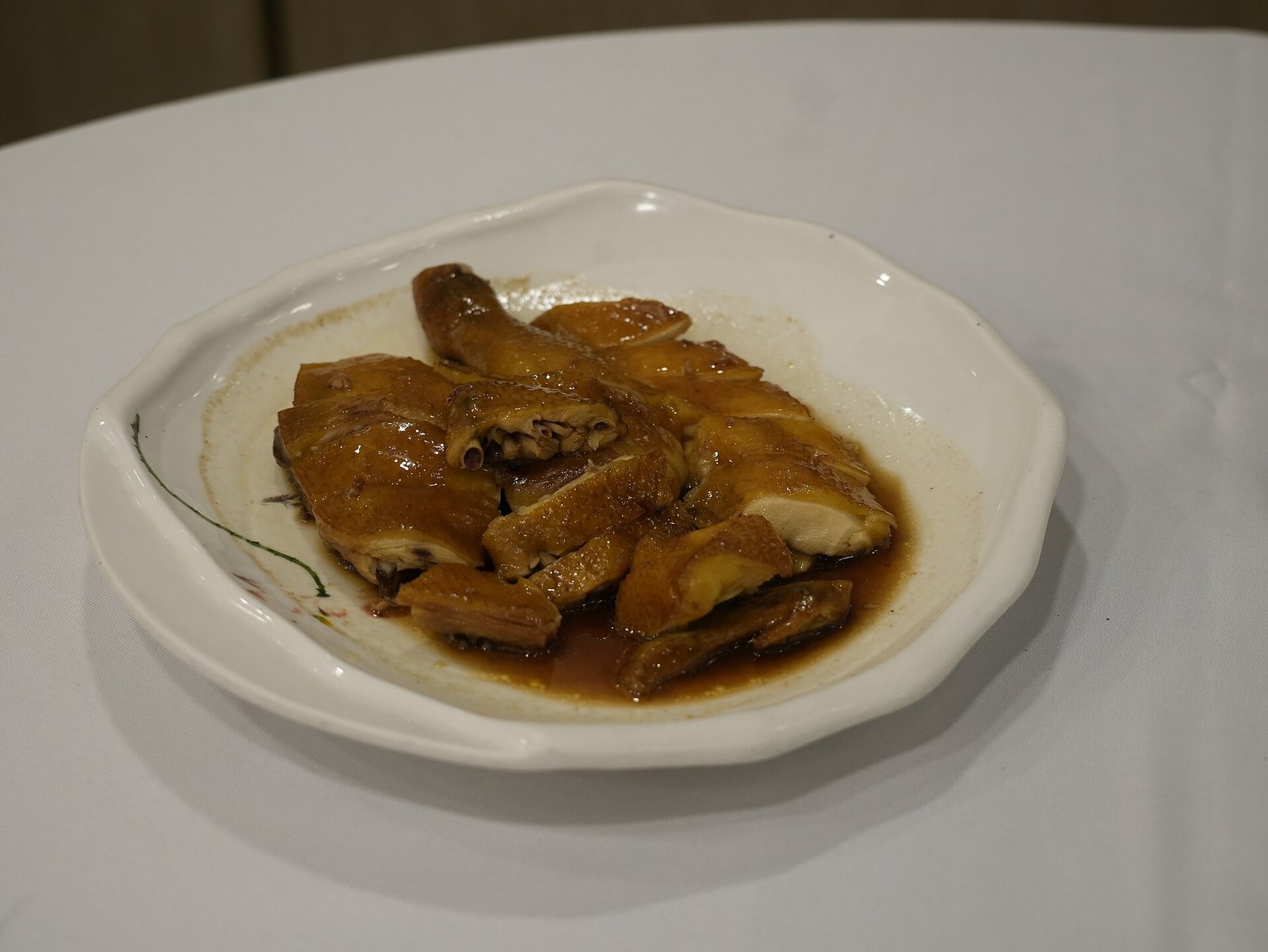
| White-cut chicken (白切鸡) | Guangdong | Poached below simmer, iced | Clean, chickeny, skin with a jelly layer |
| Mouthwatering chicken (口水鸡) | Sichuan | Poached, iced, sauced cold | Numbing, sesame-rich, bright red oil |
| Peking duck (北京烤鸭) | Beijing | Air-dried, maltose glaze, roasted | Glassy skin, almost no meat taste |
| Nanjing salted duck (盐水鸭) | Jiangsu | Brine-cured, gently poached | Pale, salty, firm, faintly herbal |
Why does white-cut chicken need an ice bath?
The ice bath sets the skin and the collagen layer just beneath it; it is not only to stop the cooking. After the bird is held at roughly 90°C for twenty to thirty minutes, it goes straight into iced water. The cold shock contracts the skin and firms the gelatinous layer into a soft jelly — the single detail that separates restaurant white-cut chicken (白切鸡 báqiē jī) from a flabby home version. Ten minutes under a cold tap is not enough; a proper twenty-minute ice bath with the cubes refreshed once makes the difference between worth making and not. Serve it only with ginger-scallion oil: shredded ginger and scallion, salt, and oil heated to just smoking poured over. Nothing else.
The Discipline of White-Cut Chicken
Of the four, white-cut chicken is the one that best explains the whole approach, because there is nowhere to hide. No sauce is cooked with it, no marinade, no browning. The bird goes into water with ginger and scallion, brought to roughly 90°C — below a simmer, so the surface of the broth barely trembles — and held there for twenty to thirty minutes depending on size. Then it goes straight into iced water.
The iced water is not optional and it is not about stopping the cooking. The shock contracts the skin and sets the collagen-rich layer just beneath it into a soft jelly, which is the single thing that distinguishes restaurant white-cut chicken from the flabby version. At home I now use a 20-minute ice bath with a tray of ice cubes refreshed once, and the difference between that and ten minutes under a cold tap is the difference between the dish being worth making and not.
Serve it with ginger-scallion oil: fine shreds of both, salt, and oil heated to just smoking and poured over. Nothing else. In a Cantonese kitchen the dish is a test of ingredient quality more than it is a test of skill, which is exactly why the province is famous for it.
How is mouthwatering chicken different from white-cut chicken?
It keeps the gentle poaching but buries the bird under a cold, bright sauce. The bird is cooked by the same logic — held below a simmer, then shocked in ice — then dressed with chilli oil, sesame paste, black vinegar, sugar, garlic and Sichuan pepper. Three failures to avoid: let the water boil and the skin splits; skimp on the ice bath and the skin will not set; chop it boneless and it reads as a stir-fry rather than cold chicken. The name, ‘saliva chicken’, points at what it does to you, not what is in it. Use a master-stock approach for the poaching liquid if you cook it often, and the batch only improves with each use.
The Sichuan Counterpoint
Mouthwatering chicken takes the same poaching method and inverts the philosophy entirely. The bird is cooked by identical logic — gently, then shocked in ice — and then it is buried under a sauce built from chilli oil, sesame paste, black vinegar, sugar, garlic and Sichuan pepper. The name means “saliva chicken”, and yes, the point is partly that it makes you salivate; the more interesting reading is that it is named for what it does rather than for what is in it.
If you want to cook the Sichuan version properly, the mouthwatering chicken problems worth knowing about are these: the water must not boil, or the skin splits; the ice bath must be genuinely cold, or the skin does not set; and the chicken must be chopped bone-in, because boneless pieces in that much sauce read as a stir-fry with chicken in it rather than as cold chicken.
Why is Peking duck such a long project at home?
Because the skin, not the meat, is the dish, and the skin needs a full day of drying. The bird is scalded, brushed with a maltose-and-vinegar glaze, pumped with air so skin and fat separate, then air-dried for a day or more before roasting until the skin shatters like glass. A proper Peking duck at home is exacting, but the part most cooks skip is the drying, then they wonder why it failed. Nanjing salted duck runs the opposite way: no crispness at all, just dry-cured or brined with salt, Sichuan pepper and star anise, then gently poached to a pale, firm, faintly herbal result closer to mild ham. If you want one duck project that fits a normal kitchen, the Nanjing version is the one to attempt first.
Duck: Two Very Different Ambitions
Chinese duck cooking splits along a line that has nothing to do with geography and everything to do with what the cook wants the skin to do.
Peking duck is a skin dish that reluctantly includes some meat. The bird is scalded, brushed with a maltose-and-vinegar glaze, pumped with air between skin and fat so they separate, air-dried for a day or more, and roasted until the skin is glass enough to shatter. As Wikipedia’s article on Peking duck notes, the dish came south to Beijing with the Yuan court and has been served in specialist restaurants since the Ming era; the modern serving — skin and a thin layer of meat rolled with scallion, cucumber and sweet bean sauce into a thin pancake — is the standardised twentieth-century version. Attempting roasting a duck the Beijing way at home is a two-day project, and the drying is the part most people skip and then wonder about.
Nanjing salted duck goes the other way entirely. There is no crispness anywhere in it. The bird is dry-cured or brined with salt, Sichuan pepper and star anise, then poached gently, and what arrives is pale, faintly pink, firm-textured and deeply savoury — closer to a mild ham than to a roast. Nanjing eats enormous quantities of it and treats a properly pale, un-browned skin as the mark of a good shop. The Nanjing salted duck method is entirely achievable in a home kitchen, and it is the one on this list I would tell a first-timer to attempt.
What do Chinese kitchens do with chicken feet and offal?
They use every part, and none of it is waste. Chicken feet go into stock for their collagen, or are braised and served as a snack. The liver, heart and gizzard are stir-fried, braised or cooked with the bird. At the table the head goes to the guest of honour and the feet are the bits regulars quietly fight over, while most newcomers leave them. The bones themselves are not discarded after carving — they go into the next pot of stock. One honest caveat: bone-in chopping throws splinters, so Chinese cooks rinse the chopped bird and pick through it before cooking. That is why a home version tastes closer to the real thing than boneless supermarket cuts ever will.
The Rest of the Bird
This is where a visitor’s nerve is most likely to go.
Chicken feet are cartilage and skin. That is all they are, and that combination — softened by long braising or steaming until the skin is sticky and the tiny bones can be worked off with the teeth — is the appeal. Cantonese dim sum serves them in black bean sauce; Sichuan does them pickled and sour.
Gizzards are dense muscle, sliced thin and either stir-fried with pickled chilli or served cold. Duck blood is set into a curd and used in soups and hot pot; it tastes like a mild pâté and not, disappointingly or otherwise, of blood. Heads are split and usually fried or braised. Then there are the eggs, which are their own subject — Chinese egg foo young at one end of it and century eggs at the other.
The honest advice is to try the gizzard first. It is the least confronting of the group and genuinely good. Everything else follows more easily after that than you think it will.
Frequently Asked Questions
Why is Chinese chicken served with bones in it?
Bone conducts heat, holds meat together as it contracts, and adds collagen to the dish. Boneless chicken exists in Chinese cooking, but it is usually minced or velveted rather than served as a chicken dish.
Is it rude not to eat the head?
No. Accepting it politely and leaving most of it is completely normal; refusing it outright is the ruder option. And you are expected to chew the bones rather than swallow them.
What is the jelly under the skin of white-cut chicken?
Collagen that gelatinised during cooking and then set during the iced bath. It is the sign of a correctly cooked bird, and a flabby version means the shock missed.
Does the same poaching method work for duck?
Partly. Nanjing salted duck uses gentle heat the same way, but duck is fattier and takes longer to render, and the skin treatment is entirely different.
Which poultry dish should a visitor order first?
White-cut chicken in Guangdong or Hong Kong, because nothing is hidden in it. Then something difficult — a Sichuan mouthwatering chicken — and you will have both ends of the tradition.
Can I buy the right kind of chicken outside China?
Yes, and it matters more than breed: buy a whole bird with the skin on, around 1.5kg, preferably free-range. A breast substitute will not work for any dish on this list.
The Point
The whole-bird rule is not nostalgia or frugality. It is a cooking decision that has consequences you can taste, and once you notice it you will see the same logic running through the rest of Chinese food — the fish served whole, the pork served with its skin and fat, the vegetables cut to match their own grain rather than to a uniform size. Buy the whole bird, learn the iced finish, and learn to chop with the grain of the bone. Everything else on a Chinese poultry menu follows from there.