Ginger in Chinese Cooking: The Root That Does Everything
Last reviewed 31 October 2026 · China Food Way editorial team
The first thing I check when I walk into a Chinese kitchen, professional or home, is the ginger. A kitchen with pale, smooth, thumb-sized young roots belongs to someone who values clarity and speed. A kitchen with tan, knobbly, fibrous old roots belongs to someone planning a three-hour braise.
Ginger does three separate jobs in Chinese cooking, and most home kitchens only use it for the first. It is an aromatic base, the note underneath garlic and spring onion in the wok. It is a cutter of heaviness, the thing that stops a fatty braise from sitting like a lump in your chest. And it is a seasoning in its own right, the bright top note of a dish finished five minutes ago.

Can I tell young ginger from mature ginger just by looking at it?
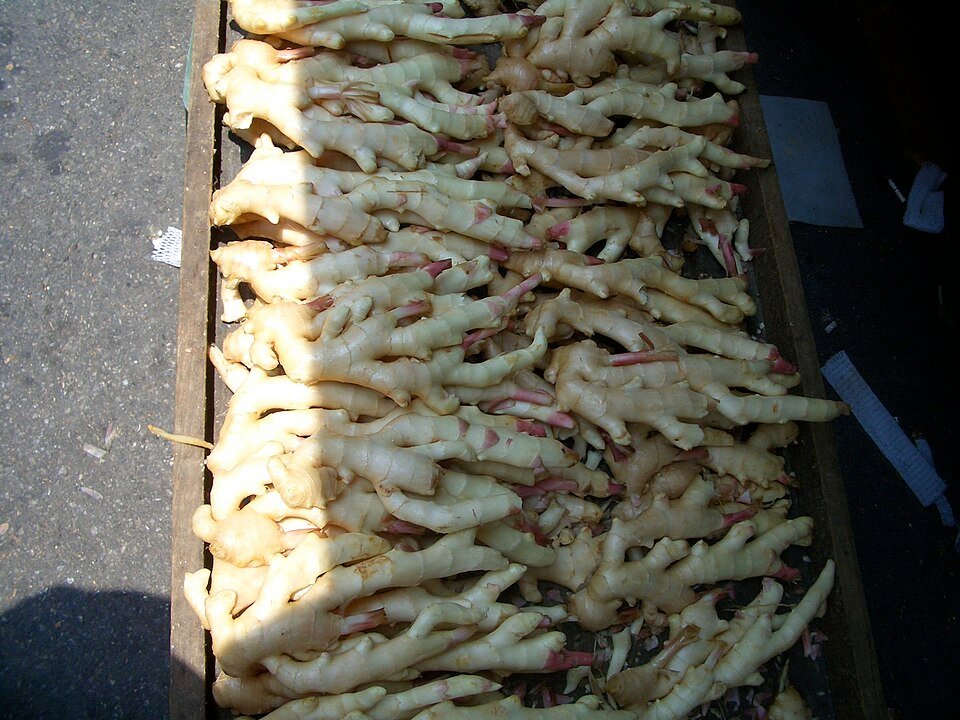
Yes, by the skin and the way it breaks. Young ginger is pale, almost translucent, with thin smooth skin that snaps cleanly under your thumb; mature ginger is tan, knobbly and fibrous, with a woody core that bends before it breaks. Young roots are about 85 per cent water, which is why they bruise and release a mist of juice, and that juice carries the bright, lemon-peppery volatile oils. Mature ginger tastes warmer and woodier and holds its aroma through a long braise. The two are not interchangeable: old ginger where a recipe wants young tastes faintly stale. One caveat — the pale pink pickled slices served with sushi are a different preparation again, not young ginger for the wok.
Two Roots, Two Different Heat
The two roots are treated as different ingredients, and their names are worth learning before you shop. Young ginger is shēng jiāng (生姜), sold as pale, watery fingers that snap rather than bend. Mature ginger is lǎo jiāng (老姜), the tan, knobbly, fibrous thing with a woody core.
Young ginger is around eighty-five per cent water, which is why it bruises under your thumb and releases a mist of juice when you slice it. That juice carries the volatile oils behind the sharp, lemon-peppery note, and those oils are gone within a minute of hitting a hot pan.
Mature ginger has far less water and a dense core, so it holds its aroma through an hour of heat, and tastes less citrus and more warm and woody. Which means the substitution is not clean: old ginger where a recipe wants young tastes slightly stale, because the bright top note never arrives.
Heat is where the two diverge most clearly. Capsaicin, the compound behind a bird’s eye burn, is stable under heat, so stir-fried chillies stay hot and the hotter the pan the faster the heat arrives. Ginger works differently: its main pungent compound is gingerol, and under heat gingerol converts into shogaol, which is sharper and slightly sweeter. The heat does not intensify; it changes identity.
So ginger works in two stages in a wok, and you have to decide which you want. Added at the start and cooked hard, it goes dull and woody, leaving a flat savoury base nobody notices. Added at the end, in the last fifteen or twenty seconds, it stays bright and peppery. The best cooks do both: old ginger fried early for depth, young ginger added at the end for lift, which is why my hot and sour soup recipe calls for two additions rather than one.
I use young ginger for fish, for chicken, for anything meeting a hot wok for under a minute, and old ginger for red-cooked pork and lamb broth. In the Chinese supermarkets of London and Manchester, a 250g bag of good young ginger runs around two pounds, with old ginger a pound or so more.
Why do recipes soak ginger slices in wine before adding them?
To pull the pungent compounds out of the fibres and into the liquid, so meat takes on the aroma without the harsh, raw bite. I soak a few crushed slices in a proper Chinese cooking wine for ten minutes, then use both the wine and the softened ginger in the marinade; nothing is wasted. The alcohol is a better solvent than water for ginger’s oily aromatics, which is why a wine soak beats a water one. Roughly a tablespoon of wine per thumb of ginger is enough. The honest caveat is that this is a marinade trick, not a stir-fry one — in a fast wok the wine would simply flash off, so add ginger early there and skip the soak.
The Shaoxing Rice-Wine Trick
Every Chinese cook who handles fish, offal or lamb knows the move: shred the ginger, mix it into a splash of Shaoxing wine, rub the mixture over the meat, and leave it twenty or thirty minutes. This is not a deodoriser trick in the way people imagine. Alcohol is a solvent for fat and for the water-soluble proteins that carry gaminess, so it lifts the meat’s surface molecules off when you wipe the marinade away. The ginger’s oils are fat-soluble, which means they stay in the flesh while the alcohol carries the smells out of it.
My version: for about 500g of lamb, take a thumb-sized piece of old ginger, slice it thin, mash it to break the fibres, stir it into two tablespoons of Shaoxing wine with a pinch of salt, rub it over the meat and leave it half an hour. Discard the liquid before cooking, which is the step people skip and which undoes half the benefit.
There is a second version of the trick at the stove, and it is the signature move of a Chinese restaurant kitchen. The oil goes into the wok until it shimmers, you add the aromatics, then pour in Shaoxing wine and ginger and let it catch. The alcohol burns off in a burst of flame or a violent sizzle, leaving concentrated fragrance of ginger and fermented rice. Restaurants call this burning the wine, and it is why restaurant stir-fried beef smells like a different food from the same recipe at home.
Ginger for the Stomach, Ginger for Lamb
Ginger has a reputation in Chinese households that goes well beyond the kitchen. Grated fresh ginger brewed as a tea, or chewed in thin slices, is the standard domestic remedy for travel sickness, for the queasy aftermath of bad food, and for the hangover that follows an evening of drinking.
Lamb is where ginger earns its place in serious cooking, because lamb carries two problems: a fatty richness that sits heavy, and a gamy edge some people genuinely dislike. Ginger addresses both. It works as a carminative in the herbal sense, settling the trapped gas and bloated feeling that follows a heavy meat meal, and its volatile oils displace the sulphurous compounds that come from a sheep’s age and diet.
My hand-pulled beef noodle soup follows the same order of operations with beef: aromatics first, meat second, liquid last. This is why almost every serious lamb dish in China starts with ginger.
How much ginger is too much in a stir-fry for two?
Around 15 grams for two people, which is a thumb-sized knob peeled and sliced into thin coins; push past roughly 25 grams and the dish starts to taste of ginger rather than of itself. How you cut it matters as much as the weight: grated ginger releases far more juice and heat than the same amount sliced, so halve the quantity if you grate. Use young ginger at the upper end and mature at the lower, since the older root is more concentrated. I weigh it the first few times and then go by eye. The caveat is that old, fibrous ginger keeps intensifying through a long braise, so for a two-hour pot start with less than you think you need.
How Much to Use
The most common ginger error is timidity, and the second is overconfidence in the other direction: a whole bulb in a pot for four people, which is a medical event rather than a meal. As a general rule, a thumb-sized piece of old ginger handles about 500g of meat or a pot of soup for four to six people. Young ginger is lighter and hotter, so use roughly half that quantity, cut thin.
| Dish | Quantity for about 500g of protein | Cut and timing |
|---|---|---|
| Stir-fried beef or pork | About 10g young ginger | Shredded, added in the last 20 seconds |
| Whole steamed fish | About 15g young ginger | Broad slices over and under the fish |
| Red-braised pork or beef | About 20g old ginger | Thick chunks, added with the stock |
| Lamb stew or broth | About 25g old ginger | Chunks early, plus slices at the end |
| Chicken poached in stock | About 15g old ginger | Sliced, with the poaching liquid |
| Dipping sauce for dumplings | About 5g young ginger | Grated into vinegar and soy |
Quantity is only half the question, because strength depends on the age of the root and on how long it has sat in the fridge. Old ginger left three weeks in the fridge has lost most of its perfume, and you should reach for fresh rather than compensate with quantity.
Why Ginger Burns at High Heat
The rule I was taught in a Chengdu kitchen is short: ginger does not like a screaming wok. Unlike garlic, which takes a hard sear before it turns sweet, ginger goes acrid and bitter at high temperature. Ginger contains free sugars and amino acids alongside its aromatic oils, and above roughly 200 degrees the sugars caramelise and the volatile oils burn off into something acrid and vaguely dirty.
Old ginger, with drier flesh, tolerates a little more than young. A second factor catches people out: ginger in oil heats far faster than ginger in liquid. A wok of oil can sit above 190 degrees while the same wok half full of braising liquid is at a gentle 90, and slices sizzling in that oil burn long before the sauce has properly reduced.
So the order of operations matters. Cool the oil slightly before the aromatics go in, or add the ginger with a liquid ingredient such as stock or wine, which drops the temperature at once. My rule for a fast stir-fry is to fry the ginger no more than fifteen seconds in the gentlest part of the wok.
Overcooked ginger does not merely lose its appeal, it spoils the dish. A single scorched slice can make an otherwise clean-tasting chicken taste stale for the rest of the meal. This is why ginger appears so early in a braise and so late in a stir-fry, and why nobody puts it into the same pan as a fierce chilli heat at the start of a quick dish. If you want the numbling register of Sichuan cooking, get it from kung pao chicken style chilli and peppercorn.
What should I look for when buying fresh ginger in a British supermarket?
Look for firm, heavy roots with taut, unblemished skin and no soft, wrinkled or weeping patches, and avoid the pre-cut trays that dry out within a day. A good knob should smell sharp and clean when you nick it with a nail; a faintly musty or fermented smell means it is past its best. British supermarkets usually stock only mature ginger, so go to a Chinese grocer for the pale young roots if a recipe calls for them. Store unpeeled ginger in a paper bag in the fridge for up to three weeks, never in sealed plastic, which traps moisture and invites mould. Freeze it whole if you bought too much; it grates fine from frozen.
Buying Ginger and Using It Across the Regions
Buy young ginger from the chiller cabinet of a Chinese supermarket, in the bagged packs, and expect around two pounds for 250g. Buy old ginger from the same shelf or from a market stall, where you can pick the heavier, denser pieces by hand. Avoid any root that is soft or showing white mould at a cut end. Do not throw the peel away either, because ginger skin carries more of the sharp citrus note than the flesh and is wonderful steeped in vinegar as a dipping sauce.
Cantonese kitchens use ginger with restraint. In a steamed fish it does one job: it sits on and under the fish through the steaming and lifts the fishiness out of the flesh, then it is thrown away with the scallion. My guide to steaming a whole fish treats ginger as a component of the steaming liquid rather than a garnish.
Northern kitchens treat it as a background seasoning that must survive an hour of simmering, so they use old ginger in larger chunks and expect it to melt into the sauce. Sichuan cooks use it mainly against cold and richness. In Cantonese the char siu recipe, the ginger does quiet work in a marinade of honey, soy and Shaoxing wine, making the glaze taste rounder without announcing itself.
Frequently Asked Questions
Can I use ground ginger instead of fresh? You can, but you lose the bright citrus note that fresh ginger gives at the end of a stir-fry. Ground ginger works well in a braise where it will cook for hours, but for a quick dish I would always use fresh.
Do I need to peel ginger? No. The skin is thin on young ginger and carries more of the aromatic oils than the flesh. Wash it well and slice or shred it straight through.
Can ginger be substituted for garlic? Not one for one, because they do different jobs. Ginger is warm and cutting, garlic is sweet and pungent. In a braise you can shift a little one way or the other, but in a stir-fried beef the garlic is structural.
Why does my ginger taste bitter? It has almost certainly scorched. Ginger browns and turns acrid above roughly 200 degrees, so fry it gently, add it late, or cook it in liquid rather than in screaming hot oil.
Is a large amount of ginger safe to eat? A normal culinary quantity, up to roughly a thumb-sized piece per 500g of meat, is safe for most people. Very large amounts of raw ginger can cause stomach upset.
Does ginger keep as long as garlic? Much less long. Mature ginger keeps a few weeks in the fridge, young ginger about a week, and frozen juice keeps for months.
The Short Version
Ginger is two ingredients in one: young ginger for brightness and speed, added in the last seconds of a stir-fry or torn over steamed fish, and old ginger for depth, simmered through a braise without complaint. Buy the young root in bags from a Chinese supermarket, and keep old ginger in the freezer for the dishes that cook for hours. Never let it sit in a screaming wok, because scorched ginger turns bitter and drags the whole dish down with it.