Liuzhou Food Guide: The Home of Luosifen
Updated 31 October 2026 · reviewed by the China Food Way editorial team
The first time I smelled luosifen I assumed something had gone off. I was on a back street in Liuzhou at 11pm, queuing behind a group of university students, and the air above the stall was thick with a fermented, almost sewage-adjacent funk that no travel brochure prepares you for. Then I ate the bowl, and the smell turned out to be the broth’s best quality: it tastes nothing like it smells, and it tastes very good. That gap between reputation and reality is the whole Liuzhou story.
I had come expecting a tourist town. Liuzhou is not one. It is a working city of roughly four million, built on steel, manganese and car parts, where the noodle is the one thing the outside world knows and the locals are quietly amazed that anyone would arrive by plane for it. The airport is small; the high-speed rail is the real way in, and the best food is in the blocks where nobody performs for a camera. I spent three days there and saw perhaps two other foreigners, both at the same luosifen museum.
Liuzhou is a manganese-and-automobile city in central Guangxi, not a tourist town, and for decades its only claim to fame outside the province was a noodle nobody outside Guangxi had heard of. Then, around 2014, the local government decided to industrialise the dish — vacuum-seal the broth, dry the noodles, ship them cold-chain — and luosifen went from regional comfort food to a packaged export that, as Wikipedia’s entry on it notes, now outsells plenty of far older brands. The city that made it barely believes its luck.
Why does luosifen taste nothing like it smells?
Luosifen tastes nothing like its smell because the famous funk comes from pickled bamboo shoot, not from the broth going off. The sour, almost sewage-adjacent aroma is released by suan cai, the fermented shoot added near the end, while the broth itself is a clean pork-and-snail liquor simmered with star anise, cassia and dried chilli. Your nose reads the shout of the pickle; your tongue gets a balanced, savoury bowl. The honest mismatch is the point: newcomers balk at the odour and miss one of Guangxi’s best noodles. A practical tip — order the standard version first rather than asking for the smell removed, because toning down the shoot flattens the whole dish. The round rice noodles should bend, not collapse, in the broth.
The Anatomy of the Bowl
Order luosifen in Liuzhou and you get, in roughly this order, the following:
- The noodles. Round rice noodles, slightly thicker than Nanning’s flat mifen, cooked to a loose bend rather than a soft collapse.
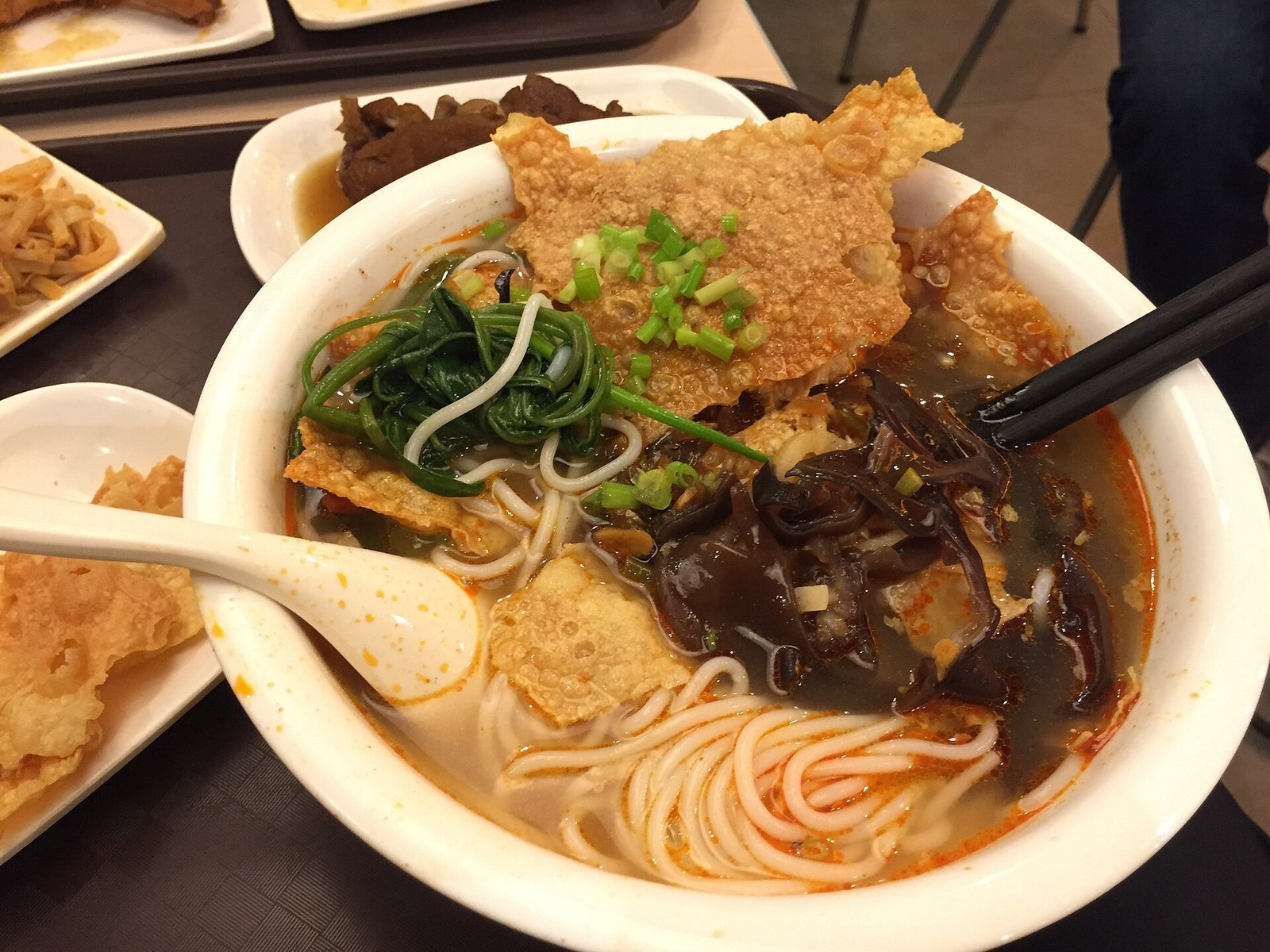
- The broth. This is the secret. It is built on pork bones and, traditionally, river snails (螺, luo) simmered for hours with star anise, cassia and dried chilli. The snails are fished out; their savoury, mineral note stays in the liquid.
- The funk. Pickled bamboo shoot (酸笋, suan sun) is what you smelled from the street. It is fermented, not rotten, and it is non-negotiable.
- The toppings. Fried tofu skin (腐竹, fu zhu), wobbly wood-ear mushroom, peanuts, and a spoon of chilli oil that sits on top like a red lid.
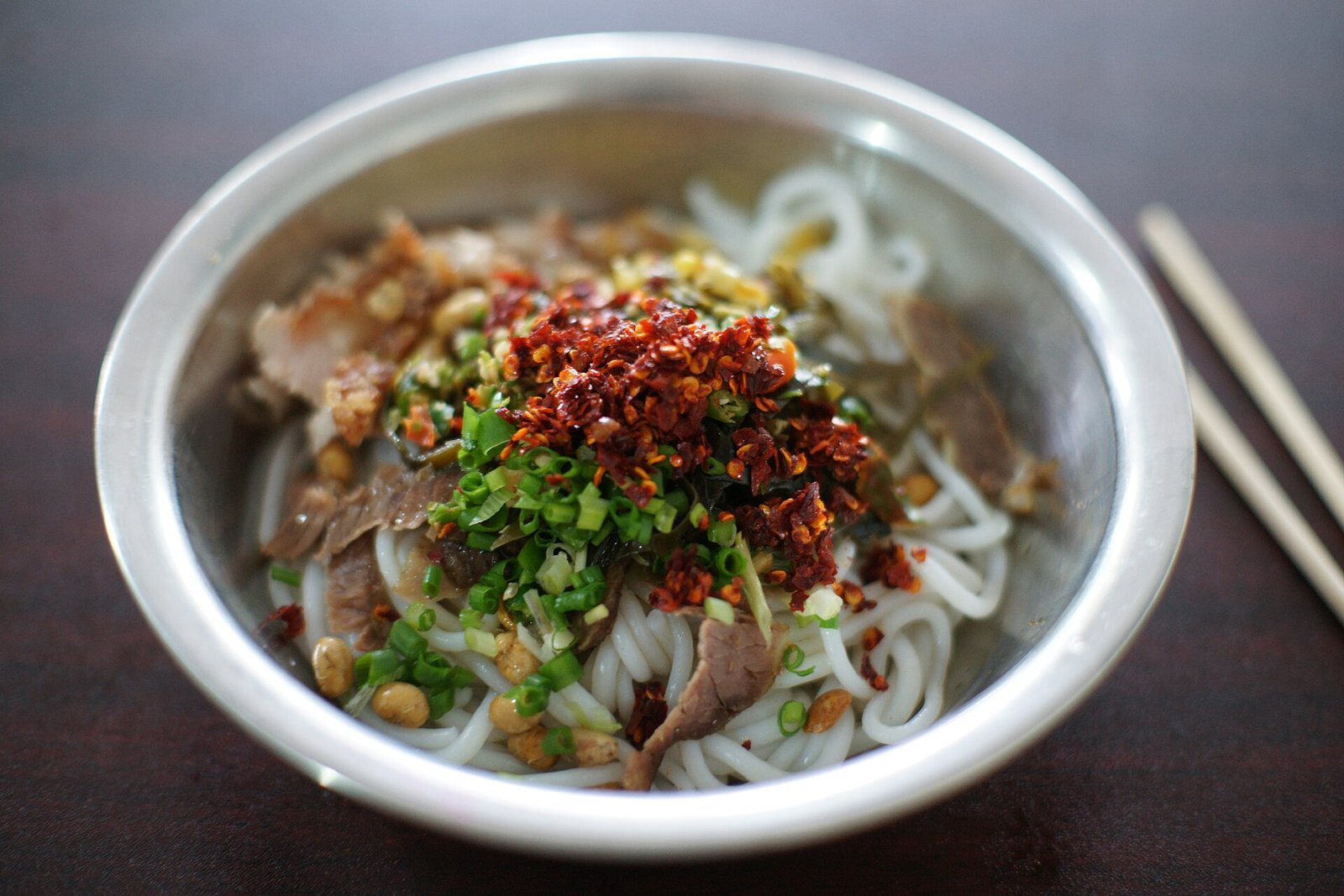
What the packaged version gets wrong, and why locals are quietly smug about it, is the broth-body. In a cup you get a powder and an oil sachet; in Liuzhou you get a broth that has actually met a snail. The difference is the difference between a photograph of a meal and the meal.
How is luosifen different from Guilin rice noodles?
Luosifen differs from Guilin mifen in three ways: the snail broth, the pickled bamboo shoot, and the round noodle. Guilin rice noodles are eaten dry or in a light clear broth, dressed with fried peanuts, scallion and a sweetish sauce, with no fermented shoot and no snail. Luosifen, by contrast, is built on a pork-and-snail liquor and gets its identity from suan cai’s sour funk. The noodle shape also separates them — Liuzhou uses round rice noodles with a loose bend, while Guilin’s are often thinner and served tossed. The honest way to tell them apart at a stall is the smell: if there is no pungent pickle in the air, you have been handed the wrong city’s bowl. Both are breakfast fare, but only one will clear the room.
Don’t Confuse It With Its Neighbours
Guangxi’s three noodles get lumped together by visitors, which is a mistake. The rice-noodle town of Guilin, ninety minutes east, serves a clean pork-bone broth you could give a child. Nanning, two hours south, leans sour-savoury with fermented black bean. Liuzhou is the loud one — funky, chilli-oiled, unapologetic. If a bowl smells like a blocked drain and tastes like comfort, you are in the right city.
The sourness across all three comes from the same place, though: the Chinese pickles that every Guangxi kitchen keeps on the go. Liuzhou just ferments its bamboo longer and puts more of it in.
From Street Stall to Factory Floor
The reason luosifen has a Wikipedia page and your local supermarket sells it frozen is a deliberate industrial policy, and it is worth understanding because it explains the city you are standing in. Around 2014 the Liuzhou government decided the noodle was the one thing the city could sell to the world, and it poured money into standardising the broth, vacuum-sealing it, and licensing factories to produce it at scale. By the late 2010s the packaged version was moving in the hundreds of millions of servings a year, and the city built a museum to the dish — a museum to instant noodles, which tells you how seriously they take it.
What this did to the local table is interesting. The packaged boom created a generation of Chinese eaters who think luosifen is a pantry snack, and a corresponding backlash of locals insisting the real thing is only ever steaming in a bowl in front of you. Both are right. The factories kept the broth conservative and mild to ship nationwide; the street stalls kept theirs funky and personal. If you want to understand the gap, eat one of each on the same day and the difference will be louder than the smell.
What hour of the day is luosifen at its best?
Luosifen is at its best from about ten at night until one in the morning, when the back-street stalls hit full stride. The city eats it late: students queue after class, workers stop on the way home, and the broth pots have been simmering all evening so the liquor is deepest after dark. Daytime bowls are fine but often taste of a pot that has not yet come into itself. A practical rule — aim for a stall in the residential blocks away from the luosifen museum, where the crowd is local and the shoot is fresh, not tourist-tamed. The honest catch is that the best spots are unmarked and close when the pot runs dry, so follow the smell and a queue of regulars rather than a brightly lit frontage.
Where to Eat It (and at What Hour)
Liuzhou eats luosifen at any hour, but the city is proudest of its night trade. The cluster around Wuxuan Road (武宣路) and the stalls near the Liujiang riverfront fill up after 9pm and run until 2am. A proper bowl in a sit-down shop costs 12–18 RMB; a roadside stall with plastic stools is 8–12. Add a side of fried pork ribs or a boiled egg and you are at 20 RMB for a full supper.
For a daytime bowl, the shops inside the railway-station vicinity are fine but generic — the good stuff is in the residential blocks west of the river, where the queues are locals and the broth is made that morning. I learned the hard way that “the one with the longest queue” is always the right call here, and that asking for extra suan sun (the funky bamboo) is a compliment the cook understands. The one night I broke my own rule and chose the empty shop with the brighter sign, the broth came from a packet and the suan sun was an afterthought. Lesson re-learned at the cost of a bowl.
The City Beyond the Noodle
Liuzhou is not a one-bowl town, even if it wants to be. The same river-snail broth shows up in hot pot (螺蛳火锅, luo si huo guo), a fiercer, souper version you cook at the table. There is a sturdy tradition of sour-and-spicy small plates — pickled long beans, pressed tofu, sour cabbage with chilli — that belong to the wider Chinese street-food repertoire but taste particular here because of the bamboo-shoot base.
If you want a break from funk, the city’s Cantonese-influenced stalls do a clean steamed fish and a decent congee, and Guangzhou’s tables, three hours east by rail, are where that style reaches its calmest. But the thing to do in Liuzhou is commit to the snail.
What do locals drink with luosifen?
Locals wash luosifen down with sweet soya milk or a cold bottled tea, and reach for neither alcohol nor anything fancy. The sour, salty broth wants something neutral and cold to reset the palate between mouthfuls, so the stall-side default is a plastic cup of doujiang or a litre of iced jasmine from the corner shop. Soda and beer turn up but sit awkwardly against the pickle. The morning after, the locals’ move is a second bowl, not a remedy — the dish is restorative precisely because it is hot, savoury and full of broth. The honest caveat is hydration: the sodium is high, so alternate the noodle with plain water across the late night. If your stomach is unsure, start with a lighter broth stall rather than the funkiest bowl in town.
What to Drink, and the Morning After
Luosifen is salty and chilli-hot, and the city drinks accordingly. The standard pairing is suan mei tang, a cold sweet-sour plum drink sold from every stall fridge, which cuts the heat better than beer does. Herbal-tea (凉茶, liang cha) stalls sit a few doors down from the noodle shops and serve bitter, room-temperature brews that locals swear cure the exact mild heartburn the noodles cause — a circular economy of spice and remedy that somehow balances.
For the morning after, Liuzhou does a decent plain rice-noodle soup without the funk, and the congee shops near the bus station open early enough to soak up a late night. The city is not a breakfast destination on the level of Guangzhou, but it feeds you well enough to face the broth again by noon.
A Short Price and Ordering Table
| Item | Where to find it | Typical price (RMB) |
|---|---|---|
| Luosifen, basic stall | Roadside, night | 8–12 |
| Luosifen, sit-down | Shop, any hour | 12–18 |
| Luosifen hot pot (per person) | Hot-pot restaurant | 45–70 |
| Boiled egg / fried ribs add-on | Any stall | 2–6 |
| Bottled sour-plum drink | Stall fridge | 4–6 |
Frequently Asked Questions
Is luosifen safe to eat if the smell puts me off? Yes — the smell is fermented bamboo shoot, not spoilage, and the broth is boiled hard. Most first-timers who push past the nose end up ordering a second bowl.
What exactly is in the broth — real snails? Traditionally yes: river snails are simmered with pork bone and spice, then removed. The broth carries their mineral savour. Vegetarian versions exist but miss the point.
Is the instant-cup version worth buying abroad? It is a reasonable hit of chilli and noodle, but the broth is powdered and lacks the snail depth. Treat it as a snack, not a substitute, and come to Liuzhou for the real thing.
Can I get it mild? You can ask for less chilli oil, but the sourness is built in. If you truly dislike funk, this is not your city — try Guilin’s mifen instead.
How long should I spend in Liuzhou for food? A day, maybe two. Eat luosifen at three different stalls, do the hot-pot once, walk the riverfront, and move on. The city is a stop, not a destination.
Is Liuzhou worth a detour from Guilin or Nanning? If you care about noodles, absolutely. It is on the rail line between them and the contrast with its neighbours is the lesson.