China’s Ancient Water Towns: Which to Visit
There are officially more than a dozen “ancient water towns” marketed within a couple of hours of Shanghai, and the first time I tried to choose, I nearly booked four of them in a row. I’m glad I didn’t. After walking six of them across two trips, I’d argue only four are worth the train fare, and two of those are worth an overnight stay rather than a rushed afternoon. The rest blur into each other: a canal, a bridge, a tea house, a souvenir stall selling the same printed fan. This is the ranking I wish I’d had before I bought the first ticket.
A water town, properly understood, is a settlement built around a lattice of canals instead of roads, where the stone bridges double as the high street and the boats are the buses. The form spread across the Yangtze delta for centuries because the flat, river-cut land made water the easiest way to move goods, and the wealth that trade brought paid for the carved beam houses you still walk past today. What separates a good water town from a tired one is not the canal itself, which every town has, but whether the life on the water still feels real or has been staged for the coach party. I judged each town below on exactly that.
The one you can reach on the metro: Zhujiajiao
Zhujiajiao is the easiest water town in China, and that’s exactly why it’s my first recommendation for a nervous first-timer. Take Shanghai Metro Line 17 to Zhujiajiao station and you’re a ten-minute walk from the old lanes. Entry to the town is free; the bundled ticket for the eight small sights is RMB 80, and I’d skip it. The pleasure here is the walk, not the museums.
I went on a Tuesday morning in March and had the north canal almost to myself. The Best Apps China Travel metro map got me there without a taxi, which mattered because the approach road jams on weekends. Go early, eat the sticky rice wrapped in lotus leaf from a canal-side stall, and leave by early afternoon.

The catch with Zhujiajiao is that it’s close enough to Shanghai that everyone else has the same idea on Saturday. If your only free day is a weekend, pick one of the farther towns instead, where the crowd thins simply because the train takes longer.
As a half-day bolted onto a Shanghai visit, though, Zhujiajiao is hard to beat. I treated it as the calm counterpoint to three days of skyscrapers and museums, and the contrast did the work. The lanes sell the usual printed fans and scented sachets, but look for the older stalls near the north gate selling cured river fish and the dense, sweet green-tea cake that travels badly and tastes best within an hour of buying. None of it is a reason to cross the country, but it is a reason to step off the metro one stop early on your way out of the city.
Wuzhen: the polished one
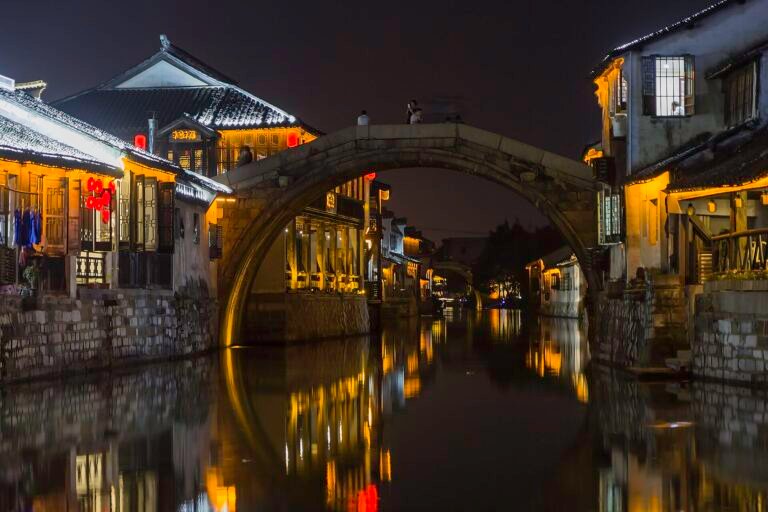
Wuzhen, in Zhejiang, is the most commercialised of the towns I visited, and also the best run. The west section charges RMB 150 and caps entries, so it never feels crushed even when full. I paid RMB 150 and stayed overnight inside the walled west zone, which is the move: after the day-trippers leave at 5.00, the lanterns come on and the canals are yours.
The Best China Tour Companies packages bundle Wuzhen with Hangzhou, and that pairing works because the high-speed train between them is under an hour. I’d treat Wuzhen as a half-day-plus-evening stop on a Hangzhou leg, not a destination of its own. The evening light show on the water is the one spectacle here that justified the ticket for me. Wuzhen also hosts a theatre festival each autumn that fills the lanes with open-air performances, and if your dates line up, the town transforms from a polished set into something closer to a living cultural event. I missed the festival by a week and still found the night worthwhile, but the travellers I met who caught it described a different place entirely. The indoor museums, by contrast, are skippable; the indigo dye workshop is the only one I’d carve time for, and even that is better as a fifteen-minute look than a paid demonstration.
What you’re actually paying for
The entry fee at Wuzhen covers the upkeep, and it shows. The stone is clean, the boats are regulated, and the indigo-dye workshop is a genuine craft rather than a photo prop. It’s less “authentic” than the quieter towns, but it’s the one I’d send my mother to, because the facilities are predictable and the signage is in English.
Tongli and the case for the quiet one
Tongli sits near Suzhou and charges RMB 100 for the through-ticket that includes the gardens. It’s smaller than Wuzhen and far less polished, and that’s precisely why I liked it. I spent a morning in the Tuisi Garden with maybe a dozen other people, where Wuzhen would have held a hundred.
For all about best time to visit china, Tongli is best in April or November, when the light is soft and the tour groups are thin. The Book Hotels China guesthouses inside the town let you step out at 7.00 before the gates open to day visitors, and that hour was the calmest of my whole water-town sweep.
Zhouzhuang: the famous one, with caveats
Zhouzhuang is the name most guidebooks lead with, and it’s pretty, but it’s also the most overrun. The RMB 100 ticket buys you a grid of canals that the bus tours hit at 10.00 sharp. I went once and left by noon, then returned on a cold January weekday and finally saw why people praise it. The famous double bridge is lovely; the crowds around it are not.
Visiting Zhouzhuang without the bus tours
The trick to Zhouzhuang is to arrive on your own terms. The bus tours roll in from Shanghai and Suzhou at 10.00 and leave by 3.00, so the hours either side belong to the town again. I came on the local bus from Suzhou, a ride of under an hour, and walked in through the quieter north gate rather than the main south entrance where the coaches unload. The north end has the working canal, the washing steps, and the old residents who still hang their washing over the water; the south end has the ticket booth and the selfie sticks. Give yourself the morning, eat at a small riverside place away from the double bridge, and you’ll understand why the guidebooks rated it first before the crowds arrived.
Which town for which traveller
| Town | Entry (RMB) | From Shanghai | Best for | Crowd risk |
|---|---|---|---|---|
| Zhujiajiao | Free (80 bundled) | Metro 17, 1 hr | First-timers, half-day | High at weekends |
| Wuzhen | 150 | 2 hr by train | Overnight, comfort | Medium (capped) |
| Tongli | 100 | 1.5 hr via Suzhou | Quiet, gardens | Low |
| Zhouzhuang | 100 | 1.5 hr | Famous name | High |
For a proper take on china 10 day, I’d slot Zhujiajiao or Tongli into a Shanghai–Suzhou–Hangzhou loop and skip the rest. Everything you need to know about china 2 week gives you room for Wuzhen as an overnight, which is the only way I’d bother with it.
As Wikipedia notes, the Canal town form spread across the Yangtze delta for centuries, which is why so many of these settlements look like cousins of one another.
Frequently Asked Questions
Which water town is closest to Shanghai? Zhujiajiao, reachable on Metro Line 17 in about an hour from the city centre. It’s free to enter the lanes, which makes it the cheapest and easiest half-day you can pull off without booking a tour or a long train.
Is it worth staying overnight in a water town? Only at Wuzhen, where the west zone caps entries and transforms after dark. The others are better as day trips; once the boat rides close, there’s little to do, and the hotels inside the walls cost more than a comparable room in the nearby city.
Are the water towns fake? Some sections are rebuilt, but the canal layout, the bridges and the oldest houses are genuine, several centuries old. Wuzhen is the most restored, Tongli the least, and Zhouzhuang sits in between. None are theme parks, but all now serve tour groups.
When should I visit to avoid crowds? Weekdays in March, April, November or January. Avoid the first week of May, the first week of October, and any summer weekend. I had the best luck arriving before 9.00, when the day-trippers’ buses are still on the motorway.
Do I need to buy the bundled sight ticket? At Zhujiajiao and Tongli I’d buy it only if a specific garden is on your list; the canal walk is free or cheap on its own. At Wuzhen the through-ticket is the only way in, so there’s no choice. Check the official site before you go, because the bundles get重组 between seasons.
Can I combine water towns with the heritage sites? Yes, and it’s efficient. Suzhou’s gardens and Tongli share a metro and a taxi, and Hangzhou’s West Lake pairs naturally with Wuzhen. I built both my trips around that delta cluster and never needed a flight to see canals, gardens and a UNESCO lake in a single week.