Crayfish (Xiao Long Xia): China’s Summer Beer Garden Obsession
Ninety-odd kilometres west of Wuhan sits a city most foreign visitors have never heard of, and it farms more crayfish than anywhere else on earth. Qianjiang, in Hubei province, is the centre of an industry that puts millions of tonnes of the creatures onto Chinese tables every summer. Not the coast. Not some pristine mountain lake. Rice paddies. The crayfish you eat at a Chengdu beer garden, in a Beijing alleyway, under a plastic awning in Shanghai drizzle, almost certainly started life swimming between the rows of a flooded Hubei paddy field.
I remember the number that finally made this click for me: China produces roughly three million tonnes of crayfish a year, and Hubei alone accounts for close to half of it. Compare that with the entire global production of, say, salmon, and the scale becomes absurd. This is not a niche delicacy. It is one of the largest aquaculture stories there is, and it runs on a rotation of rice and mudbugs that farmers in Qianjiang have spent three decades perfecting.
How flooded rice fields became a crayfish empire
The species doing all this work is the red swamp crayfish, which you can read about in detail under its scientific name, Procambarus clarkii, on Wikipedia. It is not native to China — it arrived from the Americas via Japan in the 1930s — and that origin story still surprises Chinese friends when I mention it. Something that now feels deeply, stubbornly local is, biologically speaking, an immigrant that simply outcompeted everything in the warm ditches of the Yangtze floodplain.
The modern system is called shrimp-rice co-culture: farmers flood paddies in autumn, stock them with breeding crayfish, harvest the young in spring, then plant rice into the same fields. The crayfish fertilise the rice, the rice paddies shelter the crayfish, and nobody has to choose between the grain crop and the shellfish. Drive through Qianjiang in April and you will see ditches, pumps and plastic sheeting everywhere, because the harvest peaks from May through August — precisely the months when Chinese beer gardens need them most.
Hatcheries matter here too. Early wild-caught crayfish were inconsistent, and mass-market demand demanded consistency, so the industry bred for size and shell colour. When you order “red shell” versus “green shell” at a stall, you are actually asking about maturity: darker, harder shells mean older animals with more meat and better texture.
There is an irony worth savouring: Hubei cooking sits outside the Eight Great Cuisines, the canon that defines Chinese regional cooking, yet this one ingredient from Hubei paddies out-earns half the canonical traditions combined.
The three flavours that actually matter
Menus will offer you a dozen variants, but after a few summers of field research I can tell you the market has settled on three serious contenders, plus one quiet outlier:
| Flavour | Chinese name | What the sauce does | Best moment for it |
|---|---|---|---|
| Spicy | má là | Dried chillies and Sichuan peppercorn numb and burn in turn | Big groups, cold beer, high tolerance |
| Thirteen-spice | shí sān xiāng | A braised spice liquor that clings sweet-fragrant to the shell | First-timers, children at the table |
| Garlic | suàn róng | A dense paste of slow-cooked garlic with sugar and soy | Late night, when you want savoury not fierce |
| Brine-chilled | lǔ wèi | Cold, salted, unglamorous | Lunch, or the morning after |
The spicy version is the poster child. A proper batch means cracking the head shell to slurp the juices into the meat as you pull. Thirteen-spice, despite the name, is not a fixed recipe; every brewery and stall keeper has their own blend, and cassia bark is one of the ingredients that gives it that warm, rounded base, as I explain in my notes on chinese cassia bark. Garlic is the one I order most often, mostly because the sauce soaked into the shell cavity is so good you will be tempted to drink it straight.
One practical note on the chillies in a spicy platter: most of them are in the sauce for aroma, not for destructive heat. If you want that numbing-fragrant character at home without committing to a full braise, Chili Crisp explained covers the shortcut that half of my Chinese friends use when the craving hits on a weeknight.
An evening in a beer garden, described honestly
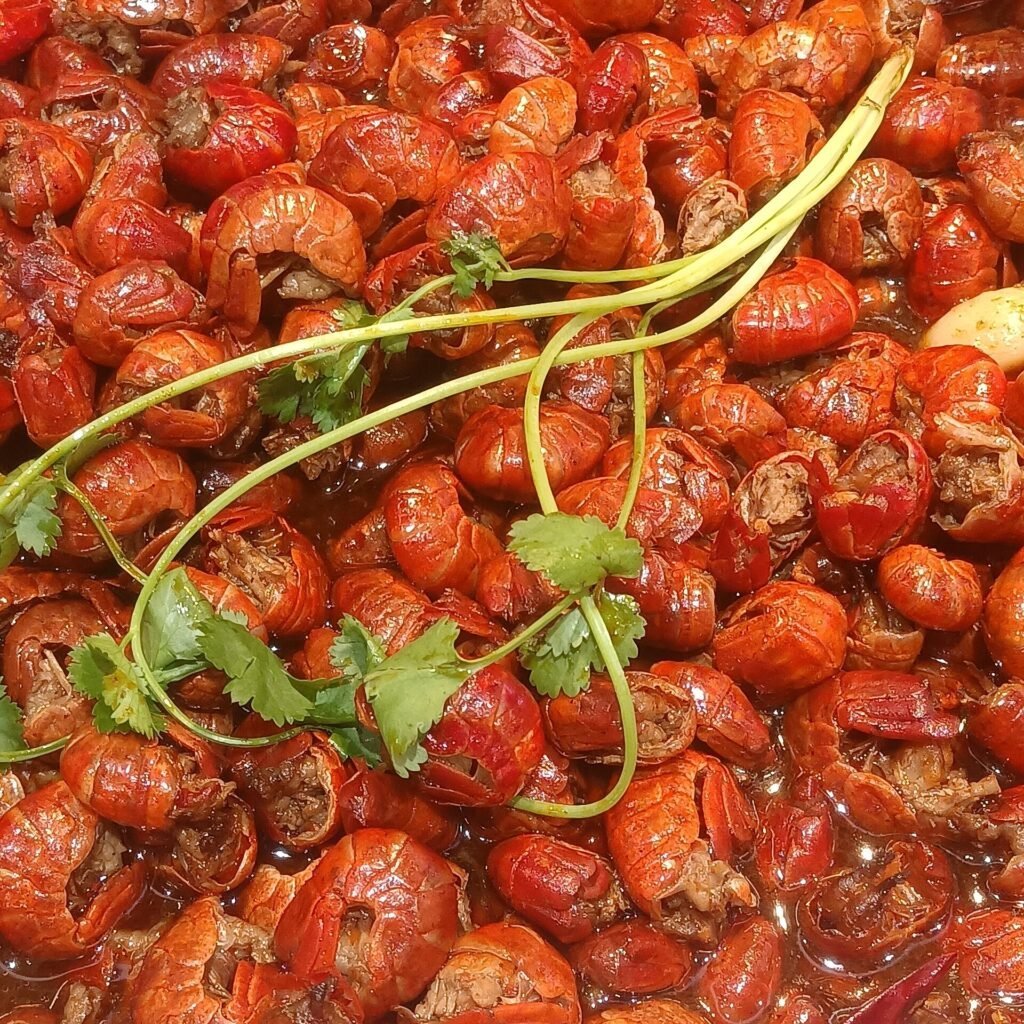
The ritual is half the reason this food exists. Nobody goes out for a quick crayfish dinner. You go for three hours, to a low plastic table outdoors, in June heat that makes the ice in your beer glass a character in the story. A steel basin arrives, heaped with glistening red crayfish, steam still coming off them. Everyone gets disposable gloves — some people wear them, purists do not, and the purists have red-stained fingers by the end as proof of commitment. The technique is a twist-and-pull: head off first, then the tail meat in one motion, optionally dragging it through the oil pooling at the bottom of the basin.
Conversation is the fuel. The shell business gives your hands something to do while you talk, which is exactly why it works for groups — the same social logic that makes hot pot a gathering rather than a meal. Nobody checks a phone for the first twenty minutes. There is simply no free hand for it.
The beer, by the way, is non-negotiable and always lager — cheap, cold, and served in tall frosted glasses. The conventional wisdom is that anything hoppy or heavy fights the spice, and in my experience that is correct. At the end of the night, a lot of groups head straight for congee. A bowl of century egg rice porridge at midnight after a crayfish session is the standard coda, and Century Egg Guide explains why that pale, silky dish has become the official chaser for this food.
Buying and cleaning: what genuinely matters
If you buy live crayfish — at a Chinese market or from a specialty supplier — the rules are few but absolute.
First: any dead crayfish gets discarded immediately, no negotiation. Dead crayfish spoil faster than almost any other shellfish, and no sauce rescues one. Keep them alive in a bucket with a damp cloth over the top, not submerged, and cook the same day.
Second: soak them in lightly salted water for half an hour so they spit out grit, then scrub the bellies under running water with an old toothbrush. The belly seam between the legs collects mud, and no amount of braising hides it.
Third: the vein trick. Pinch the middle fin of the tail, twist, and pull — the digestive tract usually comes out with it in one clean strip. Doing this before cooking saves fiddling later, though many stalls skip it and rely on diners to shell carefully.
Fourth: snip the sharp point of the head shell with kitchen scissors, and, if you like, crack the head itself so the braise can get in. That opening is how the sauce reaches the part everyone fights over.
Frozen crayfish tail meat, widely exported now, is a legitimate option for home cooking. It loses the theatre but keeps the protein, and it cuts prep from an hour to ten minutes.
Cooking garlic-braised crayfish in a home kitchen
Here is the version I make most often, sized for one kilogram of live crayfish.
Heat four tablespoons of oil in a wide pot. Fry a whole head of finely chopped garlic over low heat until it smells sweet and turns pale gold — this takes about four minutes and smells better than it has any right to. Add two more heads’ worth of garlic, raw, plus a thumb of grated ginger, three tablespoons of light soy sauce, one of dark soy, two of sugar, and half a litre of chicken stock. Bring it to a rolling boil, drop in the crayfish, and braise hard for eight minutes with the lid half on. Then take the lid off, crank the heat, and reduce until the sauce coats a spoon — roughly another five minutes. Rest them in the sauce for twenty minutes off the heat; the shells drink flavour during this window, and skipping it is the single most common home-cook mistake I see.
Variations branch out from this spine. A spoonful of everything you need to know about chinese black bean sauce stirred into the base gives you the Cantonese-leaning version some southern beer gardens serve. For the spicy version, fry a handful of dried chillies and a teaspoon of Sichuan peppercorn in the oil before the garlic. And if you go for the cold brine style instead, a splash of black vinegar as a dip is the traditional accompaniment — how chinese black vinegar is really done explains what to look for.
Leftover sauce is a resource, not a by-product. Toss it through noodles the next day — it behaves beautifully with an Easy Chow Mein — or save it for stir-frying whatever green vegetable is in the fridge. Some beer gardens serve quick stir-fried bamboo shoots on the side as a crunchy counterpoint; all about bamboo shoots covers how to prep them so they are never bitter.
The head-juice question
You will see experienced eaters twist off the head and drink. What is in there is mostly hepatopancreas — the crayfish equivalent of a liver-pancreas combo — plus whatever braise has soaked in. It is rich, briny, faintly sweet — the flavour concentrate of the dish.
Is it safe? From a reputable supplier, cooked properly, most food writers and the vast majority of Chinese diners say yes, and I eat it myself. What I avoid is the yellow-orange roe-like material from animals of dubious origin, and I never eat it raw, which a handful of dangerous internet challenges aside, nobody does. If you are squeamish, skip it — the tail meat carries enough of the sauce that you miss surprisingly little.
Frequently Asked Questions
Are crayfish in China safe to eat? From licensed farms and busy, high-turnover restaurants, yes. The industry is heavily regulated precisely because demand is enormous. The risk concentrates in wild-caught animals from polluted ditches, which no serious stall serves. Choose places where the basins empty quickly.
Why is crayfish a summer food in China? Two reasons that line up neatly: the harvest peaks between May and August, and hot weather makes cold lager plus messy, spicy, hands-on food irresistible. Winter crayfish exist but cost three times as much and taste of it.
What is the difference between red shell and green shell crayfish? Red shells are mature animals with firmer meat; green shells are younger and softer, some people find them sweeter but easier to overcook. For braising, red shell holds up better.
How spicy is the spicy version really? It looks ferocious but sits well below genuine Sichuan boiling dishes. The chillies mostly perfume the oil. Thirteen-spice is the mildest of the three, and garlic barely registers.
Can I make this with frozen crayfish tails? Yes, and reduce the braise to five minutes since there is no shell to penetrate. You lose the head-juice ritual and about forty percent of the drama, but the garlic sauce still delivers.
What do you drink with crayfish? Cheap, very cold lager, full stop. If you do not drink beer, iced sour plum drink is the classic non-alcoholic partner and cuts the spice better than water ever will.