Water Bamboo (Jiao Bai): The Southern Stem Nobody Outside China Knows
Standing in a drizzle outside the morning market in Suzhou, I watched a woman feed pale green cylinders into a hand-cranked peeler faster than I could count them. Piles of the peeled stems sat in shallow baskets, each one about the length of my palm, damp and faintly luminous, like pieces of jade someone had bitten. I asked the vendor what they were. She looked mildly amused that I didn’t know, said “jiao bai”, and handed me one raw to try. It snapped like celery, flooded my mouth with juice, and tasted faintly sweet with a green edge. I bought a kilo on the spot, which was roughly nine hundred grams more than I knew what to do with.
What Jiao Bai Actually Is
Here is the part that surprises almost everyone, including me for my first two years in China: water bamboo is not bamboo, and it grows no bamboo shoots. The plant is Zizania latifolia, a wild rice grass that stands in the shallow water of ponds and paddy edges across Jiangnan and further south. The part we eat is the swollen stem, and the swelling is caused by a fungus that infects the plant and stops it from flowering, so the stem puffs up into that fat, tender cylinder instead. As Wikipedia’s entry on Zizania latifolia explains, the infected plants are the ones farmers actually want; uninfected plants produce the wild rice grain and a stem too tough to bother with.
Because of the name, first-time visitors constantly assume it must be related to bamboo shoots. It is not, and the difference matters more than the botany suggests. I have written all about bamboo shoots elsewhere, and the honest summary is that bamboo shoots are fibrous, faintly acrid, and need boiling to tame them. Jiao bai is the opposite: crisp, juicy, delicate, with no bitterness and no need for any blanching ritual. Confusing the two will ruin your dish, because you will overcook the water bamboo into something limp and sad. This is the distinction in its shortest form:
| Jiao bai (water bamboo) | Bamboo shoot | |
|---|---|---|
| Plant part | Fungus-swollen stem of a wild rice grass | Culm of a true bamboo plant |
| Raw flavour | Sweet, juicy, no bitterness | Faintly acrid and grassy |
| Texture | Crisp and juicy throughout | Fibrous, dense |
| Prep | Peel and cook directly | Often boiled first to tame bitterness |
| Where you find it | Jiangnan wet markets, summer and autumn | Nationwide, mainly spring |
The fungus angle sounds alarming until you notice that virtually every stem sold in China is infected on purpose, propagated by division year after year, which is why the crop never turns back into a grain plant.
Choosing Good Stems at the Market
After too many disappointing kilos, here is the checklist I now run through without thinking. First, weight: a good stem feels heavy for its size, around 60 to 90 grams each, because the interior should be packed with moisture. Second, squeeze: press the middle gently with your fingers. It should feel firm and full, like a sausage, not soft or hollow at either end. Hollow ends mean the swelling has started to collapse, and the flesh inside will be cottony.
Third, colour. You want the skin a pale, milky green, the colour that gives the vegetable half its name, since jiao bai literally means “whitened”. Avoid stems with dark patches or pinkish stains, which usually mean the fungus has gone too far and the flesh will be speckled black inside. That black speckling is harmless once cooking begins, but it looks grim in a pale stir-fry and market buyers reject it. Finally, freshness is brutal and non-negotiable: jiao bai loses its snap within two or three days of harvest, so buy it in the morning and cook it that day. I once kept a bundle in the fridge for five days out of laziness and the entire batch fried up limp.
Peeling, Prep, and the Raw Question
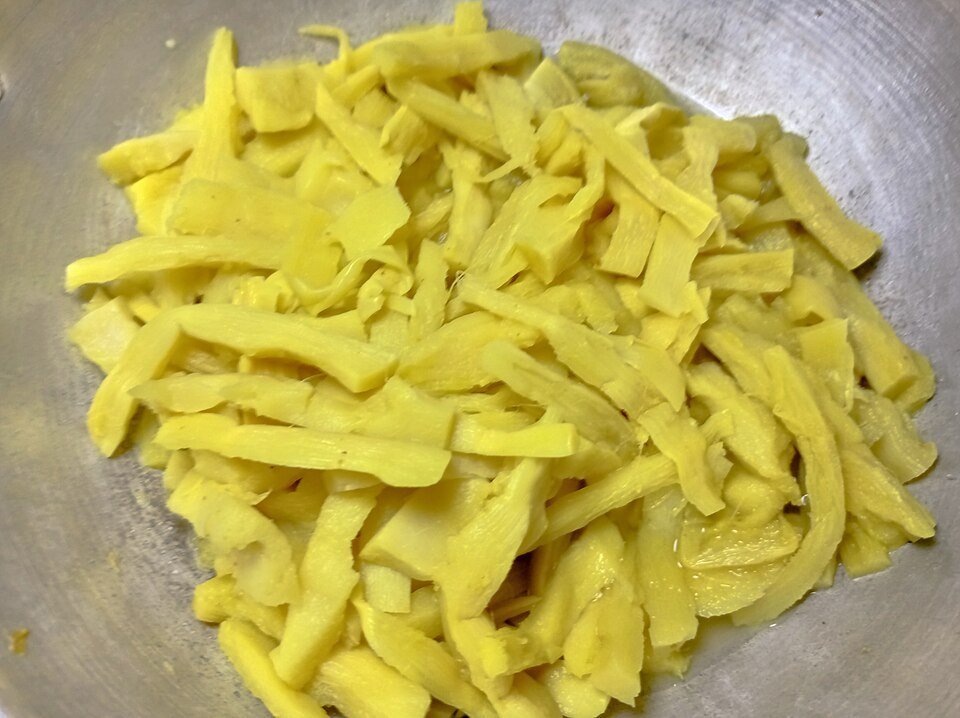
If your vendor offers to peel the stems, say yes. If not, it takes about a minute per stem: trim off the root end, pull or pare away the two or three outer leaf sheaths, and shave off any green patches on the surface. What remains is the pale inner cylinder, which you can slice on the bias into coins about half a centimetre thick, or cut into finger-length batons for braising. Keep the slices in a bowl of cold water with a squeeze of lemon if you are working ahead, because the cut surfaces oxidise and grey within half an hour.
Can you eat it raw? In Jiangnan, yes, and the market woman in Suzhou handed me one precisely to prove the point. Very fresh stems are crisp and sweet out of hand, and cold-dressed jiao bai salads do exist. But my own rule, learned after one stomach that disagreed with a whole raw stem, is to blanch slices in boiling water for 60 to 90 seconds even for cold dishes. That brief plunge keeps the crunch, sets the colour, and removes any doubt. For stir-fries and braises, skip the blanch entirely; the wok does the work.
Stir-Fried with Pork, the Jiangnan Default
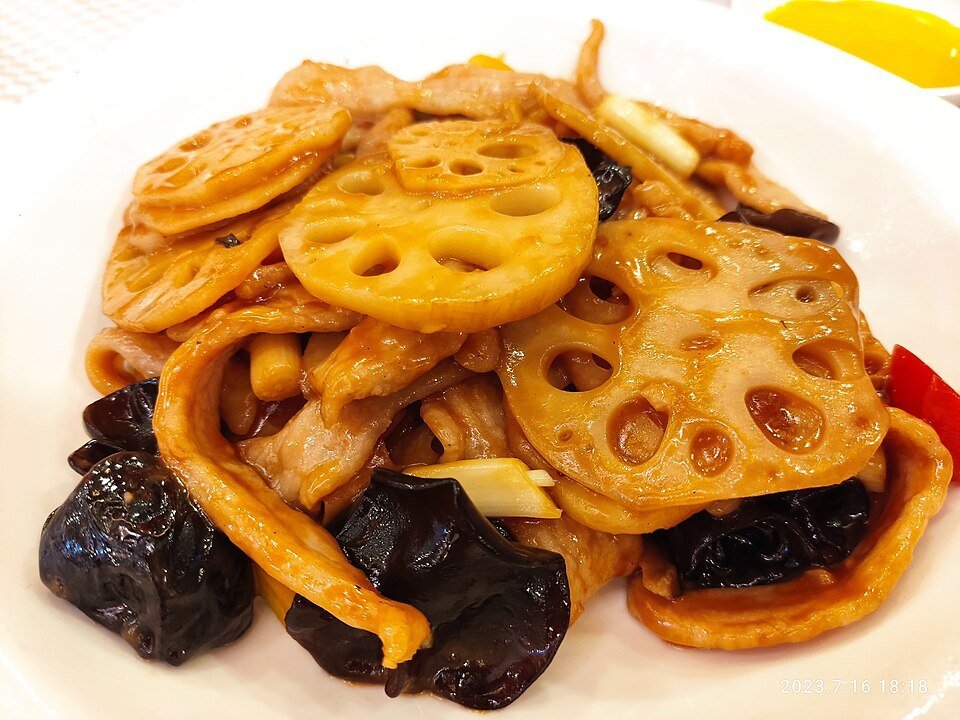
The dish you will meet most often, and the one I cook monthly, is jiao bai chao rou si: water bamboo stir-fried with shredded pork. It is the workhorse dish of home kitchens from Shanghai down through Zhejiang and into Fujian, where cooks lean a little more on seafood and you can read how that regional habit plays out in my guide to Fujian Cuisine. The technique is simple but timing matters. Marinate 150 grams of pork loin, cut into fine shreds, in half a tablespoon of light soy and a pinch of cornflour for ten minutes. Heat your wok until a drop of water skitters, add two tablespoons of oil, and sear the pork for about 40 seconds until it just loses its pink. Remove it, add another tablespoon of oil, then 400 grams of sliced jiao bai.
Fry the slices hard for two minutes. They should pick up faint golden patches; this browning is where the sweetness develops, and under-fried jiao bai tastes watery. Return the pork, add two tablespoons of stock, a third of a teaspoon of salt, and a few drops of black vinegar if you like, an acidity trick whose logic I explain properly in my piece on how chinese black vinegar is really done. Toss for another 30 seconds and plate it. Total wok time under four minutes; any longer and the crispness is gone.
Swap the pork for 200 grams of shelled shrimp and you have the banquet version, the one that appears at weddings all over Jiangnan with the shrimp blanched pink first.
You Men: The Oil-Braised Treatment
When I want jiao bai to behave like something richer than a vegetable, I braise it. You men, the oil-braising method used across the south for greens and mushrooms, suits the stem perfectly because its density lets it soak up sauce without collapsing. Cut four or five peeled stems into batons about the length of your thumb. Warm three tablespoons of oil in a flat-bottomed pan over medium heat, add the batons in one layer, and fry them for four to five minutes, turning once, until they are patched with gold.
Then add two tablespoons of light soy, one teaspoon of sugar, half a cup of stock, and cover. Simmer on the lowest heat for eight to ten minutes, until a chopstick slides into a baton with just a hint of resistance. Uncover, raise the heat, and reduce until the sauce clings and shines, which takes another two minutes or so. My one flourish is half a tablespoon of fermented black beans, mashed into the sauce at the reducing stage; the salt-and-earth depth they bring is something I cover in everything you need to know about chinese black bean sauce. If I am serving this as the only vegetable alongside something loud like a chili-oil appetiser, the gentle sweetness of the braise is exactly the counterweight, and that contrast is basically the whole argument of Chili Crisp explained.
Getting It in Shanghai, Guangzhou, and Beyond
Jiao bai is a summer-to-autumn crop with a second, smaller flush in late spring, and it is overwhelmingly a lower-Yangtze vegetable. Markets in Shanghai, Hangzhou, Suzhou and Nanjing stack it in mountains from June to October. Further south it thins out; on several trips through Guangdong I found it only sporadically, usually at bigger wet markets, and the Cantonese kitchens I know treat it as a guest ingredient rather than a staple, a pattern that fits the broader regional picture in my Guangzhou Food guide. One upscale trick worth stealing from restaurant menus: jiao bai simmered in a milky upper-broth with salted egg yolk and century egg, a soup treatment I break down piece by piece in my Century Egg Guide.
Outside China, the picture is bleak, and I want to be straight about it. The plant needs standing water and a living fungus partnership, so it is essentially never shipped to Western supermarkets, and the few frozen or vacuum-packed imports I have tried in London lost most of their juice. If you cannot get it, courgette is the substitute most often suggested, and it is fine but sweeter and softer; hearts of palm come closest on texture, though they carry a faint acidity jiao bai lacks. My honest advice, after several disappointing attempts: cook the substitute fast and hot, accept the compromise, and treat the real thing as one more reason to eat your way through Jiangnan in September.
Frequently Asked Questions
Is water bamboo related to bamboo shoots? No. Bamboo shoots are the culms of actual bamboo and are fibrous and bitter when raw, while jiao bai is the fungus-swollen stem of a wild rice grass, crisp and sweet with no bitterness and no pre-boiling required. The names overlap only because both plants grow tall in wet ground.
Why do some jiao bai have black specks inside? The specks are spore masses of the same fungus that creates the swelling. They are harmless, especially once cooked, but they signal an older stem, so buyers who care about appearance reject them at the market.
Do I need to blanch jiao bai before stir-frying? For hot dishes, no; direct stir-frying over high heat for two to three minutes keeps the best texture. For cold salads, a 60 to 90 second blanch in boiling water is my standard practice, mostly for cleanliness and colour.
Can you eat water bamboo raw? Very fresh stems can be eaten raw, and market vendors in Jiangnan hand out raw pieces as samples. I limit myself to a small taste raw and cook the rest, because quantity eaten raw has upset my stomach before.
How long does jiao bai keep in the fridge? Two to three days wrapped in a perforated bag, and texture declines visibly after that. It is a buy-today-cook-today vegetable in almost every serious kitchen I have cooked in.
What is the best substitute outside China? Hearts of palm for texture, courgette for flavour availability, but neither matches the juicy snap. Fry whichever you use hard over high heat and keep cooking time under five minutes to avoid sogginess.