Chinese Cooking Methods: The Twelve Techniques Behind the Wok
Reviewed 31 October 2026 by the China Food Way editorial team
The first time I tried to cook a proper stir-fry, I used a flat non-stick pan and I followed the recipe exactly. The result was a stew. Not a bad-tasting stew — the soy sauce and garlic were fine — but the broccoli had released a puddle of water, the chicken had boiled in its own juices, and nothing had the faintest trace of the smoky edge I had eaten a hundred times in Chinese restaurants. I remember lifting a piece of chicken out of the pan and thinking: the recipe is right, so the method must be wrong.
It was. What I had missed is that a Chinese stir-fry is not a sequence of ingredients; it is a relationship between heat and motion. Once I understood that, the rest of the technique tree — braising, steaming, deep-frying, dry-pot — stopped looking like a list of exotic procedures and started looking like four or five answers to one question: how do you get flavour into food at a temperature and speed your equipment can actually sustain?
Why does tossing the wok matter more than the recipe?
Tossing matters more than the recipe because each flight through air dries the food’s surface and lets the metal spike back to full heat, building the scorched edge called wok hei. I proved this by cooking the same ingredients two ways: stirred gently in a pan they stewed, tossed hard in a wok they seared. The motion is not theatre — it is heat management, moving food between a violent base zone and a cooler resting zone up the curved sides. The honest lesson is that a recipe lists ingredients, but the toss is what turns them Chinese. If your arm tires, cook in smaller batches so each toss still does its job.
The Heat-and-Motion Principle
A wok is not a deep pan with a funny shape. Its geometry — wide at the top, narrow at the bottom, curved sides — does three things a flat pan cannot. It creates a small zone of violent heat at the base where food sears; a large warm zone up the curved sides where food rests and finishes; and, when you toss, a brief flight through air that dries surfaces and reheats them against the metal. The design of the wok has been refined over two millennia of Chinese metalwork, and every feature of it is a heat-management device.
That last part is the one home cooks underestimate. Tossing is not theatre. Every time food leaves the surface of the wok, two things happen: moisture on its surface evaporates, and the wok’s metal, momentarily unloaded, spikes back toward full temperature. The food lands on hotter metal than it left. Do that forty times in three minutes and you have built, incrementally, the flavour that takeaway menus call “wok hei” — the faint scorched quality that a stationary pan simply cannot produce. As Wikipedia’s overview of stir frying notes, the technique is defined by this combination of high heat and constant motion, not by any specific ingredient.
The practical consequence: your stovetop has a ceiling, and the wok’s job is to let you work as close to it as possible. A domestic gas ring generates roughly a third of the heat of a restaurant burner. You cannot fix that. You can only stop fighting it — small batches, everything prepped within arm’s reach, no overcrowding, because six pieces of meat in a wok meant for two will drop the temperature and steam themselves.

Stir-Fry (Chao, 炒): The Workhorse
Stir-frying is the method you will use most, and it has a grammar worth learning properly. Aromatic first — ginger, garlic, scallion white, dried chilli — hit the hot oil for ten or fifteen seconds, until fragrant but not brown. Then the protein, in a single layer, left alone for forty seconds to sear. Then the vegetables, ordered by density: carrot and cauliflower before aubergine, aubergine before spinach. Then the sauce, poured down the hot side of the wok so it sizzles into the metal rather than onto the food, and tossed until it reduces to a glaze in seconds.
The sauce is the part beginners get wrong. A Chinese stir-fry sauce is not simmered; it is reduced by motion. That is why cornstarch slurry appears in so many recipes — the starch thickens the sauce in the time it takes to toss the pan twice, so the coating clings instead of pooling on the plate. The condiment shelf behind this logic is mapped out in my notes on the Chinese pantry: light soy for salt, dark soy for colour, a splash of wine for fragrance, vinegar off the heat for lift.
What stir-frying is bad at: large tough cuts, anything that needs thirty minutes of gentle cooking, and dishes where the sauce is the point rather than the sheen. For those you need the opposite method.
How is red-braising different from ordinary stewing?
Red-braising differs from ordinary stewing in the flavour base: it starts by frying aromatics and often sugar until caramelised, then braises in soy, wine, and stock so the meat takes a lacquered, savoury-sweet coat. I found stewing just simmers in liquid and stays pale and one-note, while hong shao rou comes out dark, glossy, and layered because the early fry builds colour the pot alone never would. The second difference is patience — a true braise runs ninety minutes to two hours so collagen breaks down into silk. The mistake is rushing it; forty minutes gives you tough meat in brown water. Slow heat and a sealed lid are the whole method.
Red-Braise (Hong Shao, 红烧): The Slow Opposite
If stir-frying is a sprint, red-braising is a long soak. The method builds a dish in stages that take minutes, not seconds: sugar caramelised in oil until amber; whole spices — star anise, cassia, sometimes fennel and clove — bloomed in the caramel; main ingredient added and coated; liquid (soy, wine, water) poured in to barely cover; then a covered simmer, forty minutes to two hours, until the liquid reduces back to a syrup and the surface of the food turns glossy and red.
The colour is chemistry, not dye. Caramelised sugar plus soy sauce plus time produces the deep mahogany that defines the method, and the Chinese name — hong shao, “red braise” — describes the result, not a chilli. The method’s showcase dish is red braised pork belly, where the braise does something no fast method can: it renders the fat slowly enough that the meat stays structural, and it reduces the sauce slowly enough that the fat and soy emulsify into a glaze rather than splitting into oil and salt.
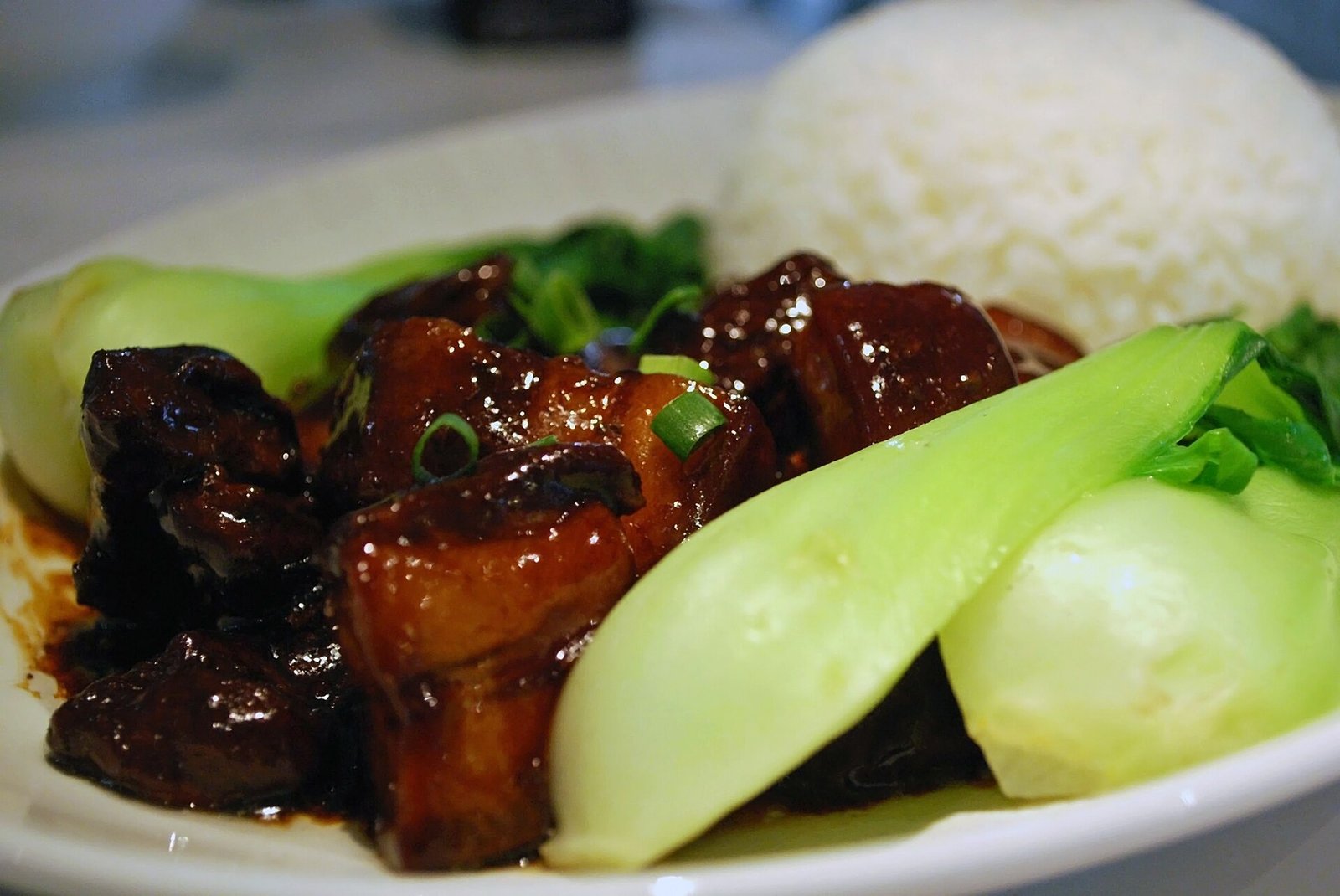
Red-braising taught me the most useful lesson in Chinese cooking: some methods are about what you add, and some are about what you remove. A braise removes water and renders fat at a rate the muscle can tolerate. You can undercook a stir-fry and serve it. You cannot undercook a braise — the time is the technique.
What foods should I steam rather than fry or boil?
Steam fish, custards, and delicate dumplings rather than fry or boil them, because gentle heat keeps their texture tender and their flavour clean. I steam a whole fish for eight to ten minutes and it comes out silky where a pan would have torn it, and a savoury egg custard set over simmering water never curdles the way a boiling pot would. The foods that suffer in steam are those needing crunch or sear — broccoli loses its bite and meat loses its crust. The honest rule: choose steam for things whose virtue is softness and purity, like fish, tofu, and buns, and leave the wok for everything that should crackle.
Steam (Zheng, 蒸): Gentleness as a Method
Steaming is the quietest of the major methods and the one Western kitchens most underuse. The logic is simple: food never exceeds 100°C, never touches fat it did not bring itself, and never browns. For fish, that last constraint is the entire point — a steamed sea bass with ginger, scallion and a pour of hot soy at the table tastes of the fish, because nothing has been allowed to happen to it. The Cantonese steaming tradition treats this as the highest form of respect for an ingredient: the fresher the catch, the less the kitchen does to it.
Steaming also solves a problem the other methods cannot: it is the only way to cook a filled dough from the outside in without burning it. Baozi, xiaolongbao, and every dumpling that is not pan-fried depend on steam. And it is forgiving — a bamboo steamer holds temperature for minutes after it leaves the heat, which is why dim sum trolleys work at all.
Deep-Fry (Zha, 炸) and Its Cousin, Dry Pot
Deep-frying in Chinese cooking is rarely a finish in itself; it is usually step one of a two-step method. The oil sets a shell — via a cornstarch or batter coating — that will later survive contact with a wet sauce. This is why sweet-and-sour pork and General Tso’s chicken can be glossy and crisp at the same time: the fry happened first, the sauce was added at the end and given thirty seconds, no longer.
Dry pot (gan guo, 干锅) is the hybrid worth knowing. It looks like a hot pot with no soup, and it is cooked like one — except the “broth” is oil and spice, the ingredients are pre-fried or pre-blanched, and the whole thing is stir-fried dry at the end. I wrote up the full method in the dry pot guide, but the principle transfers: any dish that arrives at the table sizzling in a shallow pool of oil rather than broth is using the dry-pot logic.
Blanching and Curing: The Supporting Cast
Two smaller methods complete the toolkit. Blanching (chāo, 焯) par-cooks dense vegetables and offal, removes bitterness from bamboo shoots, and sets colour before a quick stir-fry or a cold salad. Curing — salting, air-drying, pickling — is less a cooking method than a regional survival strategy, and it underpins whole cuisines rather than single dishes. Neither needs a wok, and both repay ten minutes of reading, because they explain why a Sichuan kitchen keeps a jar of pickled mustard and a Cantonese one keeps strings of lap cheong.
Which four cooking methods should a beginner learn first?
A beginner should learn stir-fry, red-braise, steam, and blanch first, because those four cover nearly every home Chinese dish. I built my whole early repertoire on them: stir-fry for quick vegetables and meat, red-braise for the slow pork, steam for fish and buns, and blanch for greens that need a thirty-second dip then a dressed toss. Deep-frying and dry-pot are fun later but not foundational. The honest starting point is stir-fry plus blanch for weeknights, then red-braise on a weekend, then steam once you own a rack. Master those four and you can cook most of the catalogue without a single new gadget.
The Four Methods a Home Cook Actually Needs
Here is my honest ranking for a Western kitchen with one decent pan and a gas or induction hob:
| Method | What it solves | Home-kit reality |
|---|---|---|
| Stir-fry | Fast weeknight dinners, vegetables that stay crisp | A flat pan works with smaller batches; a wok is better but not mandatory |
| Steam | Fish, dumplings, buns, anything delicate | A bamboo steamer over a wok or saucepan costs little and changes what you can cook |
| Red-braise | Sunday cooking, tough cuts, dishes that reheat well | Any heavy pot with a lid; the method tolerates approximation |
| Deep-fry | Crisp coatings, two-step dishes | A small wok or saucepan and 2cm of oil; no deep-fryer required |
Blanching is a bonus, and curing is a hobby rather than a method. If you can execute the four above, you can cook most of what matters — the long noodle tradition documented in a bowl of Chinese noodles and the wok classics like beef chow fun are all built from these four blocks, combined and sequenced.
Frequently Asked Questions
Can I stir-fry without a wok?
Yes, with adjustments: smaller batches, higher heat, and a willingness to accept less wok hei. A heavy flat-bottomed skillet holds temperature better than a thin wok on a weak hob. What you cannot fake is the tossing, so use two spoons and keep the food moving.
Why does my stir-fry come out watery?
Three usual causes: the pan was not hot enough when the food went in; the pan was overcrowded; or the sauce went in too early. Fix all three and the water evaporates instead of pooling.
Is red-braising just stewing?
The difference is intent and seasoning. Stewing builds flavour in the liquid; braising intends the liquid to largely disappear into a glaze, and the seasoning is added early — sugar, spice, soy — so it penetrates during the long cook rather than being poured over at the end.
Do I need a bamboo steamer, or will any steamer do?
Any steamer works. Bamboo is preferred because it absorbs excess condensation that would otherwise drip back onto the food and dilute sauce or sog the dough — a metal lid sits directly above the bun and rains on it.
What is the single most important skill?
Knife prep and timing, not heat control. Every Chinese method assumes uniform pieces and everything within arm’s reach, because once the oil is hot you have no time to cut, measure or search.
The Point
The techniques are not a ladder to climb from beginner to master; they are a set of tools, each solving a specific problem of heat, time and moisture. Learn what each one does to food — searing, rendering, gentle coagulation, crisp-then-glaze — and you can read any Chinese recipe and see the method underneath the ingredient list. That is the whole trick, and it took me one tragic stew in a non-stick pan to start understanding it.